Scenario 1: Public Only
The simplest deployment pattern with no VNet integration. The Function App and its dependencies are accessed through their public endpoints. Public endpoint usage does not necessarily mean traffic leaves the Microsoft backbone or traverses the general public internet — Azure-to-Azure traffic between resources in supported regions can stay on the Microsoft network. What defines this scenario is the absence of VNet integration and private endpoints, not the physical path every packet takes.
Portal Walkthrough
This section shows the Networking blade for a Consumption (Y1) Function App — the default public-only scenario. PII is masked.
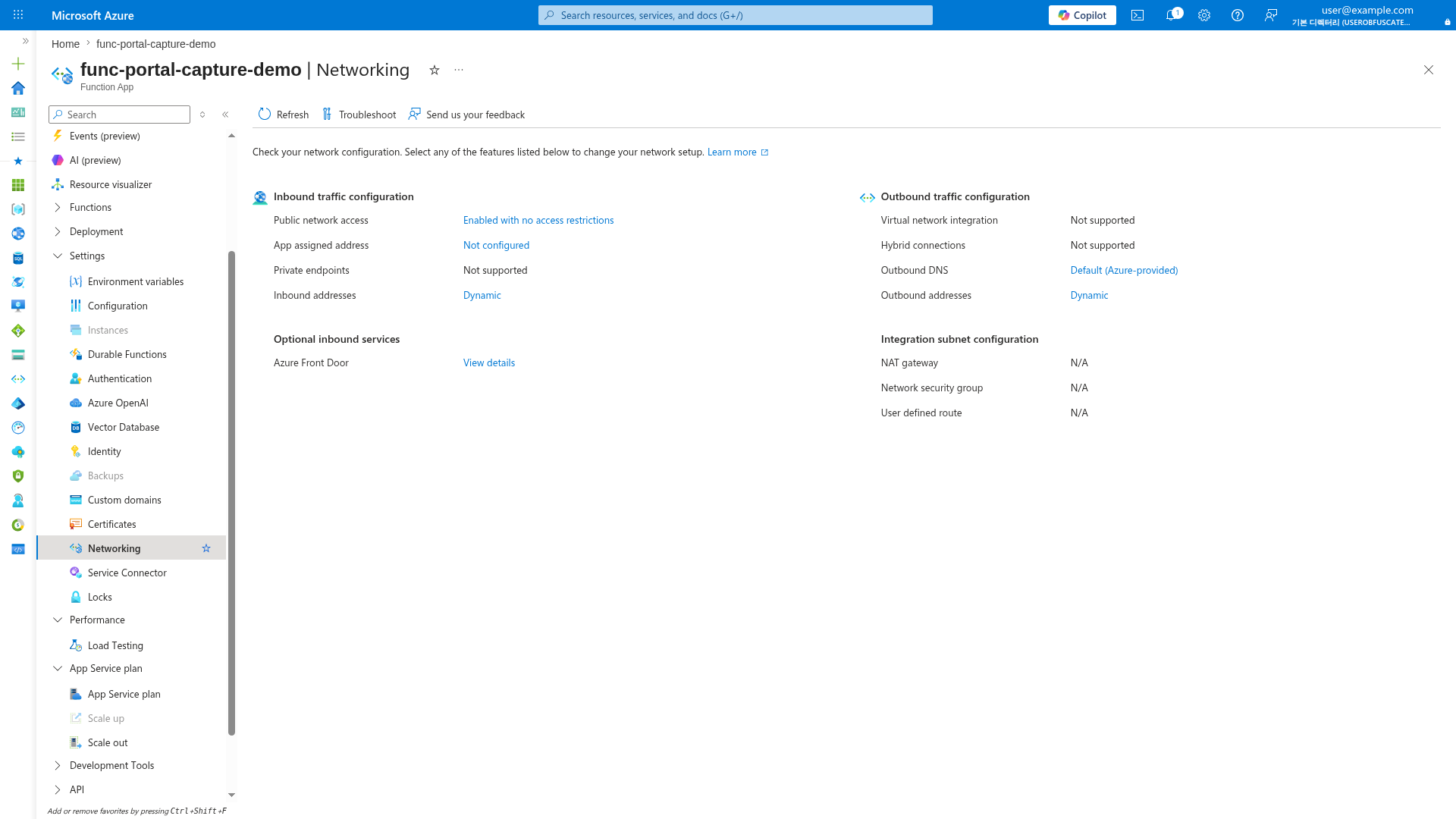
[Observed] Public network access is enabled with no restrictions. VNet integration and private endpoints are not supported on Consumption (Y1). This is the baseline public-only networking posture.
When to Use
- Development and testing environments
- Public-facing APIs without backend dependencies
- Prototypes and demos
- Workloads without compliance requirements for network isolation
Architecture
flowchart TD
    INET[Internet] -->|HTTPS| FA[Function App]
    FA -->|Public endpoint| ST[Storage Account]
    FA -->|Public endpoint| AI[Application Insights]
    FA -->|Public endpoint| OTHER[Other Azure Services]

    style FA fill:#0078d4,color:#fff
    style ST fill:#FFF3E0
Supported Plans
| Plan | Supported | Notes |
|---|---|---|
| Consumption (Y1) | Default and only option | |
| Flex Consumption (FC1) | VNet integration is optional | |
| Premium (EP) | VNet integration is optional | |
| Dedicated (B1) | Public only in this guide; VNet scenarios use S1+ | |
| Dedicated (S1+) | VNet integration is optional |
Prerequisites
This scenario requires no additional networking setup beyond the base deployment. Follow your language tutorial's 02-first-deploy.md:
Plan-Specific Configuration
Consumption (Y1)
No special configuration needed. Public access is the only option.
az functionapp create \
  --name "$APP_NAME" \
  --resource-group "$RG" \
  --storage-account "$STORAGE_NAME" \
  --consumption-plan-location "$LOCATION" \
  --functions-version 4 \
  --runtime python \
  --runtime-version 3.11 \
  --os-type Linux
| Command/Parameter | Purpose |
|---|---|
--consumption-plan-location "$LOCATION" | Creates a serverless Consumption plan in the specified region |
Flex Consumption (FC1) — Public Mode
Skip VNet integration parameters for public deployment.
az functionapp create \
  --name "$APP_NAME" \
  --resource-group "$RG" \
  --storage-account "$STORAGE_NAME" \
  --flexconsumption-location "$LOCATION" \
  --runtime python \
  --runtime-version 3.11 \
  --functions-version 4
| Command/Parameter | Purpose |
|---|---|
--flexconsumption-location "$LOCATION" | Creates a Flex Consumption plan without VNet integration |
Storage Authentication
FC1 public deployments can use either connection string or identity-based storage authentication. Identity-based is recommended for security.
Premium (EP) — Public Mode
Create without VNet integration.
az functionapp plan create \
  --name "$PLAN_NAME" \
  --resource-group "$RG" \
  --location "$LOCATION" \
  --sku EP1 \
  --is-linux

az functionapp create \
  --name "$APP_NAME" \
  --resource-group "$RG" \
  --plan "$PLAN_NAME" \
  --storage-account "$STORAGE_NAME" \
  --runtime python \
  --runtime-version 3.11 \
  --functions-version 4 \
  --os-type Linux
| Command/Parameter | Purpose |
|---|---|
--sku EP1 | Creates an Elastic Premium plan (smallest tier) |
--is-linux | Configures the plan for Linux hosting |
Dedicated (B1) — Public Only
This guide uses B1 for public-only scenarios. For VNet integration, see Private Egress with Standard (S1+) tier.
az appservice plan create \
  --name "$PLAN_NAME" \
  --resource-group "$RG" \
  --location "$LOCATION" \
  --sku B1 \
  --is-linux

az functionapp create \
  --name "$APP_NAME" \
  --resource-group "$RG" \
  --plan "$PLAN_NAME" \
  --storage-account "$STORAGE_NAME" \
  --runtime python \
  --runtime-version 3.11 \
  --functions-version 4 \
  --os-type Linux
| Command/Parameter | Purpose |
|---|---|
--sku B1 | Creates a Basic tier App Service plan (public-only in this guide) |
Verification
Test public endpoint access:
| Command/Parameter | Purpose |
|---|---|
curl --request GET | Tests the public HTTP endpoint |
Expected response:
Security Considerations
Public Exposure
Without VNet integration, your function app and its dependencies are reachable through their public endpoints, and inbound requests can originate from the public internet. Public endpoint exposure is the risk here regardless of whether a given hop stays on the Microsoft backbone. Consider:
- Function-level authorization keys for HTTP triggers
- IP access restrictions to limit source networks
- App Service Authentication for user/workload identity
- Storage firewall rules if not using private endpoints
Add IP Access Restrictions
Limit access to known IP ranges:
az functionapp config access-restriction add \
  --name "$APP_NAME" \
  --resource-group "$RG" \
  --rule-name "AllowCorporate" \
  --priority 100 \
  --action Allow \
  --ip-address "203.0.113.0/24"
| Command/Parameter | Purpose |
|---|---|
--rule-name "AllowCorporate" | Descriptive name for the access rule |
--priority 100 | Lower numbers are evaluated first |
--ip-address "203.0.113.0/24" | CIDR range to allow |
Migrating to Private Networking
To add VNet integration later, see:
- Scenario 2: Private Egress — Add VNet integration for private backend access
- Scenario 3: Private Ingress — Add site private endpoint for private inbound