Ingress Target Port Mismatch Lab
Diagnose and fix ingress failures caused by target port misconfiguration where the ingress routes traffic to the wrong port.
Lab Metadata
| Attribute | Value |
|---|---|
| Difficulty | Beginner |
| Estimated Duration | 15-20 minutes |
| Tier | Consumption |
| Failure Mode | Container healthy but external endpoint unreachable |
| Skills Practiced | Ingress configuration, port binding diagnosis |
1) Background
Azure Container Apps routes external traffic through an ingress controller to your container. The targetPort setting specifies which port the ingress forwards requests to. When this port doesn't match the port your application listens on, requests reach the container but fail to connect to any listening process.
This is one of the most common "works locally, fails in Azure" scenarios because:
- Local testing often uses different ports than production
- Dockerfile
EXPOSEis documentation only—it doesn't configure ingress - The container process can stay up even while revision health becomes unhealthy
- External requests return 503 or connection refused
Architecture
flowchart TD
    A[External Request] --> B[Ingress Controller]
    B --> C{Target Port 8081?}
    C -->|App listens on 80| D[Connection Refused]
    C -->|Correct port| E[Request Reaches App]
    D --> F[503 Service Unavailable]
2) Hypothesis
IF the ingress target port is changed from 80 to 8081, THEN external requests will fail with 503 errors because no process is listening on port 8081 inside the container.
| Variable | Control State | Experimental State |
|---|---|---|
| Target Port | 80 (matches app) | 8081 (mismatch) |
| Replica state | Running | Running (replicas stay up; the process keeps listening on 80) |
| Revision health (default probes) | Healthy | Unhealthy / Failed (this lab defines no custom probes; with ingress enabled, Azure Container Apps' default TCP probes use the ingress targetPort, so probes against 8081 fail) |
| External Access | HTTP 200 | HTTP 503 or timeout |
3) Runbook
Deploy Baseline Infrastructure
export RG="rg-aca-lab-ingress"
export LOCATION="koreacentral"

az group create --name "$RG" --location "$LOCATION"

az deployment group create \
    --name "lab-ingress" \
    --resource-group "$RG" \
    --template-file "./labs/ingress-target-port-mismatch/infra/main.bicep" \
    --parameters baseName="labingress"
| Command | Why it is used |
|---|---|
az group create ... | Creates the isolated resource group used by the example. |
Capture Resource Names
export APP_NAME="$(az deployment group show \
    --resource-group "$RG" \
    --name "lab-ingress" \
    --query "properties.outputs.containerAppName.value" \
    --output tsv)"

export ACA_ENV_NAME="$(az deployment group show \
    --resource-group "$RG" \
    --name "lab-ingress" \
    --query "properties.outputs.containerAppsEnvironmentName.value" \
    --output tsv)"

export APP_FQDN="$(az containerapp show \
    --name "$APP_NAME" \
    --resource-group "$RG" \
    --query "properties.configuration.ingress.fqdn" \
    --output tsv)"
| Command | Purpose |
|---|---|
export APP_NAME="$(az deployment group show ... --query "properties.outputs.containerAppName.value" --output tsv)" | Captures the Container App name emitted by the lab deployment so subsequent ingress and revision checks hit the correct app resource. |
export ACA_ENV_NAME="$(az deployment group show ... --query "properties.outputs.containerAppsEnvironmentName.value" --output tsv)" | Captures the environment name used by the lab so any later environment-scoped networking checks reference the right Container Apps environment. |
export APP_FQDN="$(az containerapp show ... --query "properties.configuration.ingress.fqdn" --output tsv)" | Reads the current ingress FQDN from the deployed app so the reachability checks exercise the same hostname that clients actually use during the port-mismatch failure. |
Verify Baseline (Before Trigger)
# Confirm ingress configuration
az containerapp show \
    --name "$APP_NAME" \
    --resource-group "$RG" \
    --query "properties.configuration.ingress" \
    --output table
| Command | Why it is used |
|---|---|
az containerapp show ... | Reads the Container App configuration so the documented setting can be verified. |
Expected output:
External    TargetPort    Transport    AllowInsecure
----------  ------------  -----------  ---------------
True        80            auto         False
# Confirm endpoint is reachable
curl --silent --fail "https://${APP_FQDN}" && echo "Endpoint reachable"
Trigger the Failure
The trigger script changes the target port to 8081:
| Command | Why it is used |
|---|---|
az containerapp update ... | Updates the existing Container App configuration without recreating the app. |
Observe the Failure
# Check ingress configuration - note the wrong port
az containerapp show \
    --name "$APP_NAME" \
    --resource-group "$RG" \
    --query "properties.configuration.ingress.targetPort" \
    --output tsv
| Command | Why it is used |
|---|---|
az containerapp show ... | Reads the Container App configuration so the documented setting can be verified. |
Expected: 8081
# Attempt to reach the endpoint
curl --silent --max-time 10 "https://${APP_FQDN}" || echo "Request failed"
Expected: Connection timeout or 503 error with message like:
upstream connect error or disconnect/reset before headers. retried and the latest reset reason: remote connection failure, transport failure reason: delayed connect error: Connection refused
# Verify container is still running (the issue is ingress, not the app)
az containerapp replica list \
    --name "$APP_NAME" \
    --resource-group "$RG" \
    --query "[].{name:name,runningState:properties.runningState}" \
    --output table
| Command | Why it is used |
|---|---|
az containerapp replica list ... | Runs the Azure CLI operation required by the documented step. |
Expected: Replicas show Running state—the container is healthy, just unreachable via ingress.
Fix the Issue
The live recovery script restores targetPort=80, waits for ingress propagation, sends 10 HTTPS requests, waits for the post-fix ingestion window, and reruns the strict post-fix PortMismatch KQL.
Verify the Evidence Pack
The offline verifier confirms:
- The 25-file canonical Phase A cohort is intact and temporally coherent.
- The trigger mutated
targetPortto8081, broke edge traffic, and populated the KQL window with PortMismatch rows. - The fix restored
targetPort=80, edge traffic recovered, and the strict post-fix KQL window is silent for PortMismatch. - The bounded single-variable claim holds: the integer
ingress.targetPortis the controlling variable across baseline → trigger → fix.
4) Experiment Log
| Step | Action | Expected | Actual | Pass/Fail |
|---|---|---|---|---|
| 1 | Deploy baseline | Deployment succeeds | ||
| 2 | Verify baseline endpoint | HTTP 200 | ||
| 3 | Run trigger.sh | Target port changes to 8081 | ||
| 4 | Curl endpoint | Timeout or 503 | ||
| 5 | Check replica status | Running | ||
| 6 | Run fix-and-capture.sh | targetPort returns to 80, curl recovers, strict post-fix KQL goes silent | ||
| 7 | Run Phase B bash verify.sh | 4 gates / 16 sub-gates PASS |
Expected Evidence
Before Fix
| Evidence Source | Expected State |
|---|---|
az containerapp show ... --query "properties.configuration.ingress.targetPort" | 8081 |
curl https://${APP_FQDN} | Timeout or 503 |
| Container replicas | Running (healthy) |
After Fix
| Evidence Source | Expected State |
|---|---|
az containerapp show ... --query "properties.configuration.ingress.targetPort" | 80 |
curl https://${APP_FQDN} | HTTP 200 |
./fix-and-capture.sh | H2 PASS |
bash verify.sh | 16/16 PASS |
5) Verification Queries
The canonical KQL used by the scripted reproduction is preserved in the raw Phase A evidence JSON so reviewers can inspect the exact strict-window queries used during capture:
- Trigger window (
TimeGenerated > datetime(TRIGGER_UTC)) — https://github.com/yeongseon/azure-container-apps-practical-guide/blob/main/labs/ingress-target-port-mismatch/evidence/09-kql-after-trigger.json - Post-fix window (
TimeGenerated > datetime(FIX_UTC)) — https://github.com/yeongseon/azure-container-apps-practical-guide/blob/main/labs/ingress-target-port-mismatch/evidence/15-kql-after-fix.json
Evidence depth
This lab now ships a 4-gate falsification overlay over the committed evidence cohort. Gate 14 validates the cohort itself, Gate 15 proves the trigger produced the documented failure, Gate 16 proves the fix restored recovery in a strict post-fix UTC window, and Gate 17 bounds the single-variable claim to the integer ingress.targetPort while explicitly disclosing what is NOT cohort-evidenced.
6) Portal Evidence
Phase B evidence-pack materials:
- Evidence pack overview — https://github.com/yeongseon/azure-container-apps-practical-guide/blob/main/labs/ingress-target-port-mismatch/evidence/README.md
- Gate 14 — https://github.com/yeongseon/azure-container-apps-practical-guide/blob/main/labs/ingress-target-port-mismatch/evidence/14-cohort-integrity-gate.json
- Gate 15 — https://github.com/yeongseon/azure-container-apps-practical-guide/blob/main/labs/ingress-target-port-mismatch/evidence/15-h1-trigger-produces-failure-gate.json
- Gate 16 — https://github.com/yeongseon/azure-container-apps-practical-guide/blob/main/labs/ingress-target-port-mismatch/evidence/16-h2-fix-restores-recovery-gate.json
- Gate 17 — https://github.com/yeongseon/azure-container-apps-practical-guide/blob/main/labs/ingress-target-port-mismatch/evidence/17-single-variable-falsification-gate.json
The Gate 17 falsification framing is intentionally bounded. It is accurate to say that in this lab the integer ingress.targetPort is the controlling variable, because the cohort directly evidences field-level ingress constancy outside targetPort, preserved revision name, preserved Container App identity, and the smoking-gun platform attribution The TargetPort 8081 does not match the listening port 80. What the cohort does not directly evidence is image byte-identity, pod reuse, or a direct socket capture of the container's listening port; those limits are disclosed inside the gate JSON itself.
Observed Evidence (Live Azure Test — 2026-05-01)
| Command | Purpose |
|---|---|
curl -s -o /dev/null -w "HTTP %{http_code}" https://<container-app-fqdn>/ | Probe the edge URL and print only the HTTP status code; used to compare baseline (200) vs triggered (503) vs post-fix (200) behavior. |
az containerapp ingress update --name <app> --resource-group <rg> --target-port 9999 | Trigger the failure by pointing ingress at a port the container is not listening on; this is an application-scope update and does not create a new revision. |
az containerapp ingress update --name <app> --resource-group <rg> --target-port 80 | Restore the correct target port; the edge recovers to HTTP 200 within seconds without a new revision being created. |
# Baseline: targetPort=80, app listens on 80 → HTTP 200
curl -s -o /dev/null -w "HTTP %{http_code}" https://<container-app-fqdn>/
→ HTTP 200

# TRIGGER: set wrong targetPort 9999
az containerapp ingress update --name ca-labingress-mdsbya --resource-group rg-aca-lab-test4 \
  --target-port 9999
→ TargetPort: 9999

curl -s -o /dev/null -w "HTTP %{http_code}" https://<container-app-fqdn>/
→ HTTP 503

# FIX: restore correct targetPort 80
az containerapp ingress update --name ca-labingress-mdsbya --resource-group rg-aca-lab-test4 \
  --target-port 80
→ TargetPort: 80

curl -s -o /dev/null -w "HTTP %{http_code}" https://<container-app-fqdn>/
→ HTTP 200
[Observed]Baseline: targetPort=80 → HTTP 200.[Observed]After--target-port 9999: HTTP 503 immediately (app listens on 80, ingress routes to 9999).[Observed]After--target-port 80(fix): HTTP 200 within 10 seconds.[Inferred]Container Apps ingress proxy cannot connect to the container on the wrong port; returns 503 to all clients.
Environment: koreacentral, rg-aca-lab-test4, mcr.microsoft.com/azuredocs/containerapps-helloworld:latest.
Observed Evidence (Portal Captures — 2026-06-02, failure state)
Environment: rg-aca-lab-ingress / cae-labingress-pmdar7, koreacentral, Consumption plan. App: ca-labingress-pmdar7 (mcr.microsoft.com/azuredocs/containerapps-helloworld:latest, application listens on port 80). Trigger: az containerapp ingress update --name ca-labingress-pmdar7 --resource-group rg-aca-lab-ingress --target-port 8081 — ingress-only change. In Azure Container Apps, ingress is an application-scope setting that applies to all revisions and doesn't create a new revision; consistent with that behavior, properties.latestRevisionName did not change during this update. Verification CLI (taken at the same time as the captures):
HTTP 503  (curl https://${FQDN}/)
Health: Unhealthy, RunningStatus: Failed, Replicas: 2 (both Running)
TargetPort: 8081
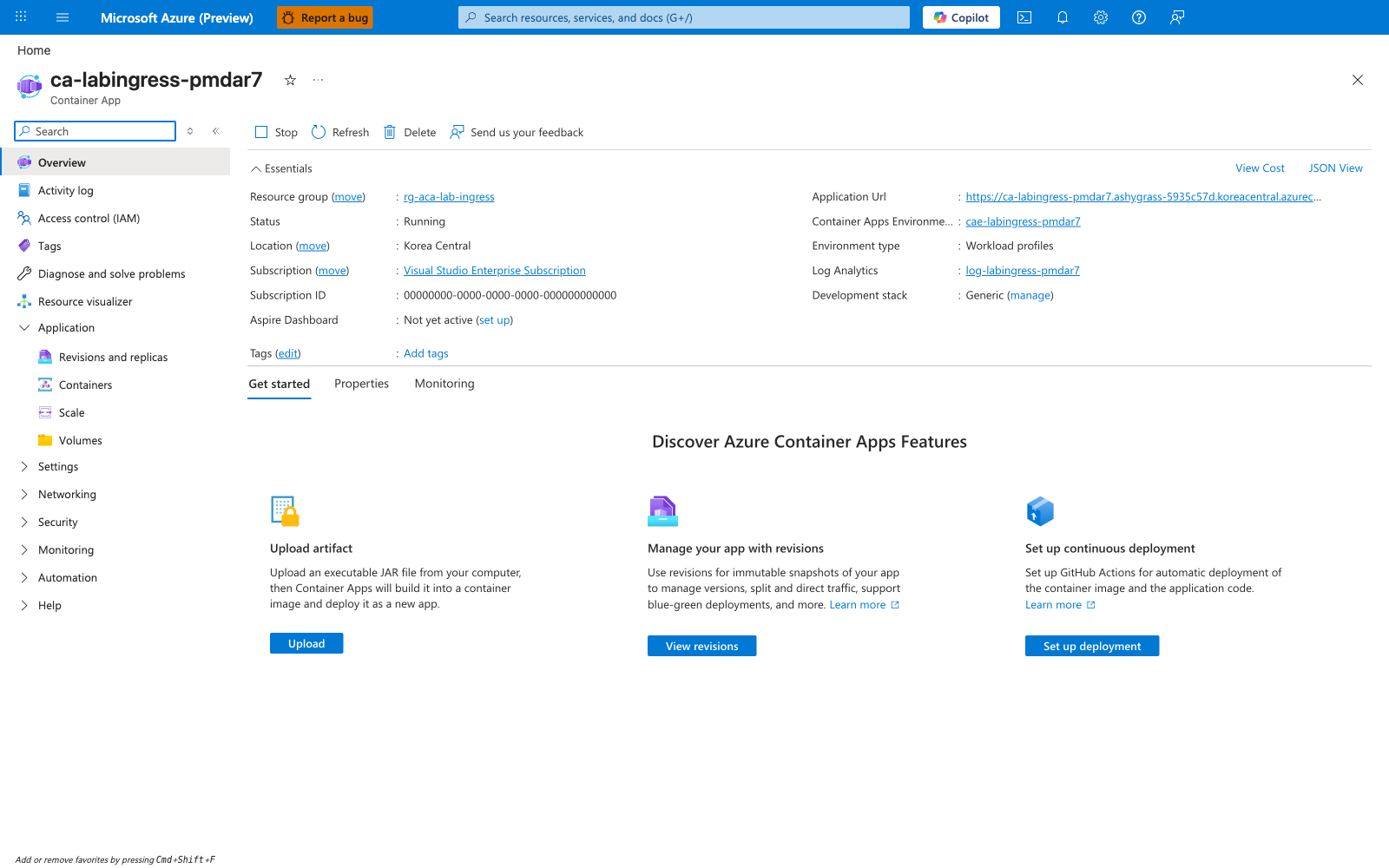
[Observed] The Container App overview blade shows the resource still in platform Status: Running during the incident:
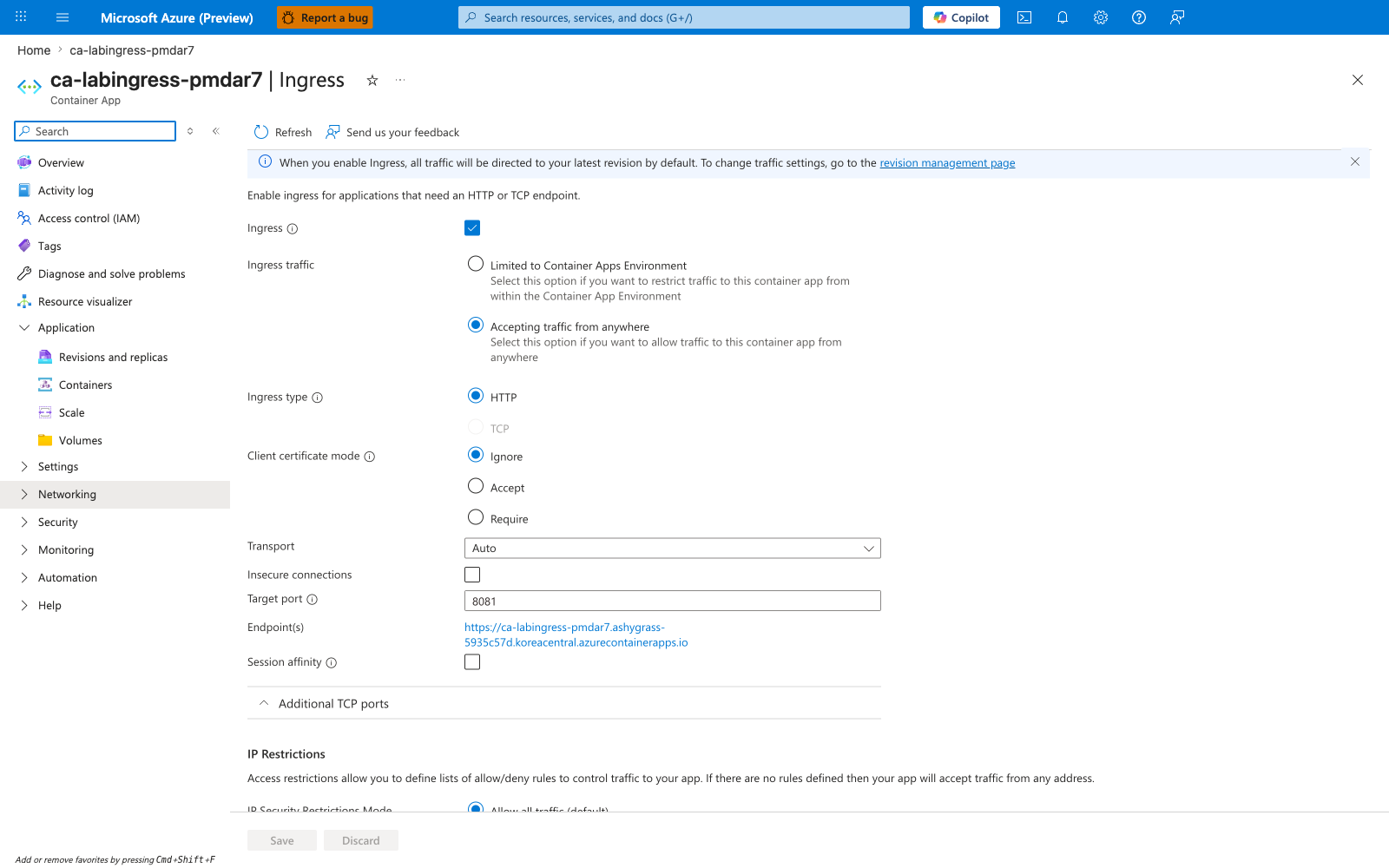
[Observed] The Ingress blade shows the misconfiguration directly: external HTTP ingress is enabled and the Target port field reads 8081:
[Observed] Metrics blade — Requests (Sum) split by Status code category over the last 30 minutes shows 5xx = 58, 2xx = 1:
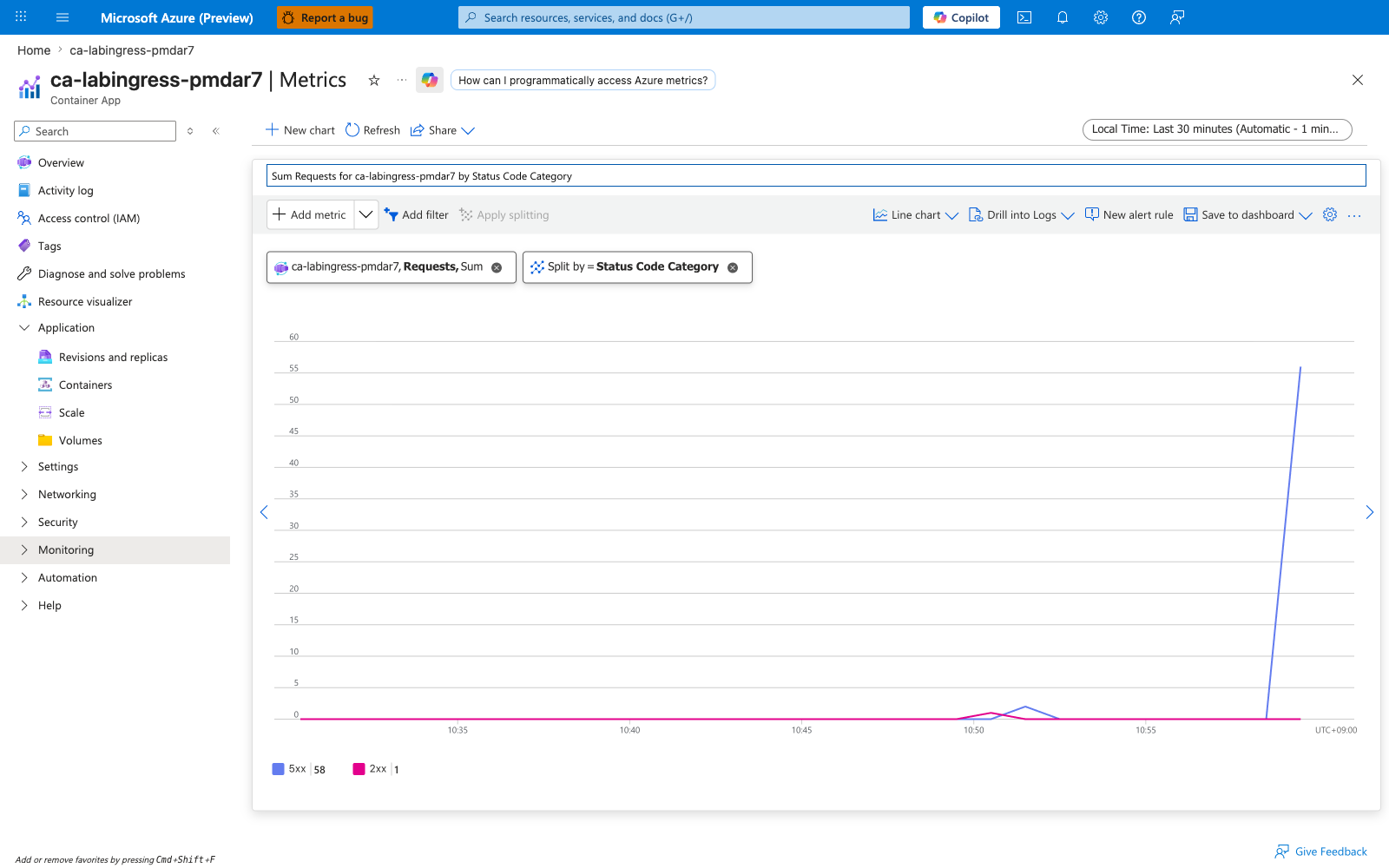
[Correlated] This metric window lines up with the post-trigger curl run captured in CLI notes; the lone 2xx point matches the pre-trigger baseline request.
[Observed] The Revisions and replicas blade shows one active revision with Running status: Failed, Traffic: 100%, and Replicas: 2:
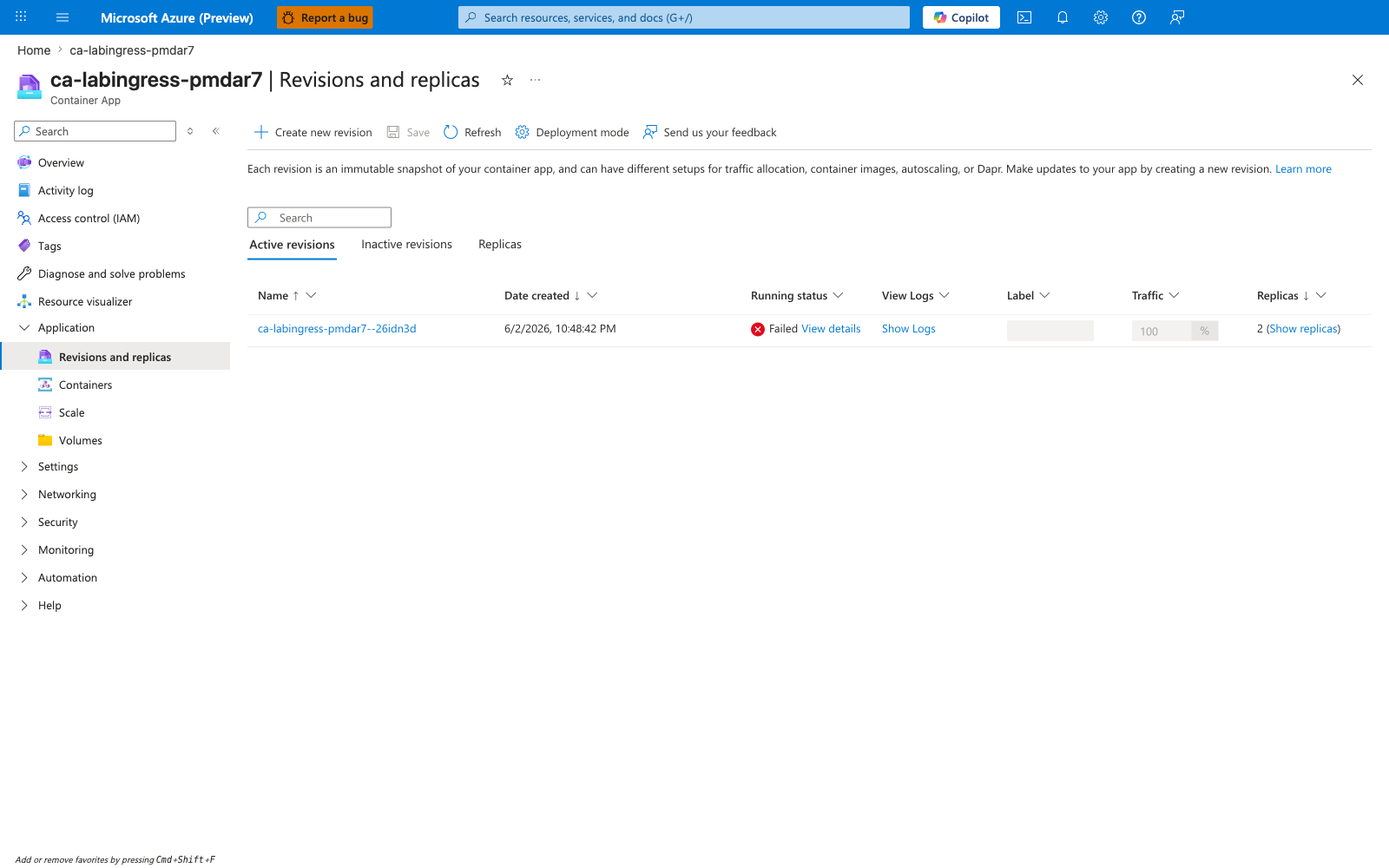
[Observed] Concurrent CLI checks showed both replicas in Running state even while the revision-level running status was Failed.
[Inferred] In this lab, the same wrong ingress targetPort affects both request routing and the default TCP probes. With targetPort=8081 and the application still listening on port 80, edge requests are forwarded to a port with no listener, and the default startup/readiness/liveness probes also check 8081, so the revision becomes unhealthy while the replica processes can remain running. The captures show the correlation; the routing and probe behavior comes from documented Container Apps behavior, not directly from these blades.
[Inferred] PR-A establishes the pre-fix baseline required for falsification: ingress targetPort=8081, application listener unchanged on 80, replicas Running, revision Unhealthy/Failed, edge returning 5xx at ~58:1 ratio against 2xx. PR-A alone does not rule out alternative theories (intermittent platform issue, the process no longer listening on port 80, transport mode). PR-B will hold image, revision template, and replica state constant and change only targetPort back to 80; recovery to HTTP 200 with the same revision is what falsifies those alternatives.
Observed Evidence (Portal Captures — 2026-06-02, after fix)
Trigger: az containerapp ingress update --name ca-labingress-pmdar7 --resource-group rg-aca-lab-ingress --target-port 80 — single-field ingress update. No revision-template fields (image, replicas, scale rules, env vars, command, args) were changed, and no new revision was created (ingress is application-scope). Verification CLI (taken at the same time as the captures):
HTTP 200  (curl https://${FQDN}/, sampled 3 times in series)
HTTP 200  (60/60 in a follow-up burst)
TargetPort: 80
LatestRevisionName: ca-labingress-pmdar7--26idn3d   (unchanged from PR-A)
RunningStatus: Running   (PR-A: Failed)
What was held constant vs. what changed (PR-A → PR-B):
| Variable | PR-A (failure state) | PR-B (after fix) | Controlled? |
|---|---|---|---|
| Revision name | ca-labingress-pmdar7--26idn3d | ca-labingress-pmdar7--26idn3d | held constant |
| Container image | azuredocs/containerapps-helloworld:latest | same | held constant |
| Revision template (env, command, args, scale rules) | unchanged | unchanged | held constant |
| Ingress transport | auto | auto | held constant |
Ingress targetPort | 8081 | 80 | changed (this is the independent variable) |
| Active replica count | 2 | 1 | not controlled (autoscaler adjusted after the revision returned to healthy) |
Revision RunningStatus | Failed | Running | dependent variable |
| Edge HTTP response | 503 | 200 | dependent variable |
[Observed] The Container App overview blade now shows Status: Running:
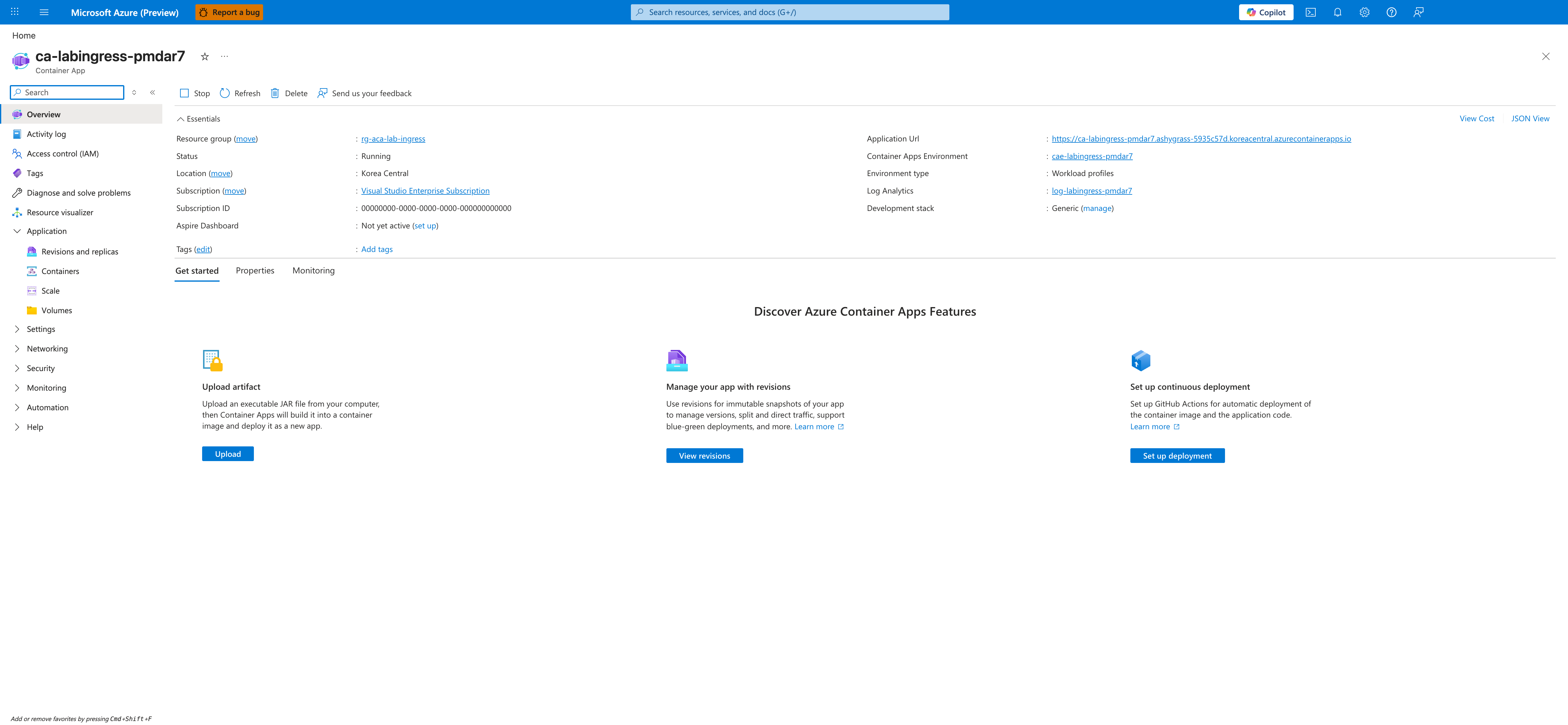
[Correlated] The platform Status: Running in the overview blade corresponds in time with the revision-level RunningStatus: Running recorded in the CLI evidence above.
[Observed] The Ingress blade now reads Target port: 80:
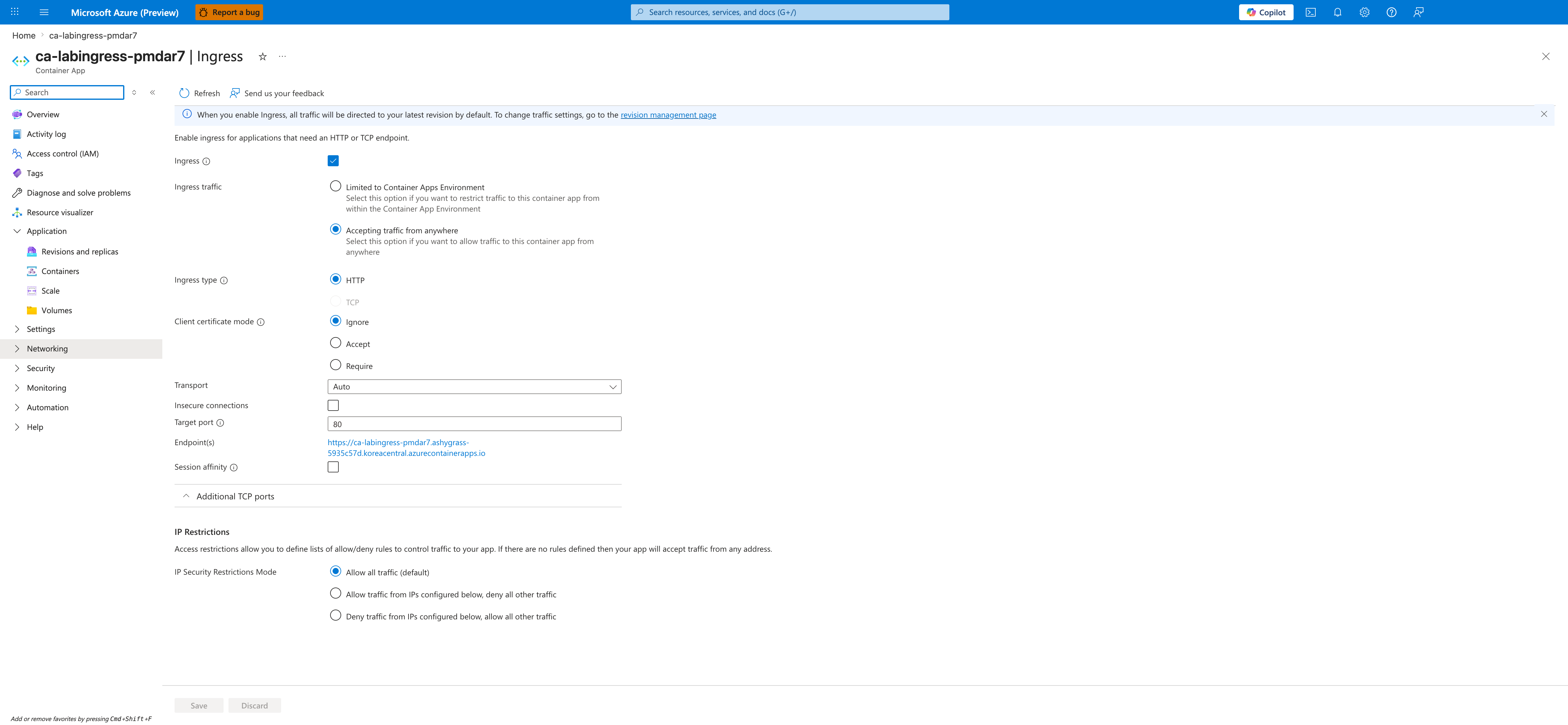
[Inferred] The CLI trigger above changed only the targetPort field; no other ingress or revision-template field was modified between the PR-A and PR-B captures.
[Observed] The Revisions and replicas blade shows the same revision name (ca-labingress-pmdar7--26idn3d) that was Failed in the PR-A capture, now with Running status: Running and Traffic: 100%:
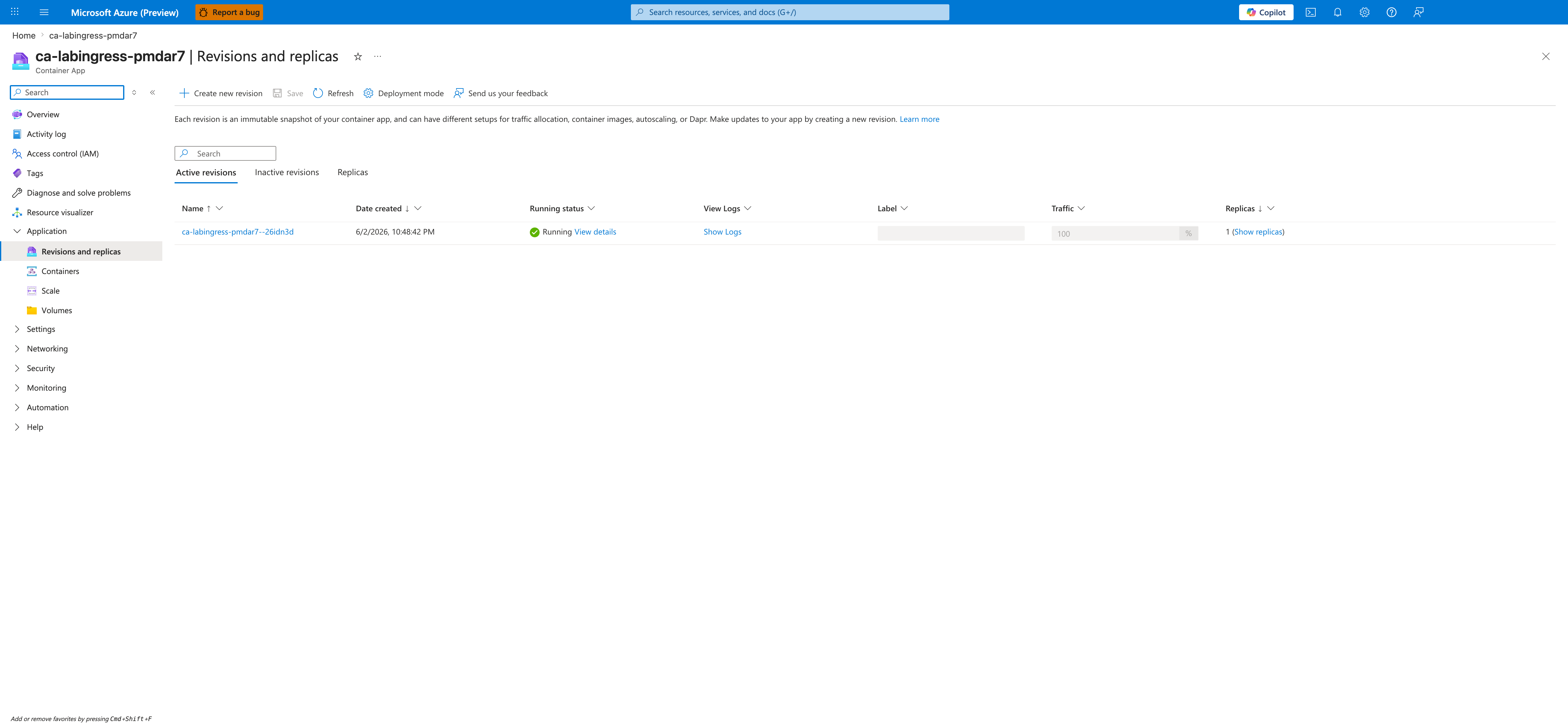
[Observed] The Metrics blade chart shows a fresh Network In Bytes (Sum) spike in the window following the fix:
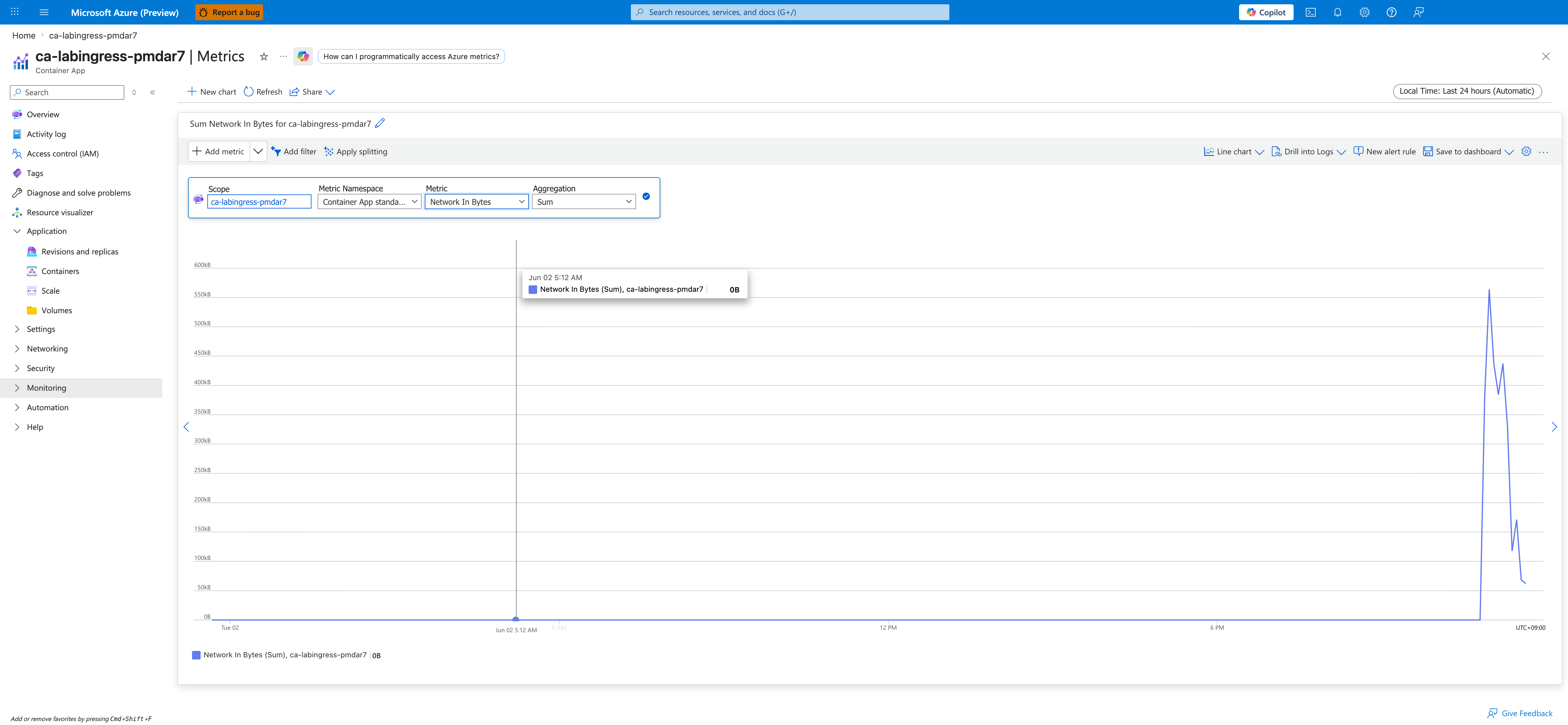
[Correlated] The traffic spike in the chart lines up with the 60-request post-fix burst captured in the CLI notes (60/60 HTTP 200). The Requests metric split by Status code category would be the more direct counterpart to the PR-A metrics-503 capture; Network In Bytes is included here because it confirms application-level traffic flow on the same chart axis while the CLI evidence (60/60 HTTP 200) provides the status-code breakdown.
[Inferred] Falsification result. Holding the revision name, container image, revision template, and ingress transport constant (see table above), changing only ingress targetPort from 8081 → 80 flipped the same revision (ca-labingress-pmdar7--26idn3d) from RunningStatus: Failed to Running and the edge response from 503 → 200 within seconds. No new revision was created. This rules out the alternative theories enumerated at the end of PR-A:
- Intermittent platform issue — falsified: recovery is deterministic on the ingress update, not on time elapsed.
- Process no longer listening on port 80 — falsified: the same image and same revision now serve 200 on the same listener.
- Transport mode regression — falsified: transport (
auto) is unchanged; onlytargetPortchanged.
[Inferred] The remaining causal chain consistent with both PR-A and PR-B observations is: ingress targetPort mismatch caused edge routing failures and, simultaneously, default TCP health probes targeting the wrong port marked the revision Unhealthy. Correcting targetPort resolves both at once on the same revision. (This causal chain combines the observed [Observed] revision-state and edge-response flip with documented Container Apps ingress and probe behavior; it is an inference, not a direct observation.)
Observed Evidence (Portal Captures — 2026-06-18, production case pattern)
This subsection captures the same hypothesis a second time, with two changes that make it more useful as a support-engineer training artifact:
- Eight failure captures are paired one-to-one with eight fix captures taken from the same blades after the only-
targetPortchange. Each pair isolates a single Portal surface and shows what flips between the two states — what to look for, and what to stop seeing. - The mismatched port mirrors a production case pattern seen in the field (a deployment manifest set
httpOptions.port=8001while the container listened on:8000). The lab usesmcr.microsoft.com/azuredocs/containerapps-helloworld:latest(which listens on:80) and an ingresstargetPort=8001, which produces the same Portal surfaces and the sameReason_s: TargetPortMismatchsystem-log message.
Environment: rg-aca-lab-port-mismatch-repro / cae-portmismatch-f7ijzp, koreacentral, Consumption plan. App: ca-portmismatch-f7ijzp — image mcr.microsoft.com/azuredocs/containerapps-helloworld:latest, container listens on :80. Trigger (failure state): initial deployment with ingress targetPort=8001 (the only field that differs from a healthy deployment). Fix: az containerapp ingress update --name ca-portmismatch-f7ijzp --resource-group rg-aca-lab-port-mismatch-repro --target-port 80. Verification CLI at capture time:
# Failure state (pre-fix window)
HTTP 503  (curl https://${FQDN}/, sampled in series)
TargetPort: 8001  (ingress configuration)
LatestRevisionName: ca-portmismatch-f7ijzp--nedy7dz
RunningStatus: Failed

# Fixed state (post-fix window, same revision name)
HTTP 200  (curl https://${FQDN}/, 200+ requests across two bursts)
TargetPort: 80   (ingress configuration after the update)
LatestRevisionName: ca-portmismatch-f7ijzp--nedy7dz   (unchanged)
RunningStatus: Running
Pair 1 — Container App overview: Running platform status hides a degraded revision
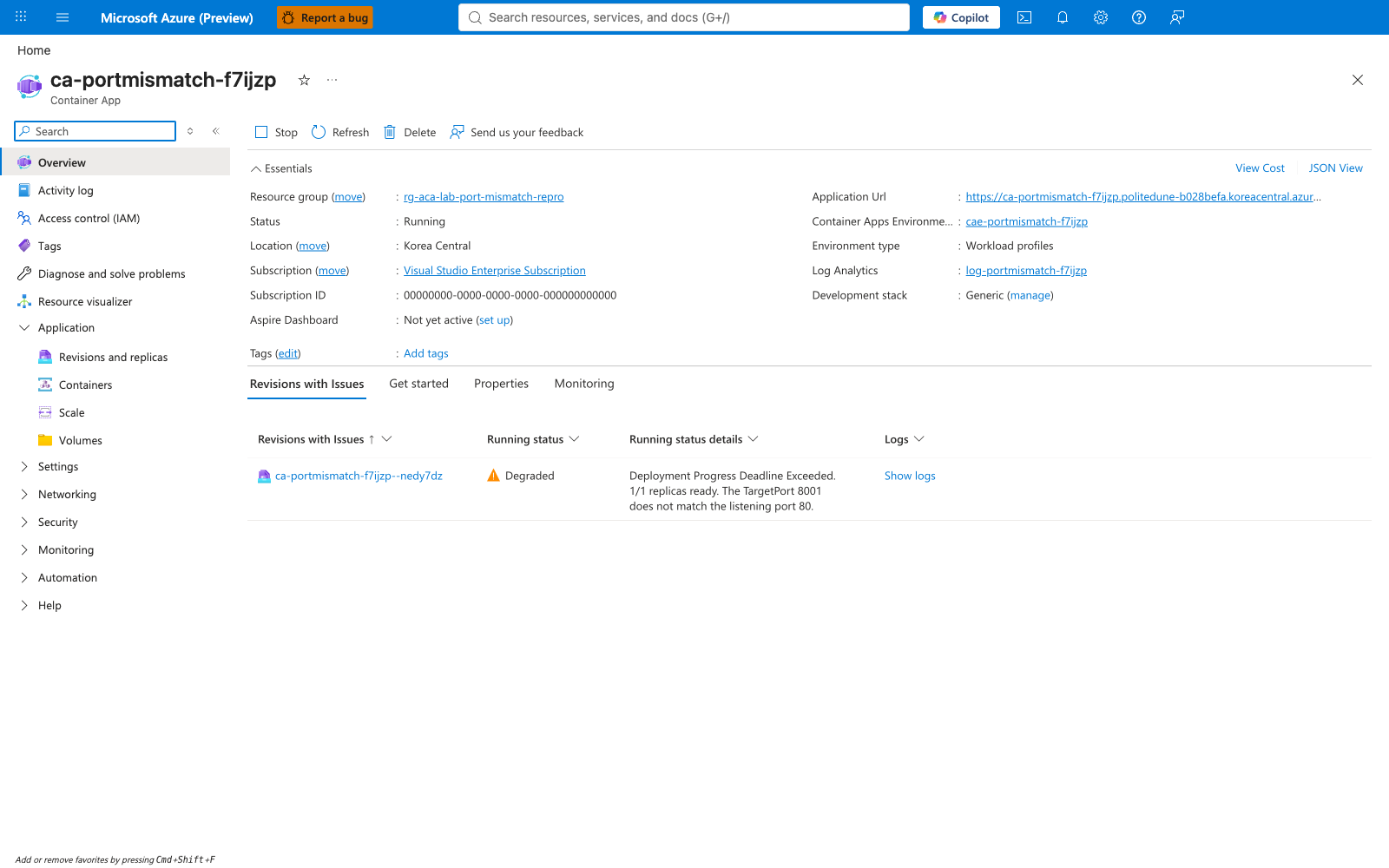
[Observed] During the failure window, the Overview blade renders the platform-level Status: Running even while the revision is unhealthy, and a fourth top-level tab labeled "Issues" appears alongside Essentials, Properties, and Capabilities:
[Observed] After the fix, the same Overview blade renders only three tabs — the "Issues" tab is gone:
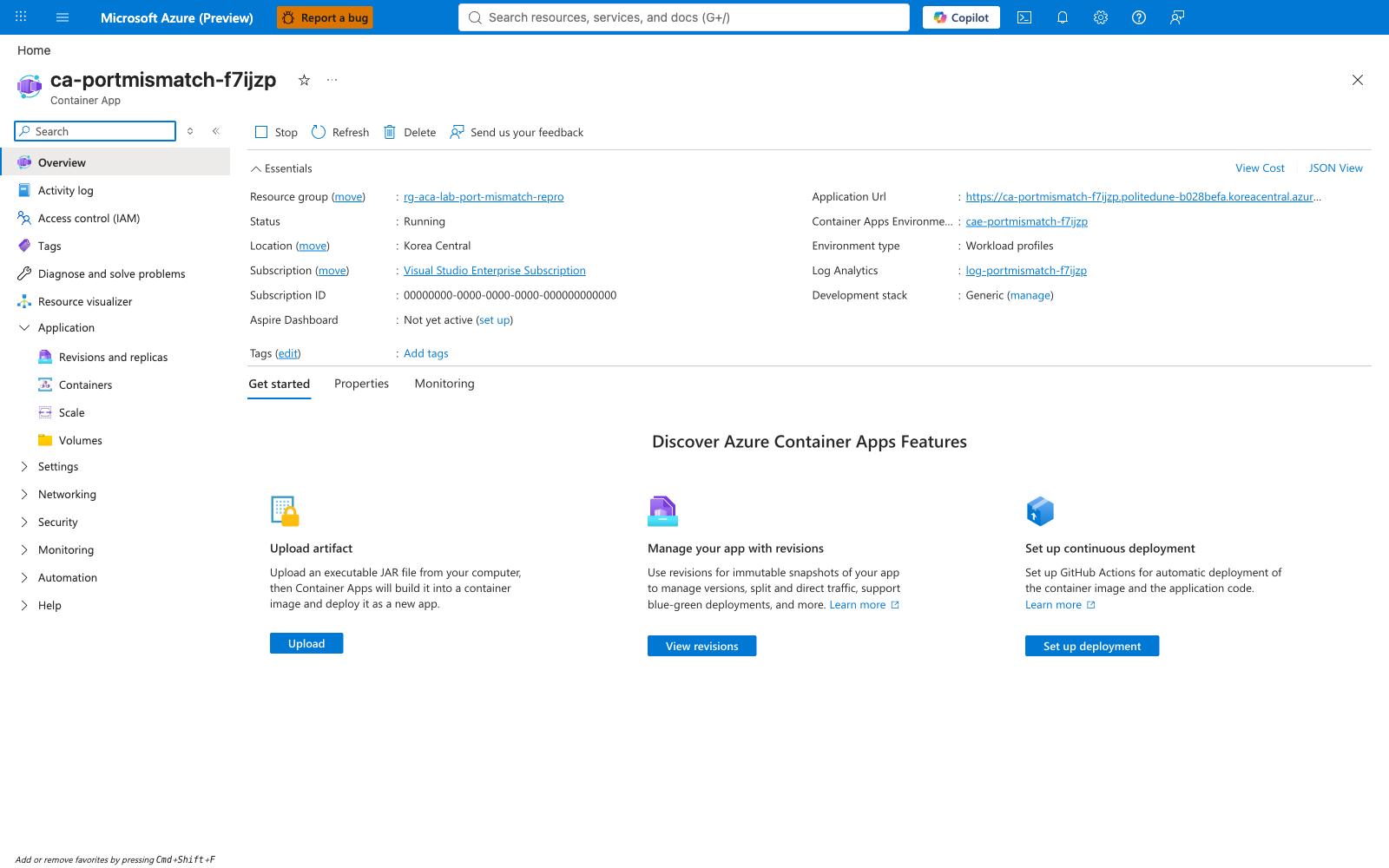
[Inferred] The platform-level Status: Running is what makes this failure class confusing — it tells you the resource is provisioned, not that traffic is being served. The presence or absence of the Issues tab is the fastest single Portal signal that a revision-level problem exists. It does not by itself say what the problem is — it only says one exists — which is why it pairs with the more specific surfaces below.
Pair 2 — Revisions and replicas: Degraded vs. Healthy
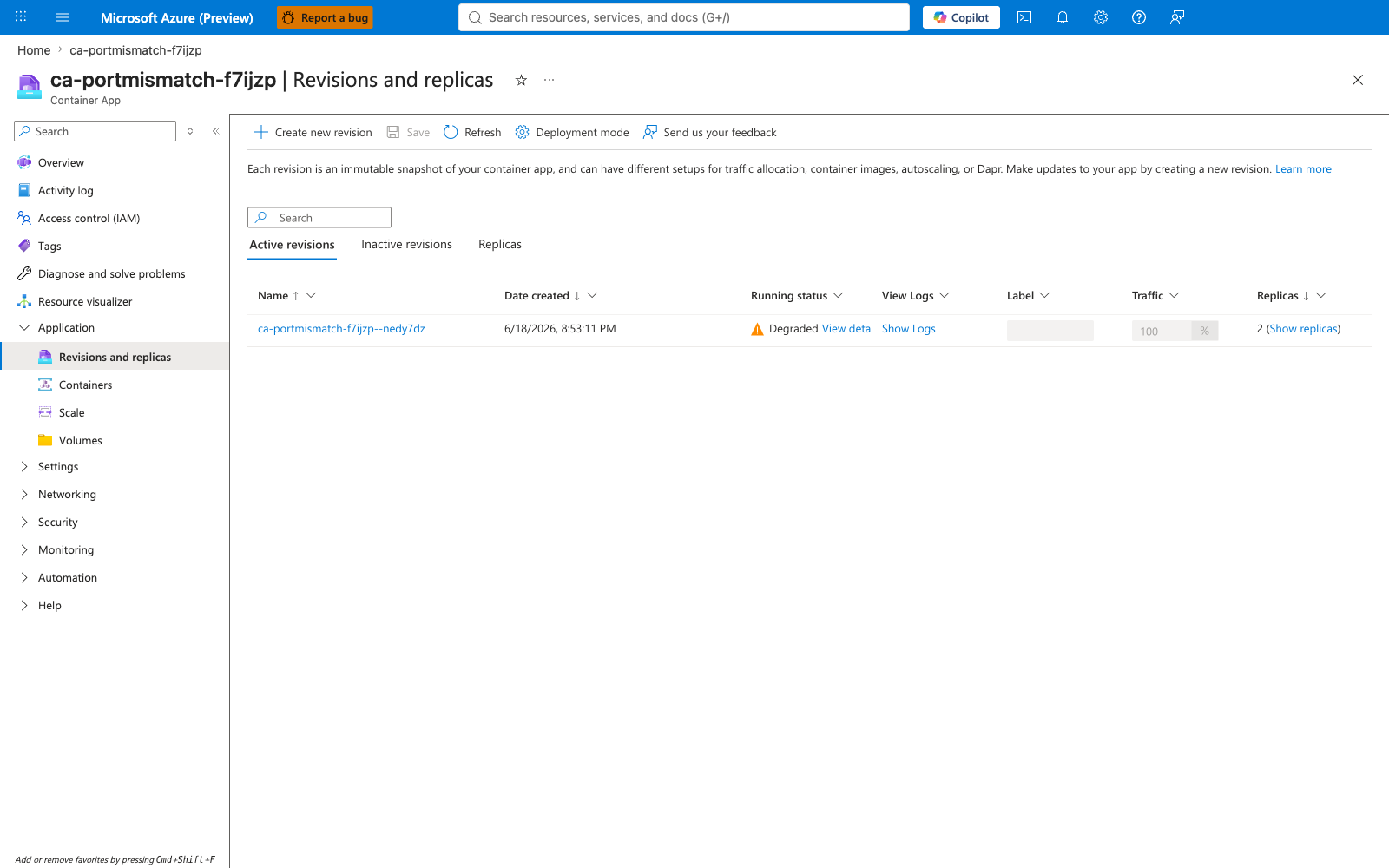
[Observed] The Revisions and replicas blade shows the active revision in a Degraded state with the warning icon during the failure window:
[Observed] After the fix, the same blade shows the same revision name (ca-portmismatch-f7ijzp--nedy7dz) now in Healthy / Running state with the success icon:
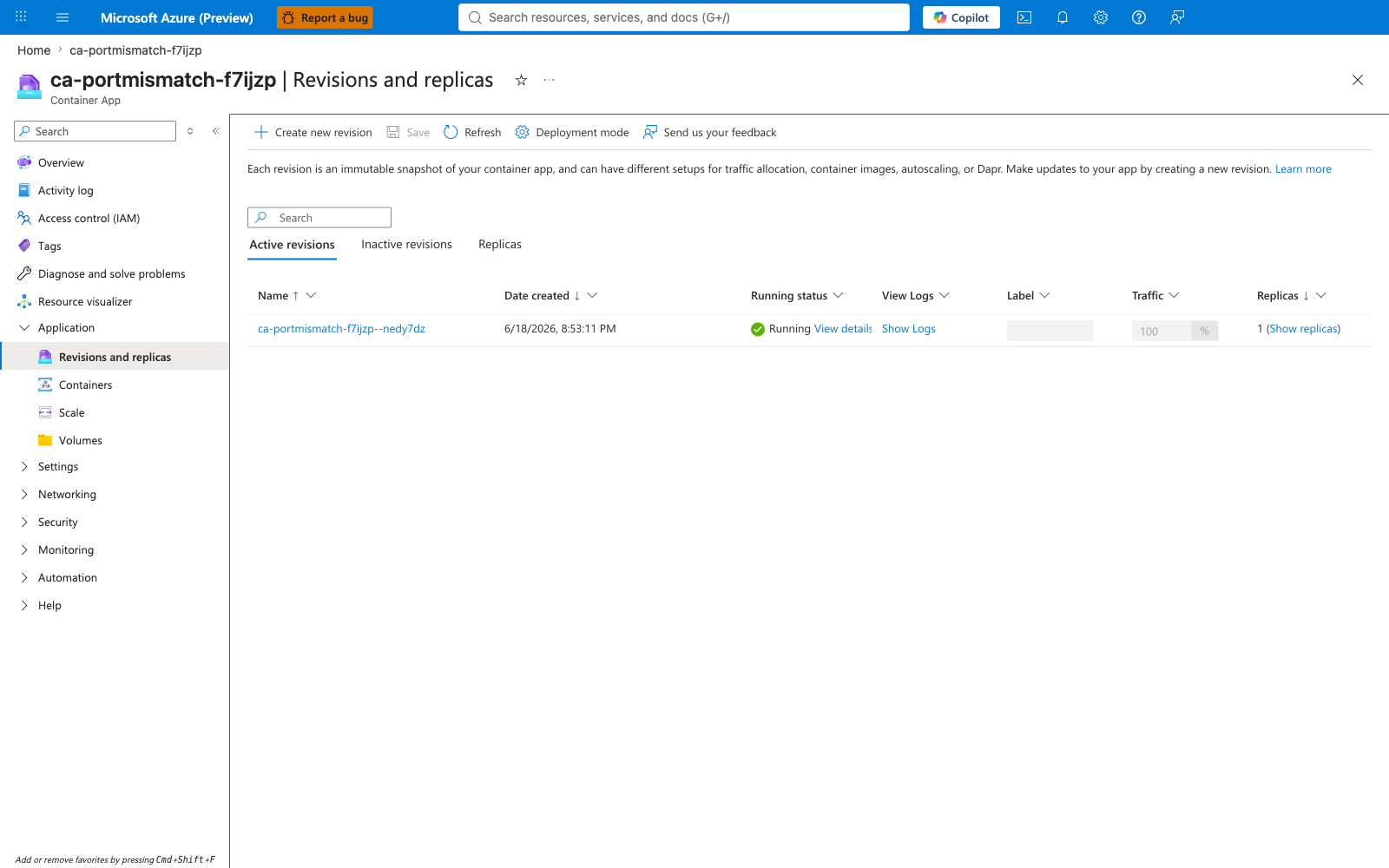
[Inferred] No new revision was created. The revision identity is unchanged across the failure and fix windows; only its health state flipped. This is consistent with the documented Container Apps behavior that ingress is an application-scope setting and ingress updates do not create new revisions.
Pair 3 — Revision status details flyout: the smoking gun message
[Observed] The "View details" flyout on the failing revision renders the exact platform message identifying the mismatch:
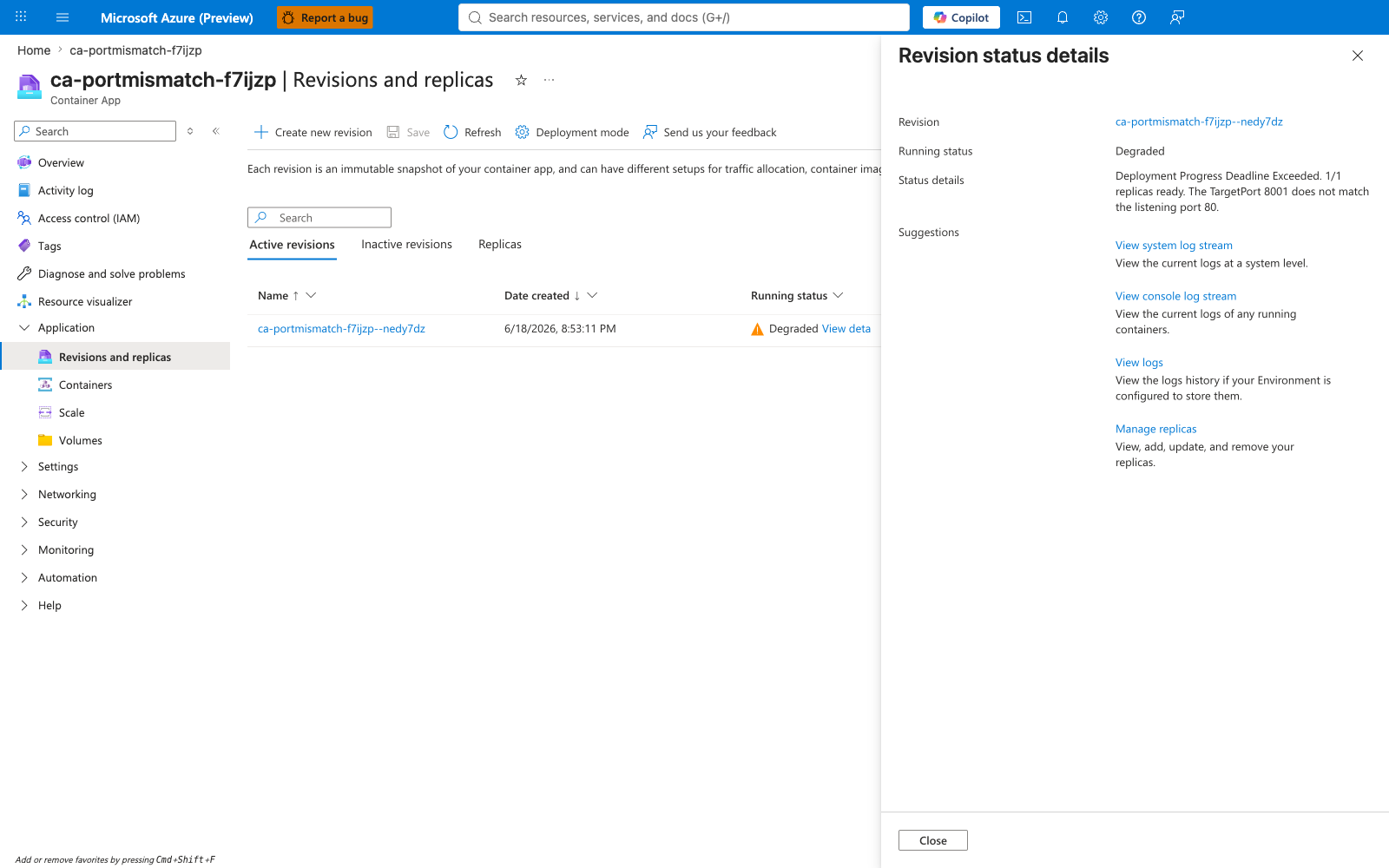
The verbatim text is:
The TargetPort 8001 does not match the listening port 80. 1/1 Container crashing: containerapps-helloworld
[Observed] After the fix, the same flyout on the same revision shows the platform's "all clear" placeholder:
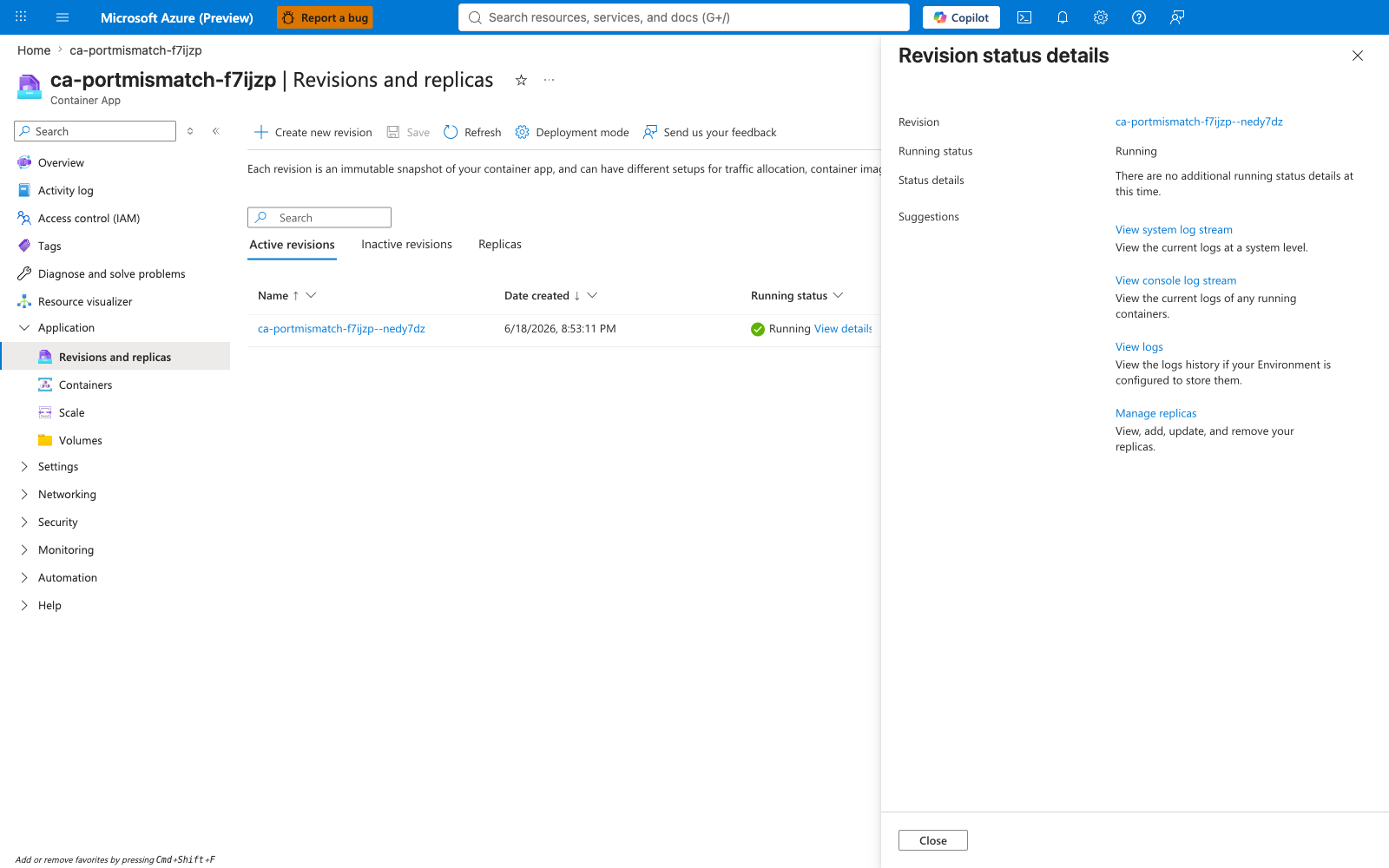
The verbatim post-fix text is:
[Inferred] The pre-fix flyout is the single highest-signal Portal artifact for this failure class — it directly attributes the failure to the mismatch and quotes both numbers (ingress port and container listening port). The post-fix "no additional running status details" placeholder is the negative-evidence counterpart: when the failure clears, the platform actively reports that nothing is wrong.
Pair 4 — Ingress blade: the actual configuration value
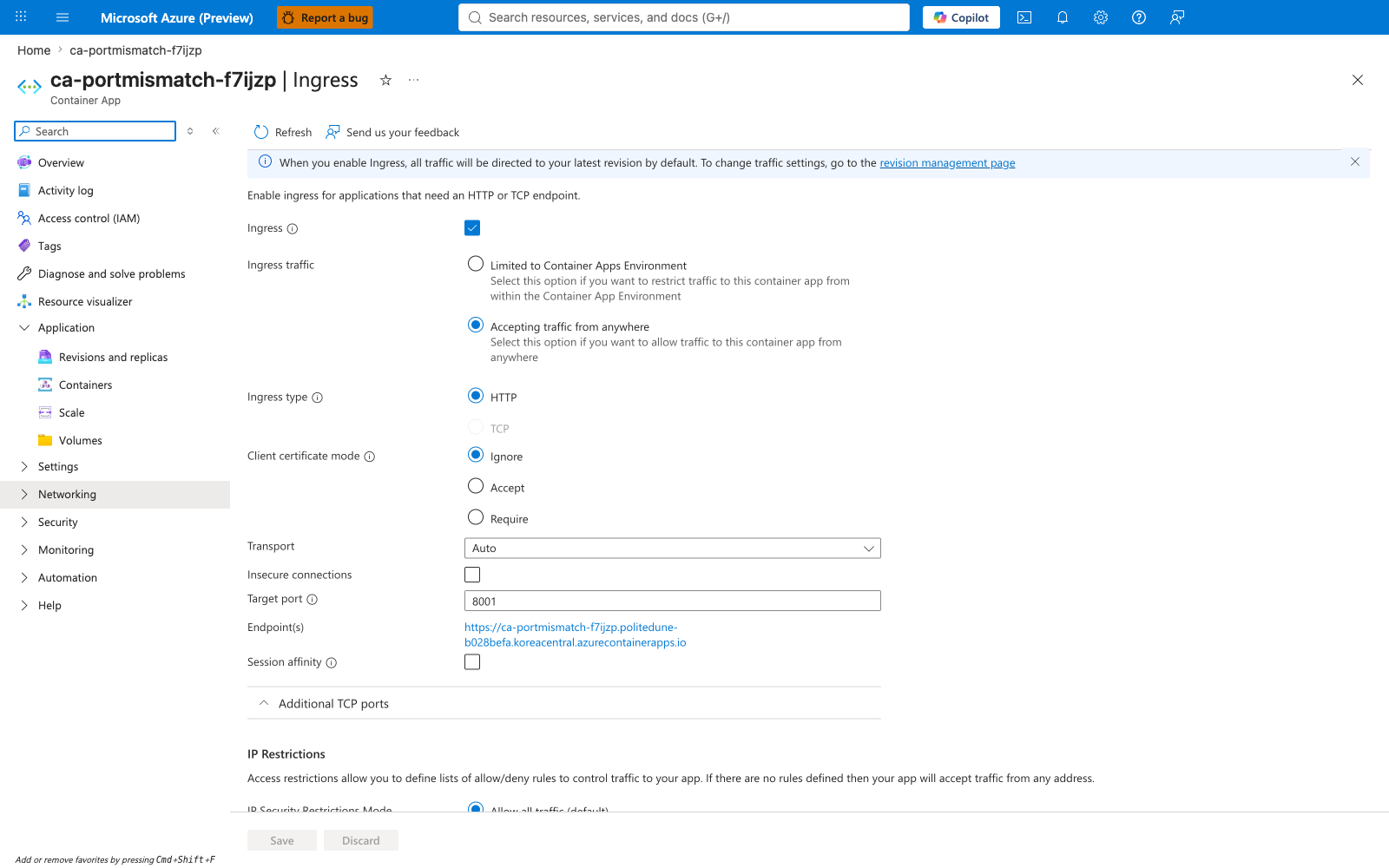
[Observed] The Ingress blade during the failure window reads Target port: 8001:
[Observed] After the fix, the same blade reads Target port: 80:
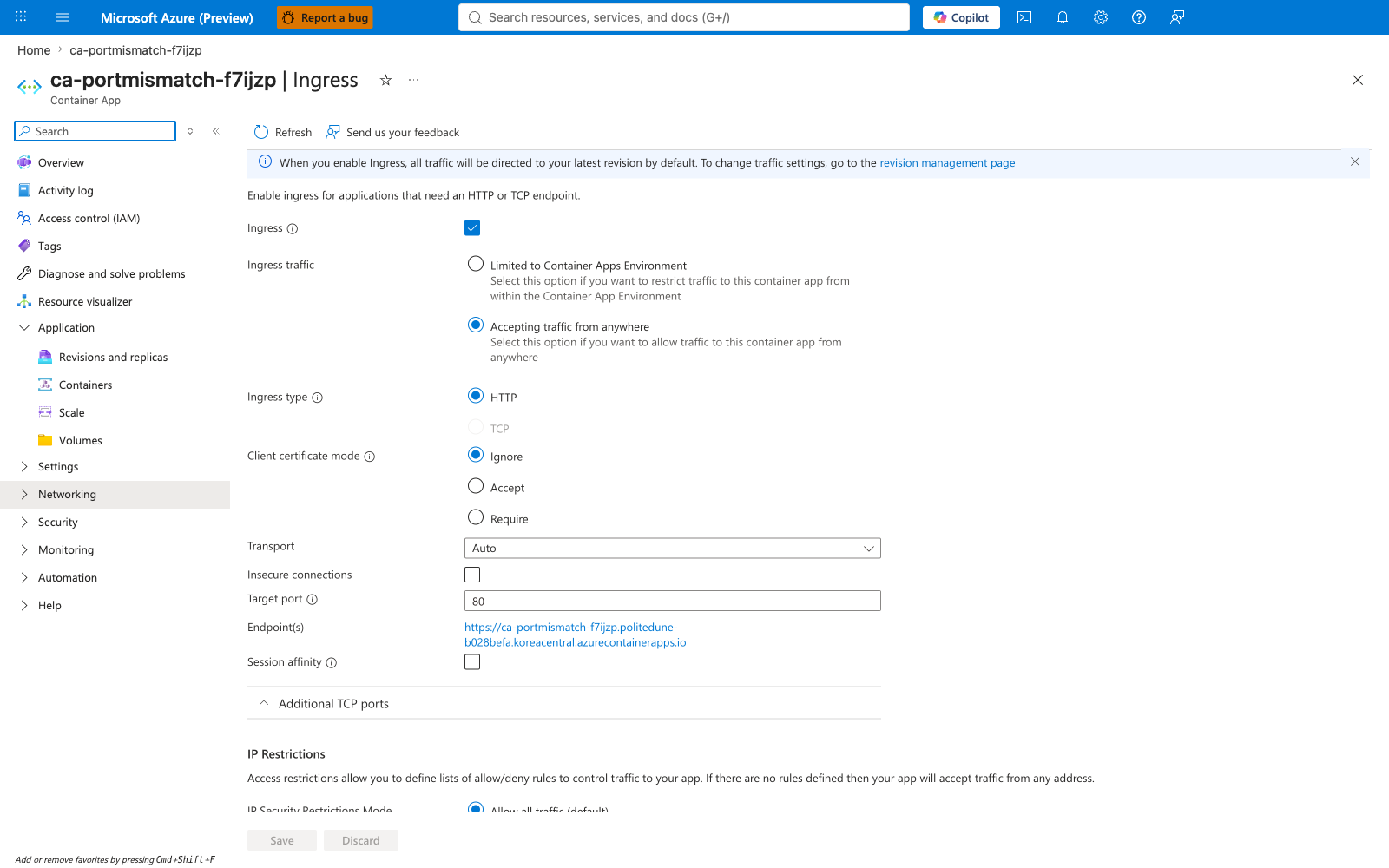
[Inferred] These are the two values that pair 3's verbatim message quotes. The flyout text is generated from this field plus the container's actual listening port — confirming that the failure is configuration, not runtime regression.
Pair 5 — Containers blade: the image and listening port are unchanged
[Observed] The Containers blade shows the same image (mcr.microsoft.com/azuredocs/containerapps-helloworld:latest) before and after the fix:
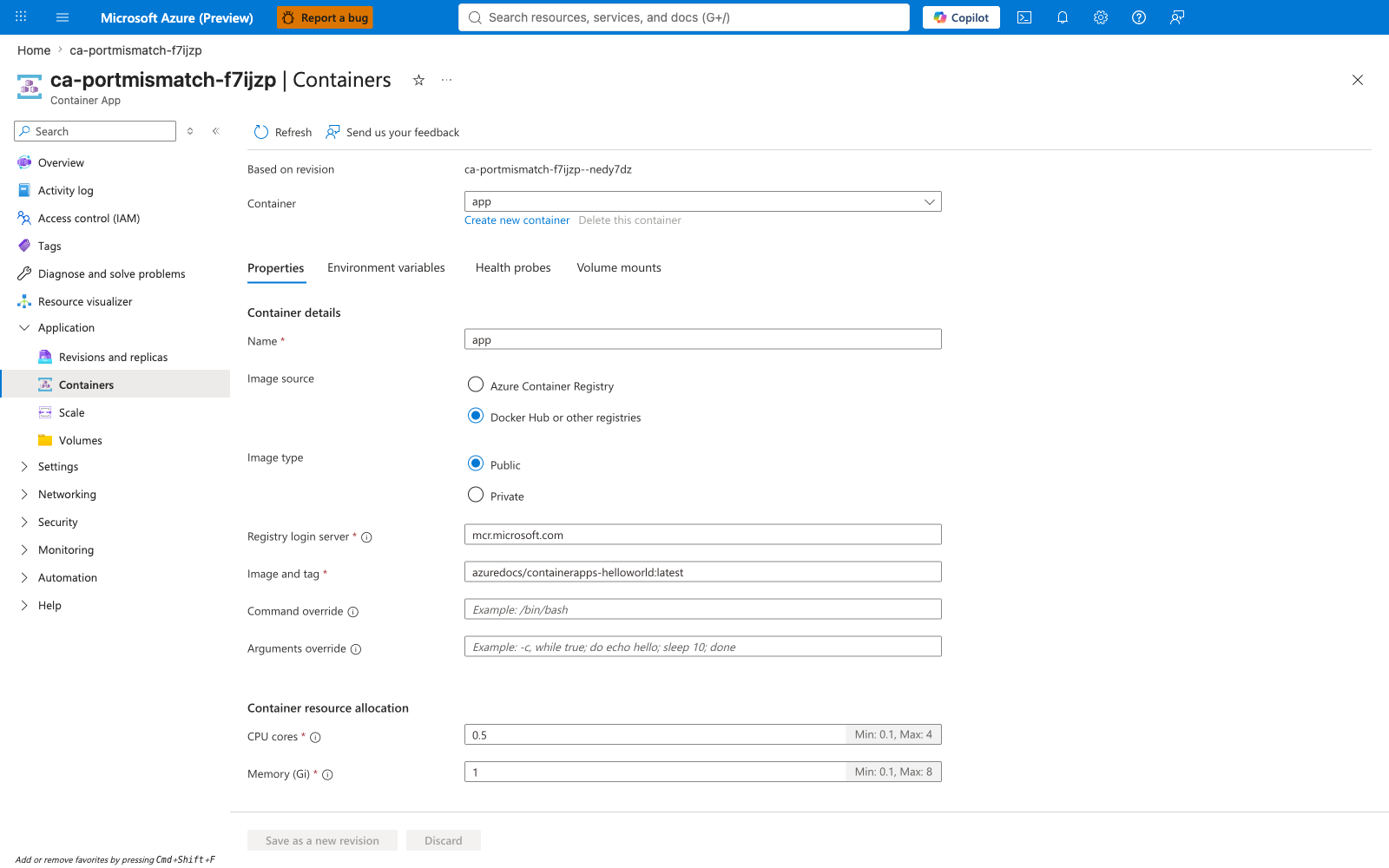
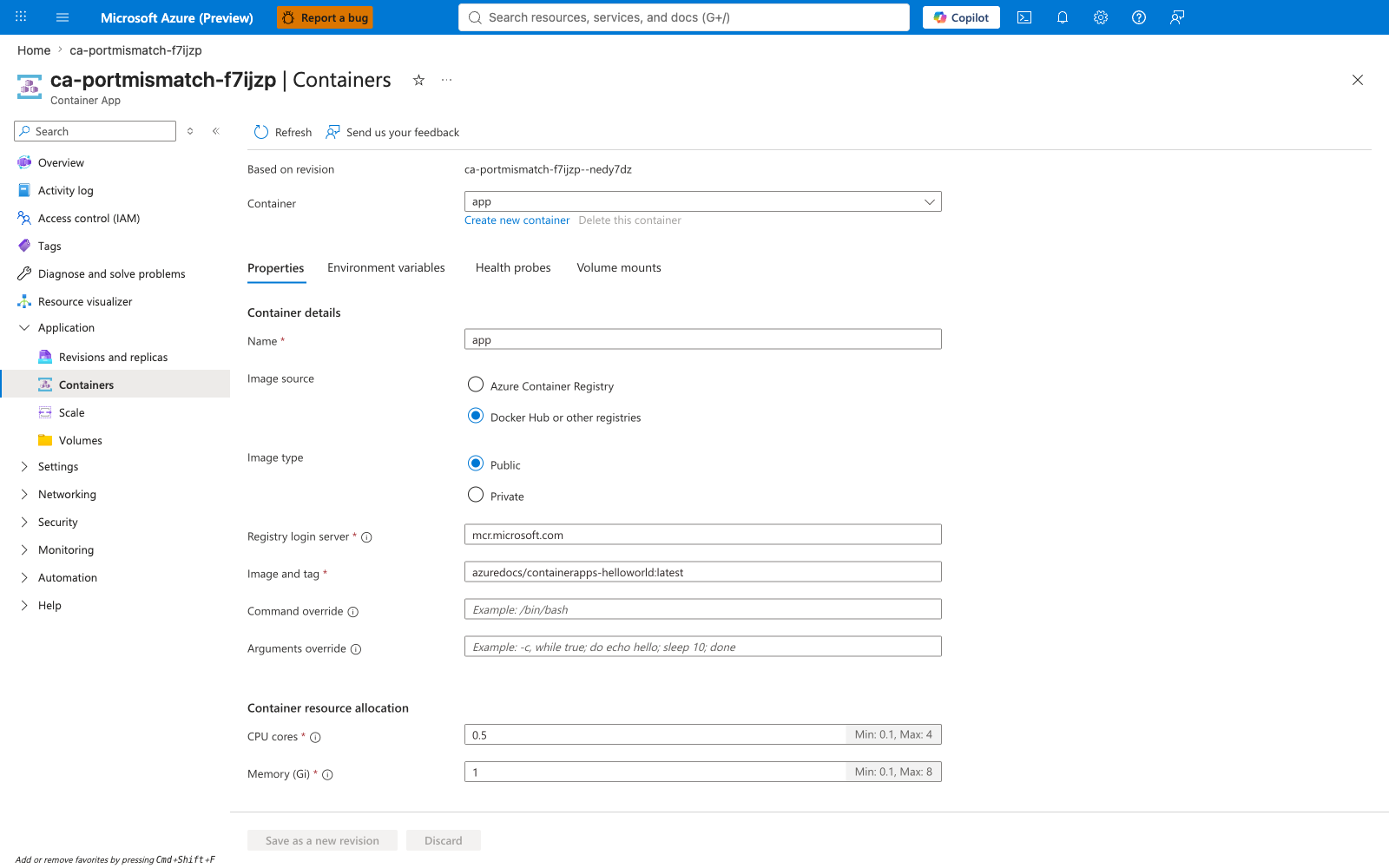
[Inferred] The image is the control variable in the falsification argument. Because the image — and therefore the listening port :80 — is identical across the failure and fix windows, the only thing that could have changed the outcome is the ingress targetPort. This rules out theories of the form "the container started listening on a different port" or "the image regressed".
Pair 6 — Metrics: 503 spike vs. 200 spike
[Observed] The Metrics blade Requests chart during the failure window shows a sustained 5xx spike:
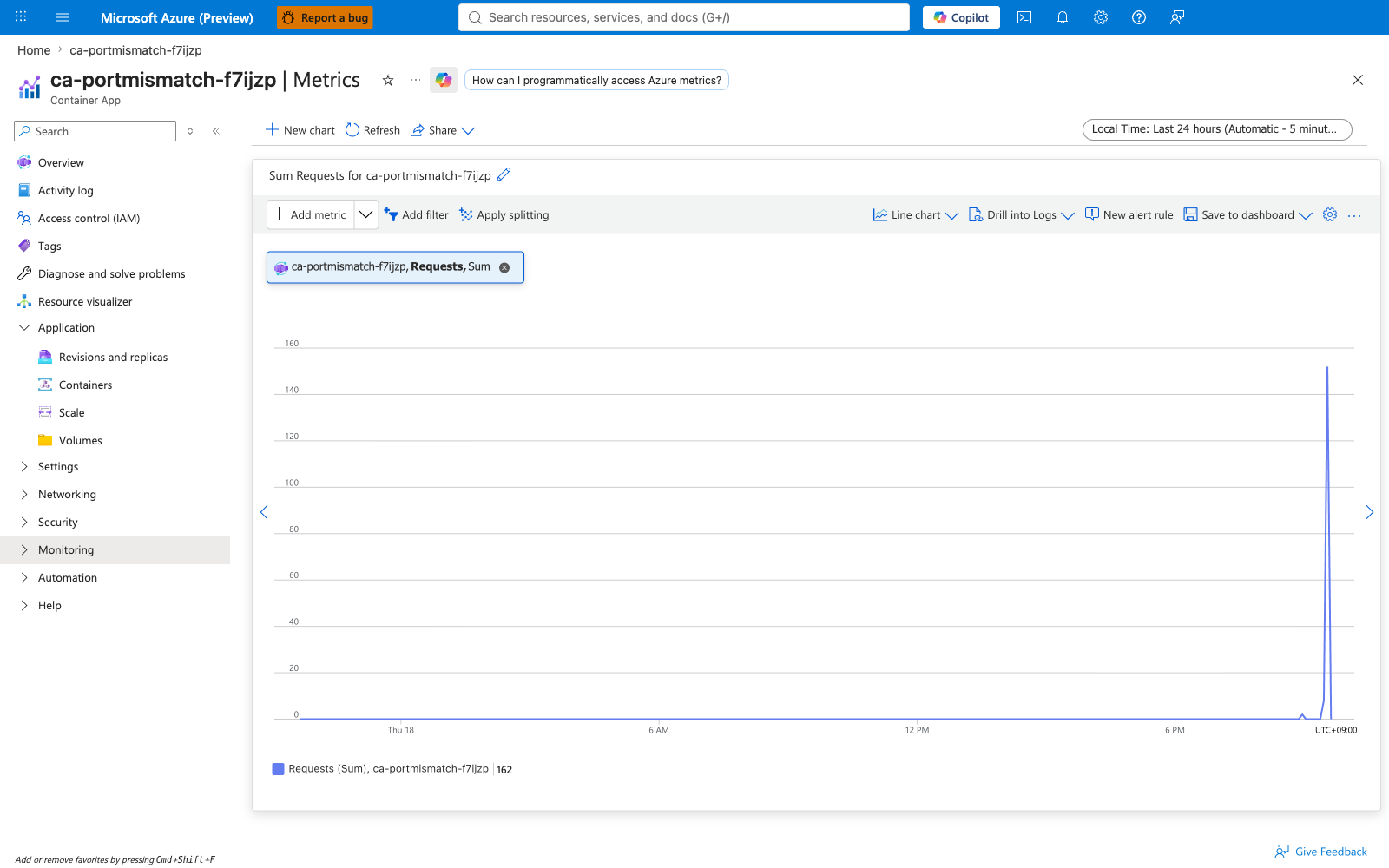
[Observed] After the fix, the same Requests chart on the same blade shows a 200 spike — Sum Requests = 327 over the post-fix burst window:
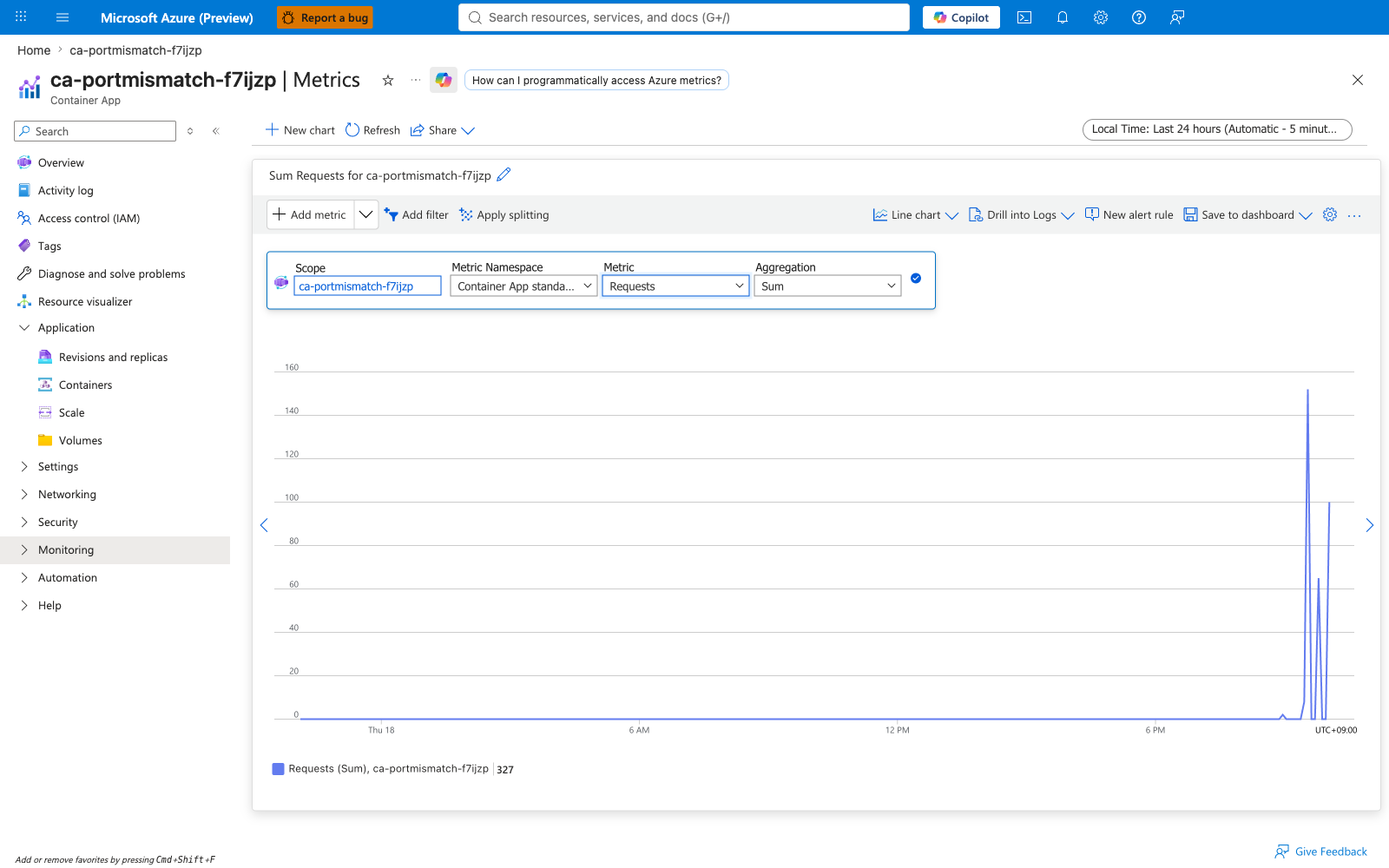
[Measured] The post-fix Sum Requests value (327) covers the entire post-fix sampling window (the lab's verify-step probes plus the two follow-up bursts). All sampled responses returned HTTP 200 — no residual 5xx after the ingress update landed.
[Inferred] The metric-level recovery is not instant because the chart aggregation window includes the pre-fix 5xx tail; once the fix lands, the 5xx series drops to zero and the 2xx series carries the burst. Reading the chart end-to-end is what makes the recovery visible.
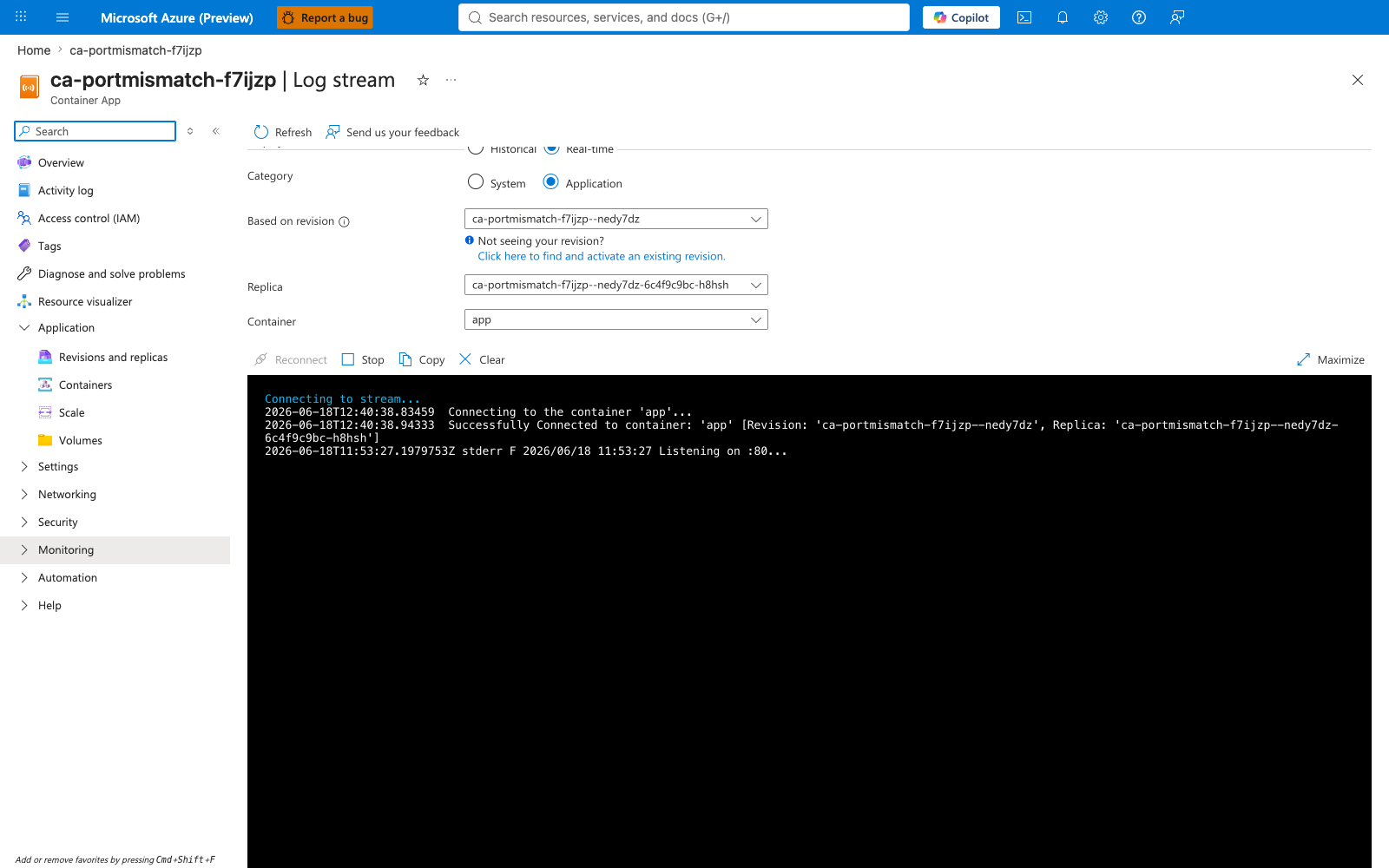
Pair 7 — Log stream: the container has been listening on :80 the entire time
[Observed] During the failure window, the Log stream blade shows the container emitting Listening on :80:
[Observed] After the fix, the same Log stream shows the same Listening on :80 line:
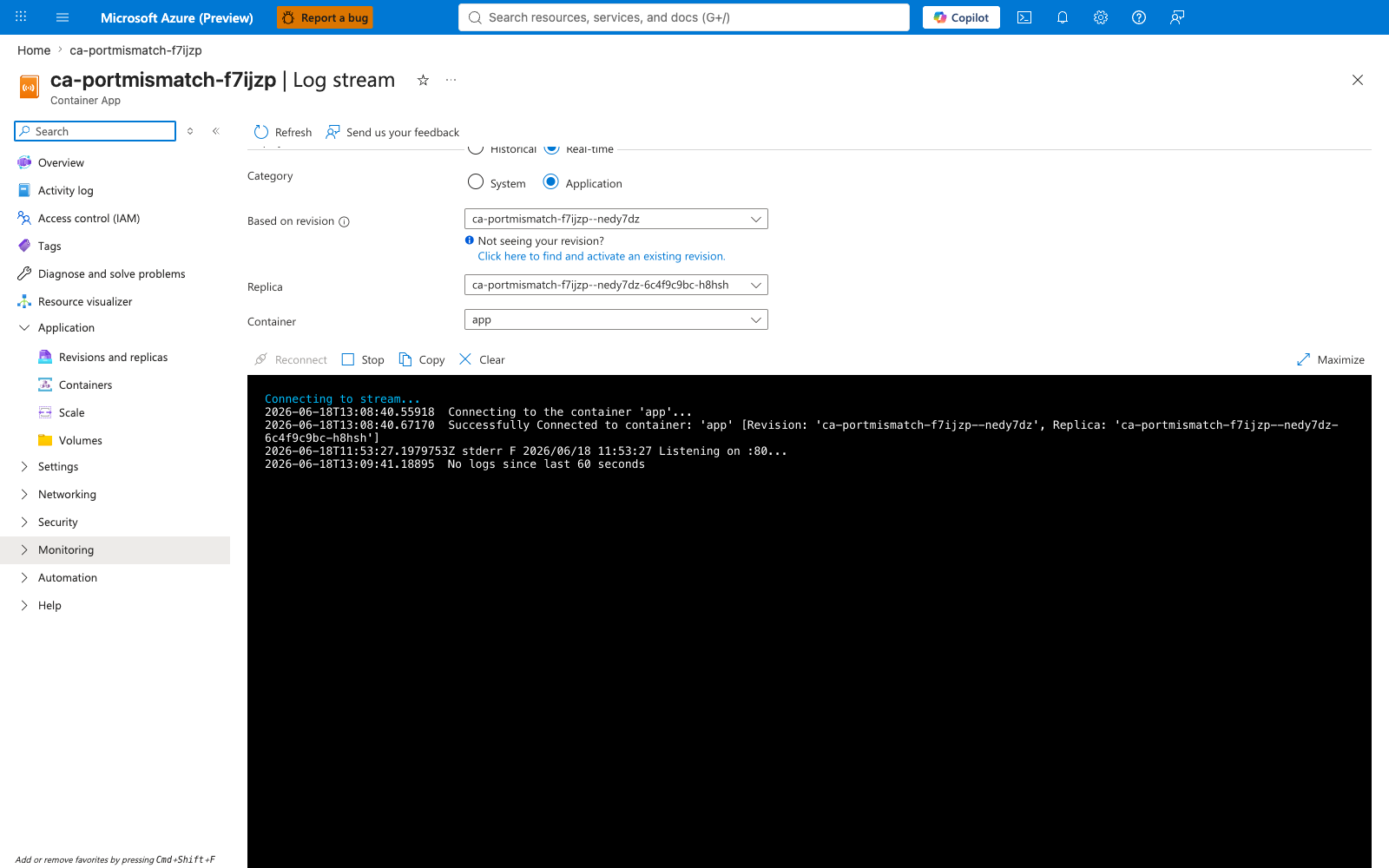
[Inferred] This pair is the dog that did not bark: the listener output is identical across both windows. The container never stopped listening on :80. Combined with pair 4 (ingress targetPort was the only thing that changed), this is what proves the failure was an ingress-to-container plumbing issue, not a container regression.
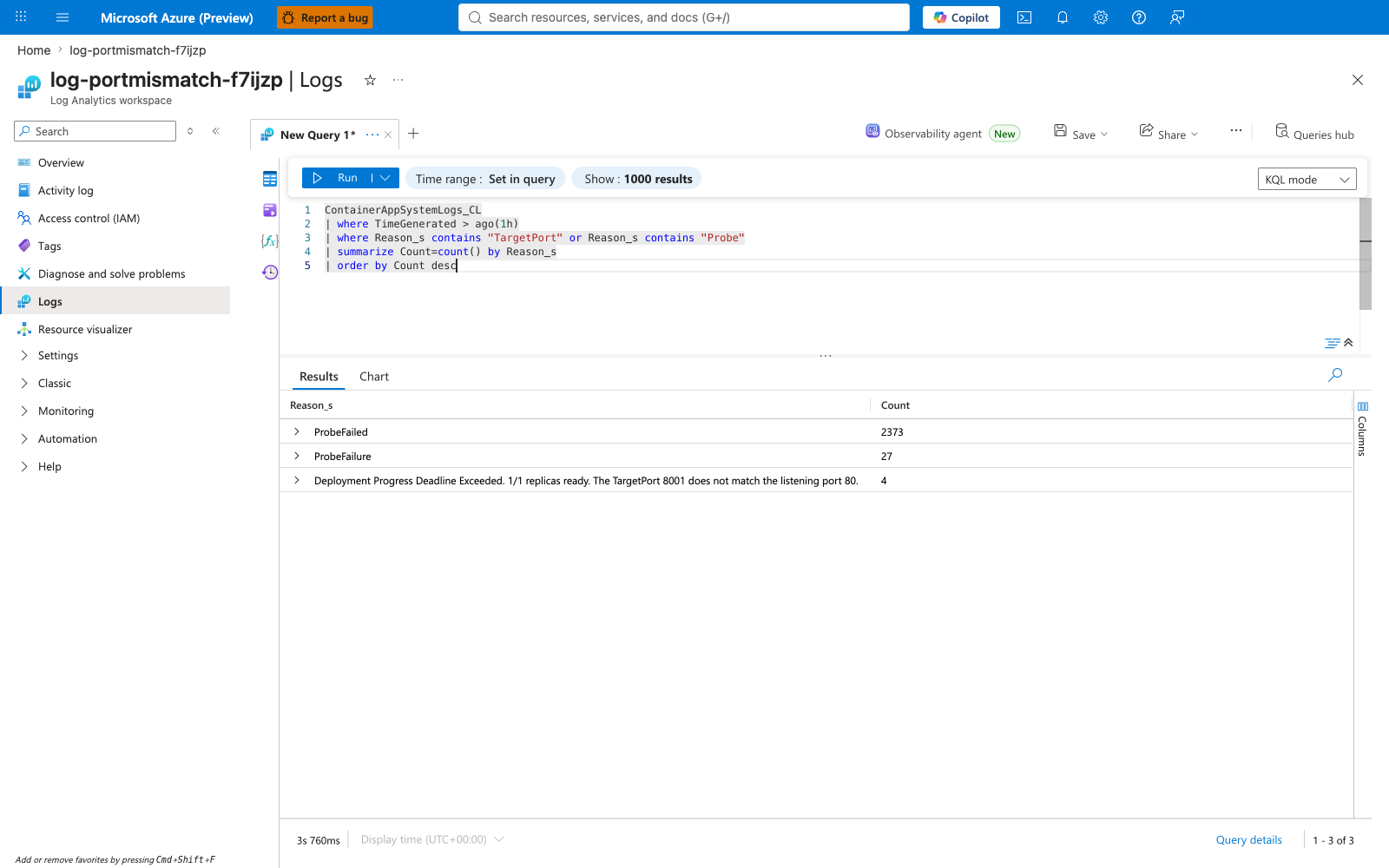
Pair 8 — Log Analytics KQL: the smoking-gun row appears and disappears
[Observed] Running the Target Port Mismatch Detection KQL query over the failure window returns the platform's verbatim mismatch attribution:
[Observed] Running the same KQL query over a ago(5m) window that starts after the fix lands returns No results found:
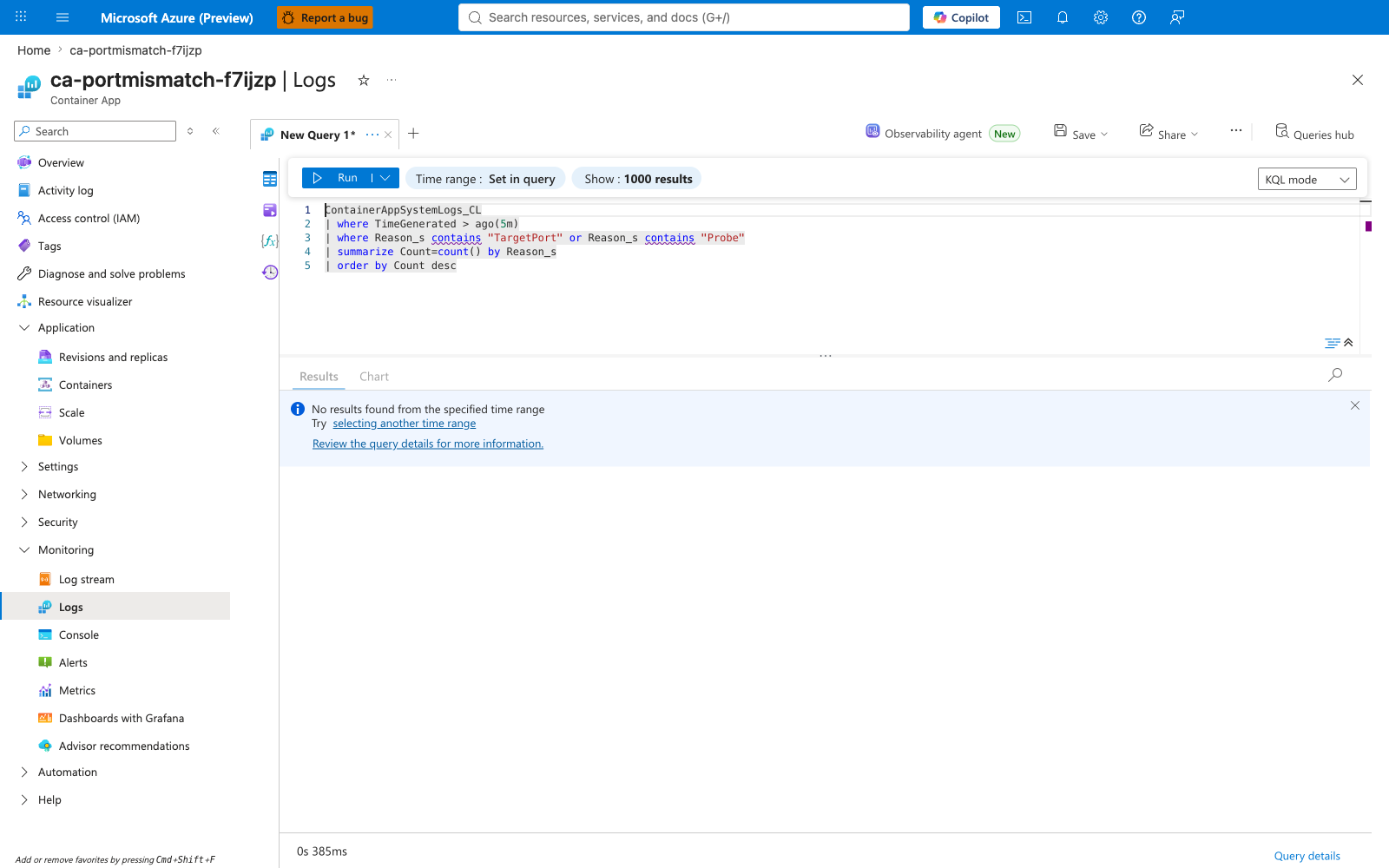
[Inferred] The transition from "row present" to "No results found" with an unchanged query is the machine-readable falsification artifact. Pairs 1–7 are visual; pair 8 is the form you can alert on, scope-back, or paste into an incident postmortem. See Target Port Mismatch Detection for the query body, schema notes, and limitations.
Production case pattern — falsification summary
| Independent variable changed | Dependent variables that flipped on the same revision | Variables held constant |
|---|---|---|
Ingress targetPort: 8001 → 80 | Overview Issues tab (present → gone), revision health (Degraded → Healthy/Running), revision status details (verbatim mismatch message → "no additional running status details"), edge response (503 → 200), KQL Reason_s contains "TargetPort" rows (present → "No results found" in the post-fix window) | Revision name, container image, container listening port (:80), ingress transport |
[Inferred] Holding the revision name, container image, listening port, and ingress transport constant and flipping only the ingress targetPort, the eight Portal surfaces above all transition together. The transition rules out the alternative theories the case originally enumerated:
- "The container is broken / image regressed" — falsified by pair 5 (same image) and pair 7 (same
Listening on :80log output). - "It's a transient platform issue, retry will fix it" — falsified by pair 8: the row stops appearing deterministically on the ingress update, not on time elapsed.
- "It's a probe configuration issue" — falsified by the verbatim flyout message in pair 3, which directly attributes the failure to the port mismatch, not to probe timing or path.
Observed Evidence (Scripted Evidence Pack — 2026-06-22, koreacentral)
This subsection captures the hypothesis a third time using the scripted falsification lab at labs/ingress-target-port-mismatch/. Two improvements over the prior subsections make this reproduction useful as machine-readable regression evidence:
trigger.sh,fix-and-capture.sh, and offlineverify.shreplace the manual workflow withbash+azCLI + KQL for Phase A plus a pure file-processor overlay for Phase B, producing JSON evidence atlabs/ingress-target-port-mismatch/evidence/(25 canonical numbered files plus 4 derived gate JSONs and the evidence README).- Strict UTC cutoffs scope both KQL gates to
TimeGenerated > datetime(${TRIGGER_UTC})andTimeGenerated > datetime(${FIX_UTC})respectively, eliminating the pre-fix-tail confounder that anago(5m)relative window would include in the H2 check.
Environment: rg-aca-lab-ingress-port / cae-ingressport-2inkav, koreacentral, Consumption plan, azure-cli 2.79.0, containerapp extension 1.3.0b4. App: ca-ingressport-2inkav — image mcr.microsoft.com/azuredocs/containerapps-helloworld:latest, container listens on :80. minReplicas=1, maxReplicas=1, 0.25 vCPU, 0.5 Gi. Trigger: az containerapp ingress update --target-port 8081 at TRIGGER_UTC=2026-06-22T12:17:44Z. Fix: az containerapp ingress update --target-port 80 at FIX_UTC=2026-06-22T12:25:06Z.
[Observed] H1 (trigger produces failure) — PASS. Pre-trigger sanity returned 10/10 HTTP 200; after the trigger and a 60 s ingress propagation wait, the same FQDN returned 0/10 HTTP 200 (all 503). After a 300 s system-log ingestion wait, the ContainerAppSystemLogs_CL KQL gate (scoped to TimeGenerated > datetime(2026-06-22T12:17:44Z)) classified the result as populated_table with portmismatch_rows=25, probefailed_rows=374, and distinct_revisions=1. Smoking-gun sample rows show Log_s = "The TargetPort 8081 does not match the listening port 80." and Reason_s = "Pending:PortMismatch", all attributed to the same replica ca-ingressport-2inkav--n6v50k0-55dfdfd9b-7bwp8 with TimeGenerated clustered between 2026-06-22T12:19:10Z and 2026-06-22T12:19:20Z (≈8–10 s after the trigger landed; detection-to-attribution is sub-minute on this reproduction).
[Observed] H2 (fix restores recovery) — PASS. After az containerapp ingress update --target-port 80 and a 30 s ingress propagation wait, the same FQDN returned 10/10 HTTP 200. After a further 300 s system-log ingestion wait, the same KQL scoped to TimeGenerated > datetime(2026-06-22T12:25:06Z) classified the result as silent_valid_baseline with portmismatch_rows=0 (the smoking-gun message stops being emitted in the post-fix window). probefailed_rows=12 in the post-fix window — these are residual ProbeFailed events without the TargetPort attribution, [Inferred] consistent with brief probe attempts during the few seconds between the ingress update and full propagation, and they do not contradict H2 because the gate is on the PortMismatch class, not on the broader ProbeFailed class.
[Observed] The latestRevisionName was ca-ingressport-2inkav--n6v50k0 before the trigger, during the triggered window, and after the fix — three captures of the same revision name. [Inferred] This is a third independent confirmation that ingress updates are application-scope (no new revision is created), consistent with How to configure ingress and with the 2026-06-02 and 2026-06-18 captures above.
[Observed] Schema observation on this reproduction. The 2026-06-22 platform emitted the port-mismatch attribution as Reason_s == "Pending:PortMismatch" with the smoking-gun text inside Log_s. The 2026-06-18 production case pattern captured above (pair 8) shows the smoking-gun text inside the Reason_s field itself, matched by Reason_s contains "TargetPort". [Inferred] Both forms carry the same operational meaning — TargetPort <X> does not match the listening port <Y> — but the field placement differs between these reproductions. The companion KQL pack at Target Port Mismatch Detection was updated 2026-06-22 to match both forms (Reason_s == "Pending:PortMismatch" OR Reason_s contains "TargetPort" OR Log_s contains "TargetPort") so a detector built on it remains valid across the two attribution shapes.
Scripted reproduction — falsification summary
| Independent variable changed | Dependent variables that flipped on the same revision | Variables held constant |
|---|---|---|
Ingress targetPort: 80 → 8081 → 80 | Edge HTTP response (200 → 503 → 200, n=10 per state), ContainerAppSystemLogs_CL gate classification (silent_valid_baseline → populated_table → silent_valid_baseline), portmismatch_rows (0 → 25 → 0 in the corresponding UTC windows) | Revision name (ca-ingressport-2inkav--n6v50k0), container image (containerapps-helloworld:latest), container listening port (:80), ingress transport (Auto), Log Analytics workspace, same KQL shape/predicates (the only intended query delta between H1 and H2 is the strict datetime(...) cutoff) |
[Inferred] Holding the revision name, container image, listening port, ingress transport, and KQL query body constant and flipping only the integer targetPort value, the edge HTTP response and the ContainerAppSystemLogs_CL PortMismatch row count flipped together in the documented direction. The strict post-fix UTC cutoff (datetime(2026-06-22T12:25:06Z) rather than ago(5m)) is what permits the H2 gate to be machine-readable — a relative window beginning at query time would include the pre-fix tail and falsely falsify the fix.
Clean Up
| Command | Why it is used |
|---|---|
az group delete ... | Removes the lab resource group and its contained resources. |