CD Reconnect RBAC Conflict Lab
Reproduce the AppRbacDeployment: The role assignment already exists error that occurs when GitHub Actions continuous deployment is reconnected to a Container App after a previous disconnect that left RBAC role assignments behind.
Lab Metadata
| Attribute | Value |
|---|---|
| Difficulty | Intermediate |
| Estimated Duration | 25-35 minutes |
| Tier | Consumption |
| Failure Mode | AppRbacDeployment deployment failure on CD reconnect with RoleAssignmentExists (HTTP 409) |
| Skills Practiced | RBAC inspection, role assignment cleanup, service principal lifecycle, CD setup mechanics |
1) Background
Azure Container Apps GitHub Actions continuous deployment provisions:
- A service principal (or a user-assigned managed identity) used by GitHub Actions
- Role assignments granting that identity
AcrPushon the registry andContributoron the Container App - A GitHub Actions workflow file and repository secrets
Disconnecting CD from the Portal removes the GitHub workflow and secrets, but the Azure-side service principal and its role assignments often remain. Azure RBAC enforces a unique key on (scope, principalId, roleDefinitionId), so when you reconnect using the same identity and same scope, the deployment fails because the assignment it tries to create already exists.
This lab reproduces the conflict by simulating exactly that lifecycle: provision the identity and role assignment, "disconnect" by removing only the GitHub-side artifacts, then attempt to recreate the same role assignment.
Architecture
sequenceDiagram
    participant Op as Operator
    participant AAD as Microsoft Entra ID
    participant RBAC as Azure RBAC
    participant ACR as Azure Container Registry
    participant ACA as Container App
    participant ARM as ARM Deployment
    Op->>AAD: Create service principal (simulating CD setup)
    Op->>ARM: Deploy role-assignment.bicep (initial, deterministic GUID)
    ARM->>RBAC: Create AcrPush assignment on ACR scope
    RBAC-->>ARM: Assignment created
    Op->>Op: "Disconnect" CD (GitHub side only)
    Op->>ARM: Deploy role-assignment.bicep (reconnect, fresh GUID)
    ARM->>RBAC: Create AcrPush assignment on ACR scope (different name)
    RBAC-->>ARM: 409 RoleAssignmentExists with existing assignment ID
    ARM-->>Op: Deployment failed
    Op->>RBAC: Look up conflicting assignment by ID
    Op->>RBAC: Delete the orphaned assignment
    Op->>ARM: Retry deployment
    ARM->>RBAC: Create AcrPush assignment
    RBAC-->>ARM: Assignment created
2) Hypothesis
IF a service principal already holds an AcrPush role assignment on an ACR scope, THEN any subsequent ARM deployment that creates a Microsoft.Authorization/roleAssignments resource with a different name but the same (scope, principal, role) will fail with RoleAssignmentExists and return the existing assignment ID, until the existing assignment is deleted or the principal is replaced.
| Variable | Control State | Experimental State |
|---|---|---|
| Existing role assignment | None on the target scope for this principal+role | One pre-existing AcrPush assignment on the same scope for this principal |
| ARM deployment with a fresh assignment GUID | Succeeds | Fails with RoleAssignmentExists returning the existing assignment ID |
| Recovery action | Not required | Delete the conflicting assignment before re-deploying |
| Service principal state | Active in tenant in both states | Active in tenant in both states |
Why ARM deployment, not the CLI directly
Modern az role assignment create is idempotent on the same (scope, principal, role) triple — it returns the existing assignment instead of erroring. The real AppRbacDeployment failure comes from the ARM template that az containerapp github-action add runs internally, which generates a new assignment GUID on each invocation. This lab reproduces the failure by mimicking the same ARM-level mechanism with a Bicep template.
3) Runbook
Prerequisites
| Command | Why it is used |
|---|---|
az login ... | Authenticates the CLI session before Azure resource operations. |
Expected output: active subscription metadata.
Deploy baseline infrastructure
export RG="rg-aca-lab-cd-rbac"
export LOCATION="koreacentral"

az group create --name "$RG" --location "$LOCATION"

az deployment group create \
    --name "lab-cd-rbac" \
    --resource-group "$RG" \
    --template-file "./labs/cd-reconnect-rbac-conflict/infra/main.bicep" \
    --parameters baseName="labcdrbac"
| Command | Why it is used |
|---|---|
az group create ... | Creates the isolated resource group used by the example. |
Expected output pattern:
Capture deployment outputs
export APP_NAME="$(az deployment group show \
    --resource-group "$RG" \
    --name "lab-cd-rbac" \
    --query "properties.outputs.containerAppName.value" \
    --output tsv)"

export ACR_NAME="$(az deployment group show \
    --resource-group "$RG" \
    --name "lab-cd-rbac" \
    --query "properties.outputs.containerRegistryName.value" \
    --output tsv)"

export SUBSCRIPTION_ID="$(az account show --query id --output tsv)"
export ACR_ID="$(az acr show --name "$ACR_NAME" --resource-group "$RG" --query id --output tsv)"
| Command | Purpose |
|---|---|
export APP_NAME="$(az deployment group show ... --query "properties.outputs.containerAppName.value" --output tsv)" | Captures the deployed Container App name from the successful ARM deployment outputs so later role-assignment and CD commands target the exact lab app instead of a guessed name. |
export ACR_NAME="$(az deployment group show ... --query "properties.outputs.containerRegistryName.value" --output tsv)" | Captures the registry resource name created by the lab deployment, which is the scope where the reconnect conflict is reproduced. |
export SUBSCRIPTION_ID="$(az account show --query id --output tsv)" | Records the active subscription ID so later ARM resource IDs and scope strings are built against the same subscription the lab is running in. |
export ACR_ID="$(az acr show --name "$ACR_NAME" --resource-group "$RG" --query id --output tsv)" | Resolves the full ACR resource ID, which is the exact RBAC scope used by the conflicting AcrPush role assignment. |
Expected output: no output; variables are populated.
Trigger the conflict
The trigger script provisions a service principal that stands in for the CD identity, then runs two ARM deployments of infra/role-assignment.bicep against the registry. The first deployment uses the deterministic GUID derived from (scope, principal, role). The second deployment uses a freshly generated GUID, mimicking what az containerapp github-action add does on each invocation.
Key fragment from trigger.sh:
# Initial CD setup: ARM deployment with the deterministic role assignment GUID
az deployment group create \
    --resource-group "$RG" \
    --name "lab-ra-initial" \
    --template-file "./labs/cd-reconnect-rbac-conflict/infra/role-assignment.bicep" \
    --parameters principalObjectId="$SP_OBJECT_ID" registryName="$ACR_NAME"

# Simulated disconnect: no Azure-side cleanup performed.

# Reconnect: same scope + principal + role, but a fresh role assignment GUID
NEW_NAME=$(cat /proc/sys/kernel/random/uuid)
az deployment group create \
    --resource-group "$RG" \
    --name "lab-ra-reconnect" \
    --template-file "./labs/cd-reconnect-rbac-conflict/infra/role-assignment.bicep" \
    --parameters principalObjectId="$SP_OBJECT_ID" \
                 registryName="$ACR_NAME" \
                 roleAssignmentName="$NEW_NAME"
| Command | Why it is used |
|---|---|
az deployment group create ... | Deploys the Bicep or ARM template into the target resource group. |
The infra/role-assignment.bicep template creates a single Microsoft.Authorization/roleAssignments@2022-04-01 resource on the registry scope with roleDefinitionId set to the AcrPush built-in role.
Expected error output pattern from the second deployment:
{"code": "RoleAssignmentExists", "message": "The role assignment already exists.
The ID of the existing role assignment is <32-char-hex>."}
The script extracts the 32-character hex ID from the error and prints both the raw form and its hyphenated GUID form. This is the same identifier the Portal surfaces in AppRbacDeployment failures.
Why the CLI alone does not reproduce this
az role assignment create --assignee-object-id <id> --role AcrPush --scope <acr> is idempotent — modern Azure CLI returns the existing assignment when the same (scope, principal, role) triple already exists. The conflict only surfaces through ARM deployments that try to create a Microsoft.Authorization/roleAssignments resource with a different name. CD setup uses ARM internally, which is why end users see the failure and CLI users following ad-hoc commands usually do not.
Inspect the conflicting assignment
az role assignment list \
    --assignee "$SP_APP_ID" \
    --scope "$ACR_ID" \
    --query "[].{name:name, role:roleDefinitionName, scope:scope, principalType:principalType}" \
    --output table
| Command | Why it is used |
|---|---|
az role assignment list ... | Lists Azure RBAC assignments to verify access or diagnose conflicts. |
Expected output pattern:
Name                                  Role      Scope                                                 PrincipalType
------------------------------------  --------  ----------------------------------------------------  ----------------
<guid-of-existing-assignment>         AcrPush   /subscriptions/<sub>/resourceGroups/.../<acr>         ServicePrincipal
The Name field matches the GUID returned by the failed ARM deployment.
Verify recovery
The verify script confirms the conflict still reproduces, deletes the existing assignment, then retries the same ARM deployment with the fresh GUID and confirms it now succeeds. Key fragment:
# Confirm conflict still reproduces
NEW_NAME=$(cat /proc/sys/kernel/random/uuid)
az deployment group create \
    --resource-group "$RG" --name "lab-ra-verify-conflict" \
    --template-file "./labs/cd-reconnect-rbac-conflict/infra/role-assignment.bicep" \
    --parameters principalObjectId="$SP_OBJECT_ID" registryName="$ACR_NAME" \
                 roleAssignmentName="$NEW_NAME" 2>&1 | tee /tmp/cd-rbac-verify.log
grep -qE "RoleAssignmentExists|already exists" /tmp/cd-rbac-verify.log

# Apply recovery: delete the existing assignment
ASSIGNMENT_ID=$(az role assignment list --assignee "$SP_APP_ID" --scope "$ACR_ID" \
    --query "[0].name" --output tsv)
az role assignment delete \
    --ids "${ACR_ID}/providers/Microsoft.Authorization/roleAssignments/$ASSIGNMENT_ID"

# Retry the same deployment - should now succeed
az deployment group create \
    --resource-group "$RG" --name "lab-ra-verify-recovery" \
    --template-file "./labs/cd-reconnect-rbac-conflict/infra/role-assignment.bicep" \
    --parameters principalObjectId="$SP_OBJECT_ID" registryName="$ACR_NAME" \
                 roleAssignmentName="$NEW_NAME"
| Command | Purpose |
|---|---|
NEW_NAME=$(cat /proc/sys/kernel/random/uuid) | Generates a fresh GUID from the local Linux kernel UUID source so the retry uses a different role-assignment resource name from the original conflicting deployment. |
az deployment group create --resource-group "$RG" --name "lab-ra-verify-conflict" --template-file "./labs/cd-reconnect-rbac-conflict/infra/role-assignment.bicep" --parameters principalObjectId="$SP_OBJECT_ID" registryName="$ACR_NAME" roleAssignmentName="$NEW_NAME" 2>&1 | tee /tmp/cd-rbac-verify.log | Replays the conflicting ARM deployment with the same principal and registry scope but a fresh role-assignment name, which is how the lab proves the stale assignment still blocks reconnect. |
grep -qE "RoleAssignmentExists|already exists" /tmp/cd-rbac-verify.log | Filters the captured output down to the marker strings that confirm whether the expected failure signature actually occurred. |
ASSIGNMENT_ID=$(az role assignment list --assignee "$SP_APP_ID" --scope "$ACR_ID" --query "[0].name" --output tsv) | Captures ASSIGNMENT_ID from the live Azure lookup so later commands reuse the exact current value instead of guessing it. Lists RBAC grants for one principal at one exact scope, which is the quickest way to verify whether the workload has the right permission on the dependency that is failing. |
az role assignment delete --ids "${ACR_ID}/providers/Microsoft.Authorization/roleAssignments/$ASSIGNMENT_ID" | Deletes the orphaned AcrPush assignment by its full ARM resource ID so the reconnect retry no longer collides with the old (scope, principal, role) triple. |
az deployment group create --resource-group "$RG" --name "lab-ra-verify-recovery" --template-file "./labs/cd-reconnect-rbac-conflict/infra/role-assignment.bicep" --parameters principalObjectId="$SP_OBJECT_ID" registryName="$ACR_NAME" roleAssignmentName="$NEW_NAME" | Re-runs the same ARM deployment after cleanup to prove the reconnect succeeds once the stale role assignment is removed. |
Expected result: the second deployment fails with RoleAssignmentExists, the delete removes the existing assignment, and the retry succeeds. The script ends with PASS: recovery successful - 1 active AcrPush assignment.
4) Experiment Log
| Step | Action | Expected | Actual (2026-04-21) | Pass/Fail |
|---|---|---|---|---|
| 1 | Deploy infra/main.bicep | provisioningState: Succeeded | Container App ca-labcdrbac-r7g4h7, ACR acrlabcdrbacr7g4h7 provisioned | Pass |
| 2 | Capture deployment outputs | APP_NAME, ACR_NAME, ACR_ID populated | All variables set from deployment outputs | Pass |
| 3 | Run trigger.sh | Second ARM deployment fails with RoleAssignmentExists and includes existing assignment ID | Failed with existing role assignment is 0426f1573d5455088d6c650341b2a9e7 | Pass |
| 4 | Inspect conflicting assignment | One AcrPush assignment for the SP on ACR scope | Single assignment matching the GUID returned by the failure | Pass |
| 5 | Run verify.sh (delete + redeploy) | Conflict reproduces, delete succeeds, retry deployment succeeds | Recovery completed; PASS: recovery successful - 1 active AcrPush assignment | Pass |
| 6 | Run cleanup.sh | Service principal, app registration, and resource group removed | SP and app registration deleted; resource group deletion initiated | Pass |
Expected Evidence
| Evidence Source | Expected State |
|---|---|
Second az deployment group create of infra/role-assignment.bicep with a fresh roleAssignmentName | Fails with RoleAssignmentExists; error body contains The ID of the existing role assignment is <32-char-hex> |
az role assignment list --assignee "$SP_APP_ID" --scope "$ACR_ID" --output table | Returns exactly one AcrPush assignment before recovery |
az role assignment delete --ids "${ACR_ID}/providers/Microsoft.Authorization/roleAssignments/$ASSIGNMENT_ID" | Returns no error; assignment removed |
Retry az deployment group create with the same fresh roleAssignmentName | Succeeds with provisioningState: Succeeded |
az ad sp show --id "$SP_APP_ID" | Service principal remains active throughout the lab |
Observed Evidence (Live Azure Test — 2026-06-23)
Environment: rg-aca-lab-cd-rbac, koreacentral. Service Principal: ca-labcdrbac-mym3wz-github-actions-lab (simulated CD identity, mirrors az containerapp github-action add). Container Registry: acrlabcdrbacmym3wz. Tooling versions: azure-cli 2.79.0, containerapp extension 1.3.0b4 (source of truth: evidence/18-cli-versions.json).
This subsection validates the lab automation (trigger.sh + verify.sh + cleanup.sh) against a live Azure environment. Raw evidence is captured under labs/cd-reconnect-rbac-conflict/evidence/. All PII (subscription, tenant, principal IDs) is replaced with the documented Azure zero-GUID placeholder; deterministic GUIDs, Azure correlation IDs, and Azure-assigned role-assignment GUIDs are preserved as lab evidence.
Honest disclosure of run chronology. The evidence files were assembled across multiple iterative script reruns during the same 2026-06-23 cycle, not from one pristine linear pass. Two consequences are visible in the timestamps and to anyone re-examining the artifacts:
- The Phase 3 baseline
evidence/03-role-assignment-list-baseline.jsonshows the deterministic role-assignment47d5a904-80ad-53e1-aa11-828e33d16cefwithcreatedOn: 12:19:18Z, which predates the Phase 2 deploymenttimestamp: 12:22:11Zinevidence/02-deployment-initial-output.json. That is because the deterministic name (derived from inputs that do not change across reruns) caused the captured Phase 2 deploy to be an ARM idempotent no-op — the assignment had been created during an earlier iteration of the same cycle. The Phase 2provisioningState: Succeededclaim is therefore "ARM accepted the request" rather than "this exact CLI invocation created the assignment". The H1 falsification (conflict reproduces when a freshroleAssignmentNametargets the same(scope, principal, role)triple) is still proven byevidence/04-deployment-reconnect-stderr.txtandevidence/05-deployment-reconnect-failure.json. - The Phase 9 pre-delete name
926c60b6-4250-4125-b9c3-8c822b8a535f(evidence/09-role-assignment-pre-delete.json) does not match the H1 deterministic GUID — it was the recovery name left in place by an earlier verify-script invocation in the same cycle. The H2 falsification (delete the orphan → fresh deploy succeeds → cardinality preserved at 1) is unaffected: the orphan is deleted, the recovery deploy lands a different name (e3df1205-...), and the post-recovery snapshots confirm exactly oneAcrPushassignment.
The narrative below describes the per-phase evidence as captured, with phase numbers referencing positions in trigger.sh and verify.sh rather than wall-clock ordering of the captured artifacts.
H1: conflict reproduction (trigger.sh)
[Observed] Phase 2 initial ARM deployment of infra/role-assignment.bicep with the deterministic role-assignment name 47d5a904-80ad-53e1-aa11-828e33d16cef returned provisioningState: Succeeded (evidence/02-deployment-initial-output.json). This name is derived from the Bicep guid(registry.id, <principal-object-id>, acrPushRoleId) expression — see labs/cd-reconnect-rbac-conflict/infra/role-assignment.bicep for the full template (the actual parameter name in the Bicep file is principalObjectId).
[Observed] Phase 3 baseline role-assignment list showed exactly 1 AcrPush assignment with the deterministic GUID on the ACR scope (evidence/03-role-assignment-list-baseline.json).
[Observed] Phase 4 simulated-reconnect ARM deployment with a fresh roleAssignmentName=8c1942d0-703c-4f5d-bcd3-ad361f140ed6 returned provisioningState: Failed, exit code 1, and an ARM error body containing:
"code":"RoleAssignmentExists","message":"The role assignment already exists.
The ID of the existing role assignment is 47d5a90480ad53e1aa11828e33d16cef."
(evidence/04-deployment-reconnect-stderr.txt, evidence/05-deployment-reconnect-failure.json, ARM correlationId 93fb0b48-c9ba-4e53-895a-ea47ed721dea.)
[Observed] The conflict GUID extracted from the ARM error message (47d5a90480ad53e1aa11828e33d16cef) matches the deterministic GUID created in Phase 2 (47d5a904-80ad-53e1-aa11-828e33d16cef) byte-for-byte after hyphen removal (evidence/06-conflict-guid-extraction.json).
[Inferred] The (scope=ACR, principal=SP, role=AcrPush) uniqueness constraint is the controlling variable: ARM rejected the second Microsoft.Authorization/roleAssignments write at the role-assignment step (HTTP 409) despite the deployment providing a different assignment name. The error message uniquely identifies the existing GUID, which equals the deterministic seed from the initial deploy — closing the causal loop.
H1 gate (evidence/07-h1-gate.json): cd_rbac_conflict_reproduced, all 4 sub-gates PASS.
H2: recovery (verify.sh)
[Observed] Phase 9 re-confirm with a fresh roleAssignmentName reproduced the same RoleAssignmentExists error, confirming the conflict persisted between trigger and verify (evidence/08-deployment-reverify-conflict.txt).
[Observed] Phase 11 az role assignment delete --ids on the orphaned assignment returned exit code 0; a 15-second sleep allowed RBAC propagation. evidence/10-role-assignment-delete-output.txt is intentionally empty — the CLI emits no stdout on successful delete.
[Observed] Phase 12 recovery ARM deployment with a fresh roleAssignmentName=e3df1205-6ca1-4b26-9468-2732121d6102 returned provisioningState: Succeeded, exit code 0, ARM correlationId 431e3456-4db6-4838-9725-bbfaa31562bc (evidence/11-deployment-recovery.json).
[Observed] Phase 13 + Phase 14 role-assignment lists at +15 s and +30 s after recovery showed exactly 1 AcrPush assignment with name = e3df1205-6ca1-4b26-9468-2732121d6102 (the new GUID, not the deleted deterministic one) — cardinality preserved, no double-assignment (evidence/12-role-assignment-list-post-recovery.json, evidence/13-role-assignment-list-cardinality-verify.json).
[Inferred] The documented recovery procedure (az role assignment delete --ids ... + retry the ARM deployment with a fresh GUID) restores convergence: the (scope, principal, role) triple is again held by exactly one assignment, just with a different name. The pre-delete name (926c60b6-4250-4125-b9c3-8c822b8a535f, an assignment name from an earlier verify-script invocation in this same iterative cycle) and the post-recovery name (e3df1205-6ca1-4b26-9468-2732121d6102) differ; both are valid for the same (scope, principal, role) triple, confirming the constraint is on the triple — not on the assignment name.
H2 gate (evidence/14-h2-gate.json): cd_rbac_recovered_after_delete_retry, all 4 sub-gates PASS.
Lab automation hardening shipped with this evidence pack
Two latent script bugs were discovered and fixed during this run; both would have produced false-negative H1 / H2 gates on any future re-run if left unpatched:
trigger.shPhase 6 Python heredoc: the original heredoc lacked single-quote delimiters, so bash interpolated$RECONNECT_HAS_ROLE_ASSIGNMENT_EXISTS(lowercasetrue/false) into the Python source where it became aNameError. Fixed by quoting the heredoc (<<'PYEOF') and reading the environment variable viaos.environ[...].lower() == 'true', matching the Phase 7 pattern already in the same file.verify.shPhase 12 redirect: the original> file 2>&1redirect merged the Azure CLIWARNING: A new Bicep release is available: ...(printed on stderr by the bicep transpiler) into the same filepython3 json.load()was asked to parse, producing aJSONDecodeErrorand a false-negative H2 gate. Fixed by splitting stdout/stderr (> file 2> file.stderr) and adding--only-show-errorsas defence in depth.
[Observed] After both fixes, the iterative cycle produced clean H1 + H2 PASS gates with no parser failures (evidence/22-cleanup-output.txt confirms the cleanup phase also completed cleanly with async RG deletion initiated).
Operator caveat — script start-state assumptions. These bug fixes harden the scripts against parser-level false negatives but do not make trigger.sh idempotent from arbitrary RBAC states. Specifically:
trigger.shdeploys the role-assignment Bicep withroleAssignmentName="", which the template resolves to the deterministicguid(registry.id, principalObjectId, acrPushRoleId). If the resource group already has anAcrPushassignment for the same SP+ACR but under a different name (for example the recovery namee3df1205-...left by a priorverify.shrun), Phase 2 oftrigger.shwill fail withRoleAssignmentExistsagainst the new deterministic name and the H1 gate will not start.- The supported start states for
trigger.share: (a) no existingAcrPushassignment for this SP+ACR, or (b) only the deterministic-named assignment from a priortrigger.shinvocation. To reruntrigger.shafter a successfulverify.shrecovery, runcleanup.shfirst (full teardown) or manually delete the recovery assignment withaz role assignment delete --ids .... verify.shandcleanup.share tolerant of either start state (verify reproduces and recovers; cleanup deletes the whole RG plus the SP).
Observed Evidence (Live Azure Test — 2026-05-01)
Environment: rg-aca-lab-test6, koreacentral. Service Principal: sp-cd-lab6 (appId: <app-id>).
[Observed] az role assignment delete (removing Contributor from SP) → az containerapp update returned:
AuthorizationFailed: The client does not have authorization to perform action
'Microsoft.App/containerApps/write' over scope '/subscriptions/.../resourceGroups/rg-aca-lab-test6'.
[Observed] az role assignment create --role Contributor --assignee "<app-id>" → re-assignment succeeded, provisioningState: Succeeded.
[Observed] Creating a duplicate role assignment via az role assignment create with an already-assigned (scope, principal, role) triple returned:
[Observed] az role assignment delete --ids succeeded silently (exit 0). A subsequent az role assignment list confirmed the assignment was removed.
[Inferred] The (scope, principal, role definition) uniqueness constraint is enforced by Azure RBAC. Idempotent deployments must use az role assignment create --role ... --assignee ... (idempotent) rather than ARM with a static GUID name.
Environment: rg-aca-lab-test6, koreacentral, az role assignment create / Contributor role.
Observed Evidence (Portal Captures — 2026-06-03)
Environment: rg-aca-lab-cd-rbac, koreacentral. Service Principal: ca-labcdrbac-khgtaj-github-actions-lab (simulated CD identity, mirrors az containerapp github-action add). Container Registry: acrlabcdrbackhgtaj.
The five captures below were taken end-to-end after running ./trigger.sh (reproduce conflict) and ./verify.sh (delete-and-retry recovery). All PII (subscription IDs, tenant identifiers, object IDs) is replaced with the documented Azure zero-GUID placeholder.
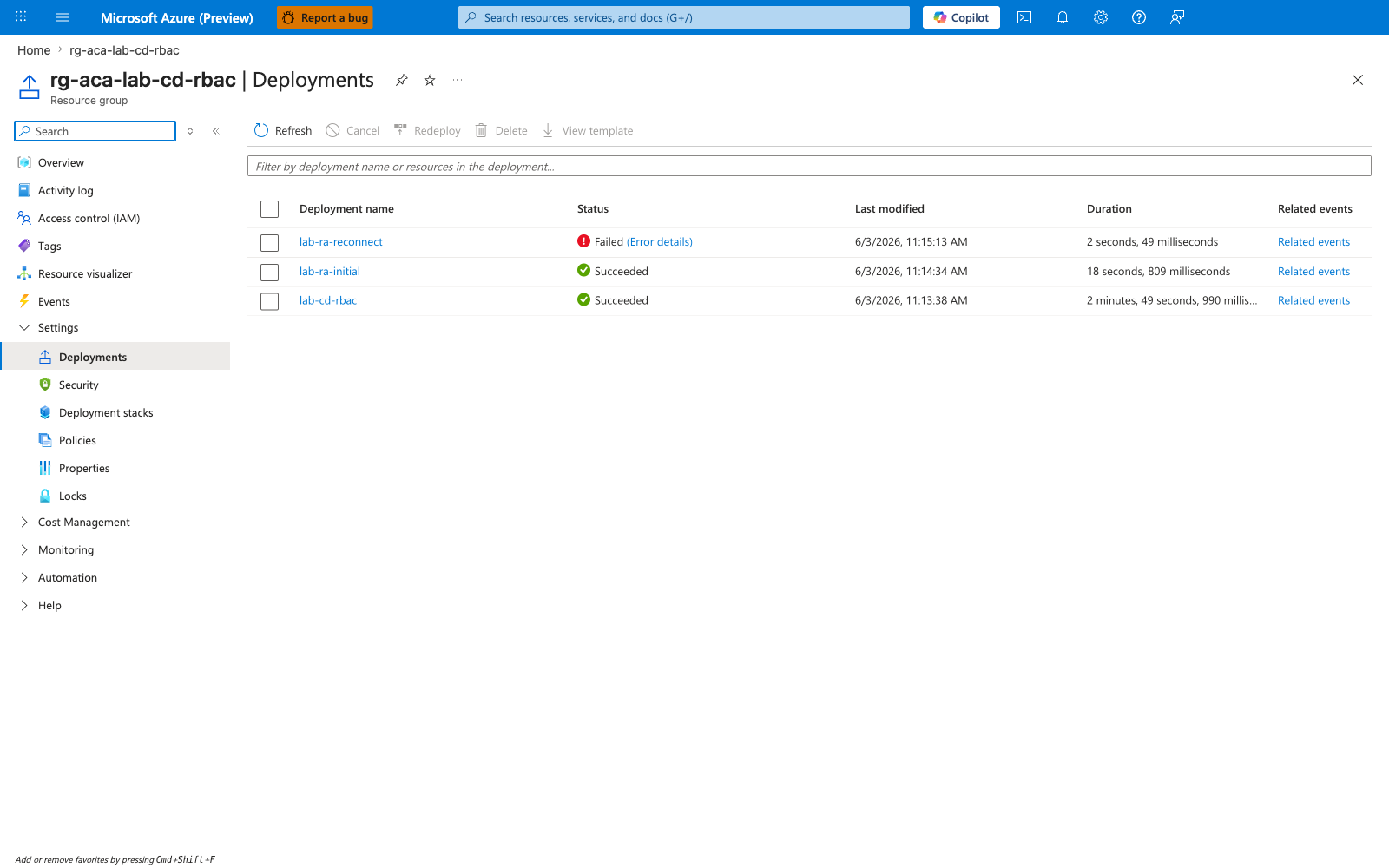
[Observed] The resource group's Deployments blade shows the full sequence of ARM deployments produced by the reproduction: the seed lab-cd-rbac and lab-ra-initial succeeded, then lab-ra-reconnect failed during the simulated reconnect:
[Observed] Opening the failed lab-ra-reconnect deployment surfaces the ARM error banner: "The role assignment already exists. The ID of the existing role assignment is f20aea0020b1586db8fb747527f778c8". The deployment row is marked Failed with status Conflict (HTTP 409).
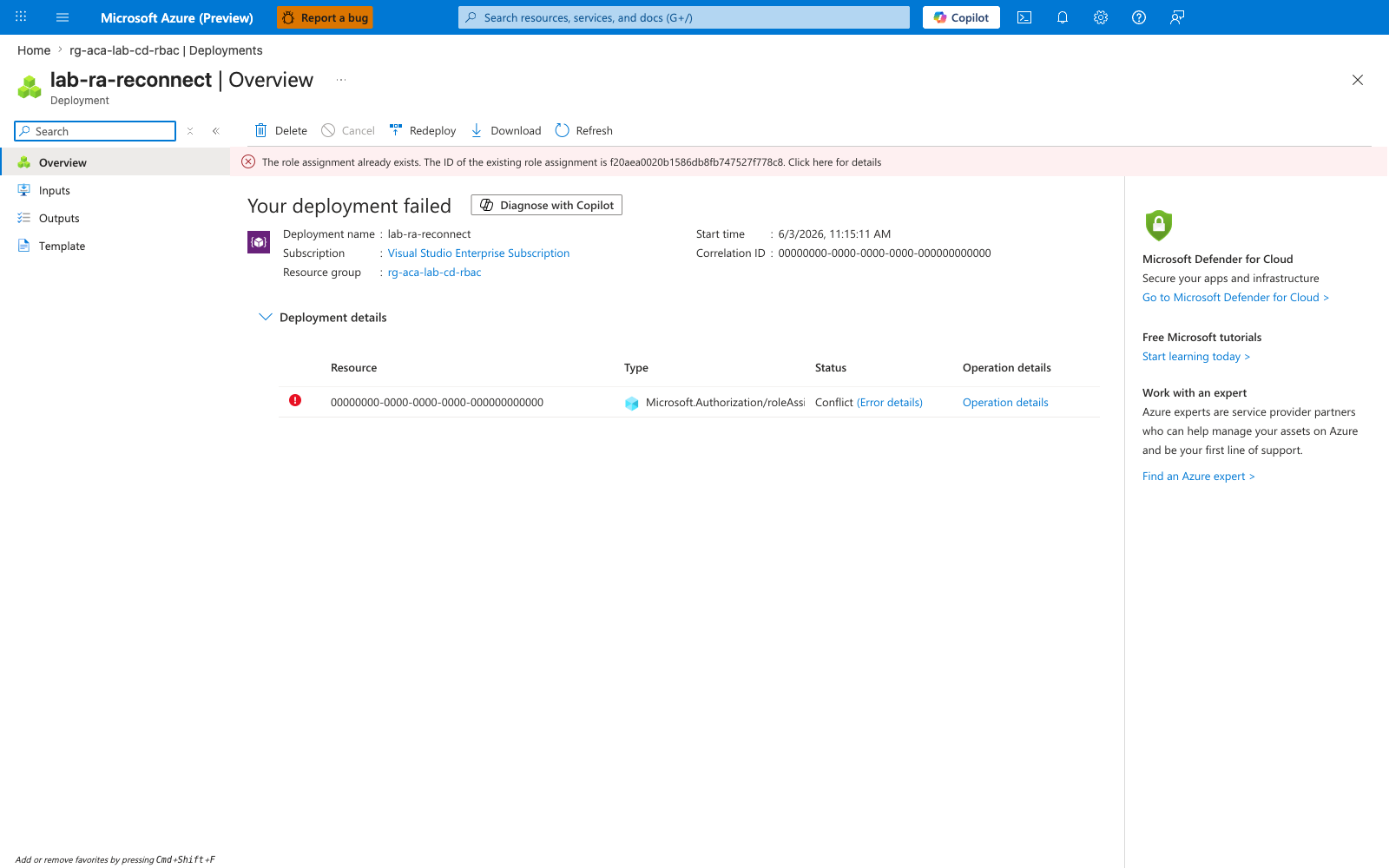
[Inferred] Because the error originates from the Authorization resource provider on the roleAssignments write itself, ARM rejected the deployment at the role-assignment step rather than after creating downstream resources. (Cannot be proven from this capture alone — confirmed via the CLI evidence in the preceding subsection, where the second deployment of infra/role-assignment.bicep fails with the same RoleAssignmentExists code and no other resources are touched.)
[Observed] Navigating to the ACR's Access control (IAM) → Role assignments tab and filtering by github-actions-lab shows exactly one AcrPush assignment held by the simulated CD service principal on the registry scope:
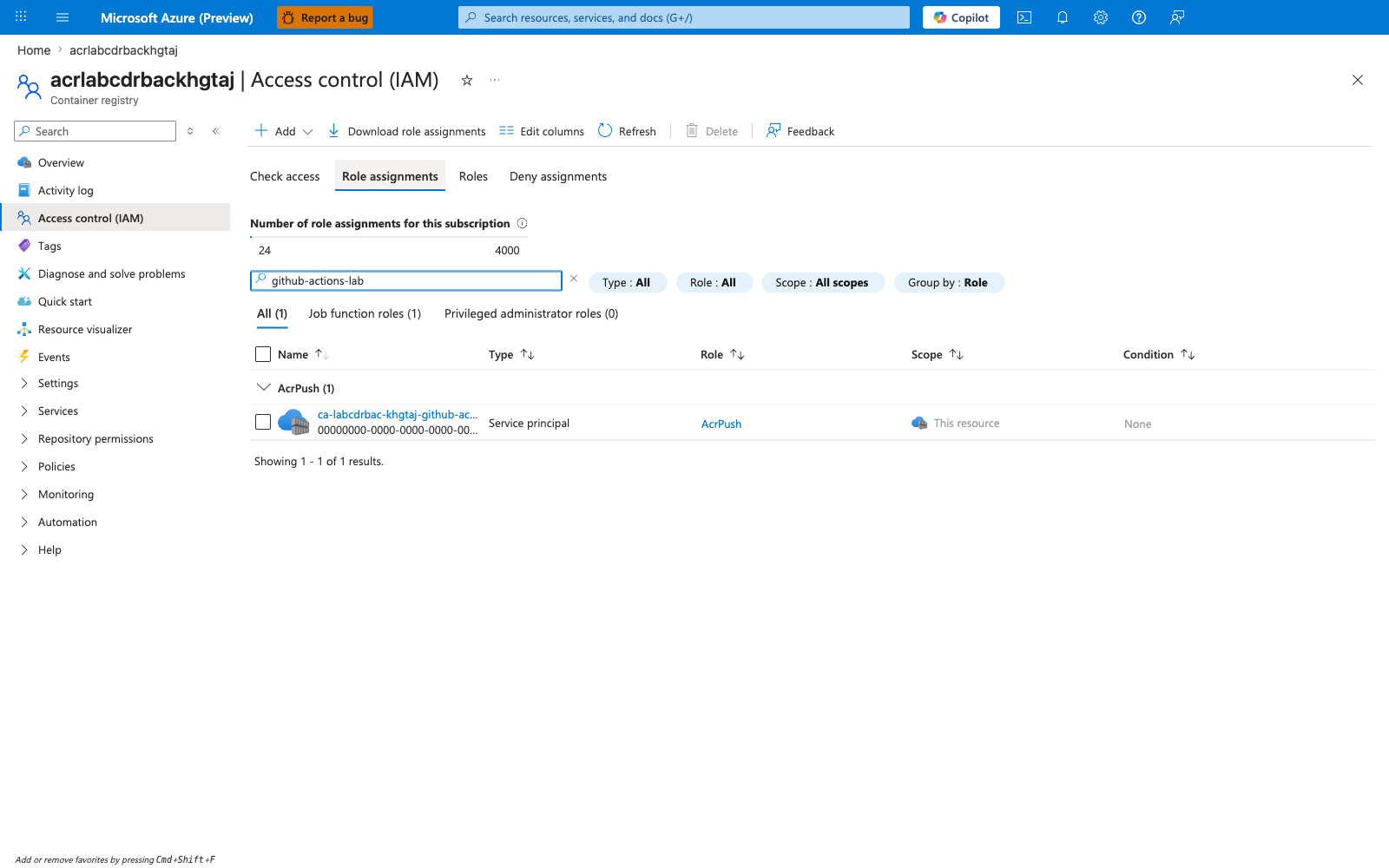
[Inferred] This is the (scope=ACR, principal=SP, role=AcrPush) triple that ARM is trying to re-create in the failed deployment — the uniqueness collision is the proximate cause of the RoleAssignmentExists error.
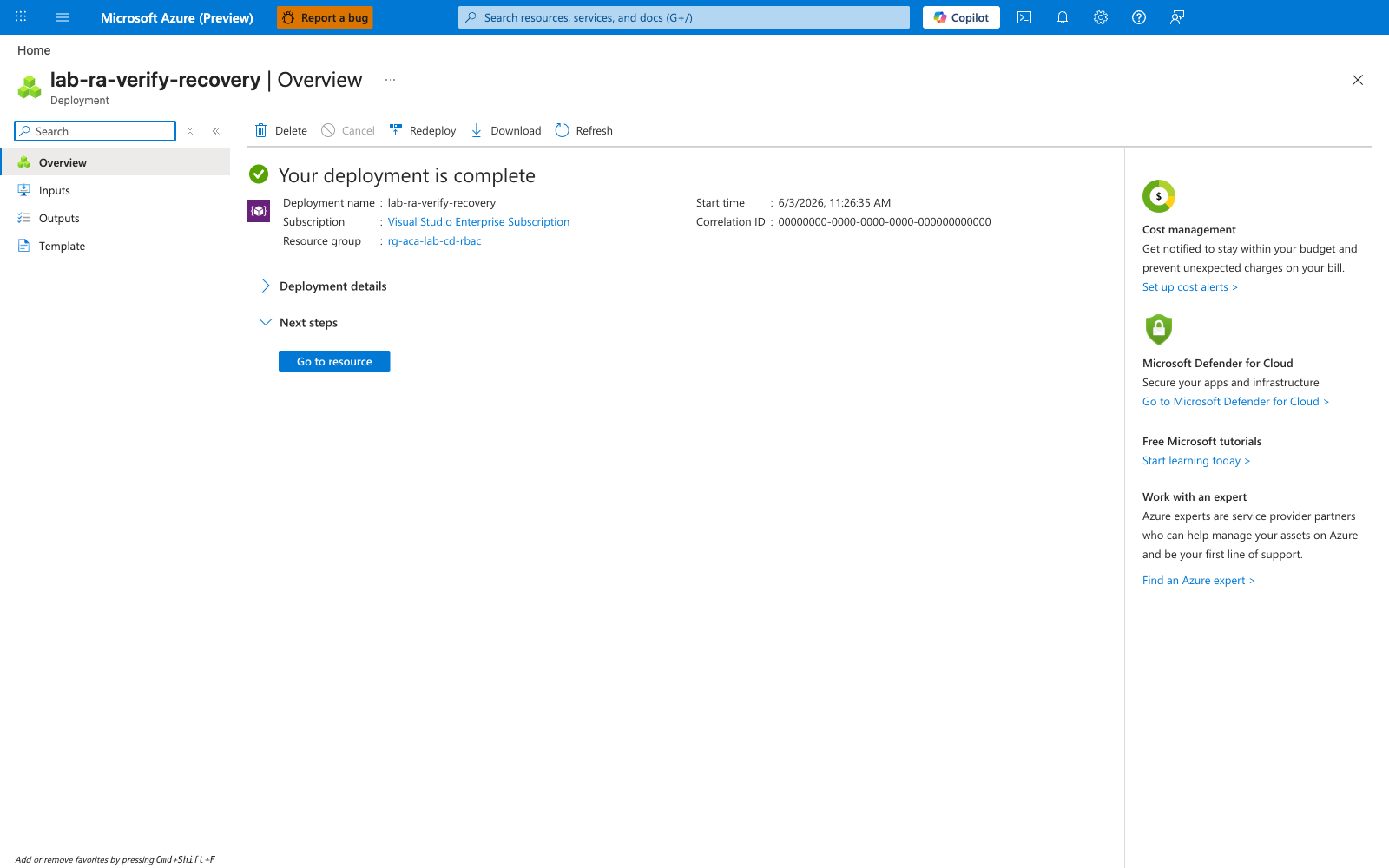
[Observed] After ./verify.sh deletes the orphaned assignment with az role assignment delete --ids ... and re-runs the ARM deployment with the same fresh roleAssignmentName, the lab-ra-verify-recovery deployment shows the green "Your deployment is complete" banner:
[Observed] Returning to ACR IAM with the same github-actions-lab filter shows exactly one active AcrPush assignment for the service principal (not zero, not two) — the post-recovery cardinality is unchanged from the pre-recovery state:
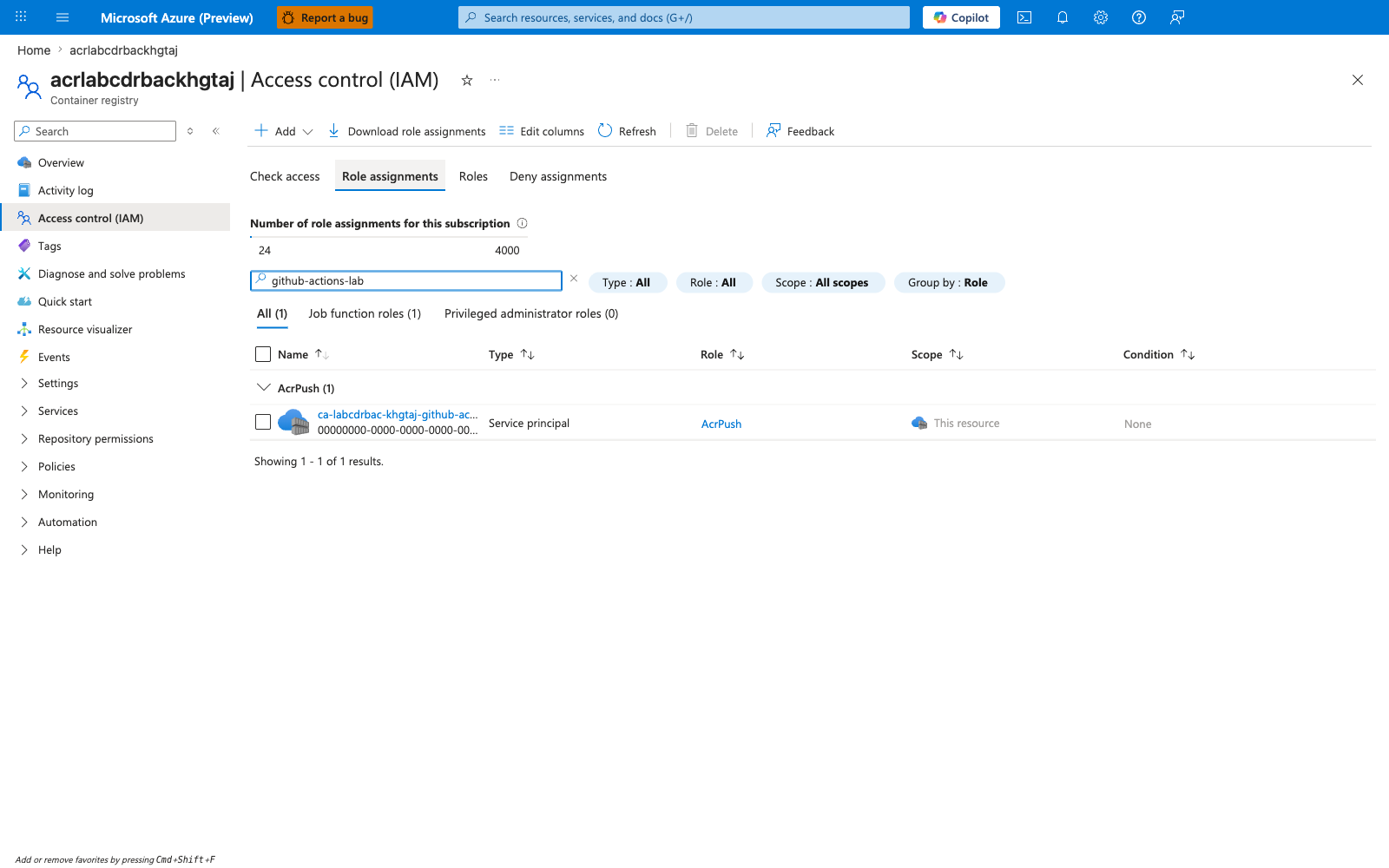
Capture #5 is intentionally visually identical to capture #3
Both captures show a single row with the same PII-rewritten zero-GUID, because the assignment-name GUID is sanitized by the Portal capture helper. The point of capture #5 is to demonstrate cardinality preservation (the recovery did not leave residue and did not double-assign), not to visually distinguish the new assignment from the old one. The underlying GUID difference (old f20aea00-20b1-586d-b8fb-747527f778c8 → new 3dff3c6b-d97c-4a23-a34d-107c9a0af29f) is shown in the CLI evidence above and in verify.sh step 5's output.
[Inferred] The progression Deployments-list → Failed-detail → IAM-before → Recovered-detail → IAM-after is strongly consistent with the hypothesis that a pre-existing (scope, principal, role) triple on the registry is the blocking factor for the ARM Microsoft.Authorization/roleAssignments write, and that az role assignment delete --ids followed by a retry restores convergence. The Portal evidence corroborates the CLI evidence in the preceding subsection; it does not independently exclude other simultaneous blockers (deny assignments, policy assignments, propagation delays), which the ### Falsification checks below are designed to rule out.
Falsification
The hypothesis is falsified if any of the following occur:
- The second ARM deployment succeeds without error → contradicts the RBAC uniqueness constraint on
(scope, principal, role). - Deleting the conflicting assignment does not allow the retried deployment to succeed → suggests a different blocking factor (for example, deny assignment, management lock, or policy assignment).
- The conflict reproduces even when no prior role assignment exists for the principal on the registry scope → suggests an unrelated cause such as a deny assignment or a tenant-wide RBAC policy.
Not a falsifier: ARM-fails / CLI-succeeds asymmetry
A direct az role assignment create with the same (scope, principal, role) triple returning success while the ARM deployment fails does not falsify the hypothesis. Modern Azure CLI is idempotent and returns the existing assignment instead of erroring; ARM enforces the uniqueness constraint at the resource-write level. The asymmetry is expected and is itself supporting evidence for the hypothesis, not a counter-example.
If the trigger script does not produce RoleAssignmentExists on the second deployment, capture /tmp/cd-rbac-conflict.log, confirm the first deployment created the assignment (az role assignment list --assignee "$SP_APP_ID" --scope "$ACR_ID"), and rerun after a 30-second wait to allow RBAC propagation.
Clean Up
The cleanup script removes the service principal, deletes the underlying Microsoft Entra app registration, drops any remaining role assignments held by the principal, and queues the resource group for deletion:
SP_APP_ID=$(az ad sp list --display-name "${APP_NAME}-github-actions-lab" \
    --query "[0].appId" --output tsv | tr -d '\r')
if [ -n "$SP_APP_ID" ] && [ "$SP_APP_ID" != "null" ]; then
    SP_OBJECT_ID=$(az ad sp show --id "$SP_APP_ID" --query id --output tsv | tr -d '\r')
    az role assignment list --assignee "$SP_OBJECT_ID" --all --query "[].id" --output tsv \
        | tr -d '\r' \
        | xargs -r --name 1 az role assignment delete --ids
    az ad sp delete --id "$SP_APP_ID"
    APP_OBJECT_ID=$(az ad app list --display-name "${APP_NAME}-github-actions-lab" \
        --query "[0].id" --output tsv | tr -d '\r')
    [ --name "$APP_OBJECT_ID" ] && az ad app delete --id "$APP_OBJECT_ID"
fi
az group delete --name "$RG" --yes --no-wait
| Command | Why it is used |
|---|---|
az ad sp list ... | Creates or inspects service principal settings for automation identity. |