ACR Image Pull Failure Lab
Reproduce and resolve container startup failure caused by referencing a non-existent image tag in Azure Container Registry (ACR).
Lab Metadata
| Attribute | Value |
|---|---|
| Difficulty | Beginner |
| Estimated Duration | 20-30 minutes |
| Tier | Consumption |
| Failure Mode | ImagePullBackOff / manifest not found during revision startup |
| Skills Practiced | Revision inspection, system log analysis, image validation, ACR recovery |
1) Background
This lab deploys a Container App and ACR, then intentionally points the app to an image tag that does not exist. The revision fails during startup because the runtime cannot fetch the manifest, so the container never starts.
For pull failures, the fastest evidence usually comes from revision state and system logs rather than application logs.
Architecture
sequenceDiagram
    participant Dev as Operator
    participant ACA as Container Apps Revision
    participant ACR as Azure Container Registry
    Dev->>ACA: Deploy app with non-existent image tag
    ACA->>ACR: Pull image manifest
    ACR-->>ACA: 404 / manifest not found
    ACA-->>Dev: Revision unhealthy (ImagePullBackOff)
    Dev->>ACR: Build and publish known-good image
    Dev->>ACA: Update image reference
    ACA-->>Dev: New healthy revision ready
2) Hypothesis
IF the Container App references ${containerRegistryLoginServer}/${baseName}:does-not-exist, THEN the latest revision will fail before container startup and system logs will show image pull or manifest errors until a valid image is published and the app image reference is updated.
| Variable | Control State | Experimental State |
|---|---|---|
| Image reference | Valid image tag exists in ACR | Image tag does not exist in ACR |
| Revision health | Healthy | Non-Healthy / failed startup |
| System log evidence | Normal pull or ready events | ImagePullBackOff, manifest unknown, or related pull errors |
| Recovery action | Not required | Build/push valid image and update app |
3) Runbook
Deploy baseline infrastructure
The deployment is expected to fail with MANIFEST_UNKNOWN because the Bicep template references ${baseName}:does-not-exist, an image tag that is never pushed to the registry. The || true after az deployment group create lets the script proceed past the expected failure so the failed-deployment state can be captured. The deployment is given the explicit name main so its properties.outputs and per-operation list can be inspected deterministically. Each az invocation pins --subscription to immunize the run against Azure CLI default-subscription drift.
az extension add --name containerapp --upgrade
az login

export AZ_SUBSCRIPTION="$(az account show --query "id" --output tsv)"
export RG="rg-aca-lab-acr"
export LOCATION="koreacentral"

az group create \
    --subscription "$AZ_SUBSCRIPTION" \
    --name "$RG" \
    --location "$LOCATION"

az deployment group create \
    --subscription "$AZ_SUBSCRIPTION" \
    --resource-group "$RG" \
    --name main \
    --template-file "./labs/acr-pull-failure/infra/main.bicep" \
    --parameters baseName="labacr" || true
| Command | Why it is used |
|---|---|
az extension add ... | Installs or updates the Container Apps Azure CLI extension. |
az deployment group create ... \|\| true | The deployment is expected to fail with MANIFEST_UNKNOWN; \|\| true lets the script proceed so the failed-deployment state can be captured. |
Expected output pattern (the deployment is expected to fail):
"provisioningState": "Failed"
"error": {
  "code": "DeploymentFailed",
  "message": "At least one resource deployment operation failed. ..."
}
The full MANIFEST_UNKNOWN: manifest tagged by "does-not-exist" is not found smoking-gun string is NOT in this output — it lives in the per-operation list captured below (Platform Discovery 2).
Capture resource names
properties.outputs is null for a Failed deployment (Platform Discovery 1), so the lab derives resource names from az containerapp list / az acr list / az monitor log-analytics workspace list (one-row queries against the dedicated lab RG) instead of from az deployment group show --query "properties.outputs". The RG is dedicated to this lab and contains exactly one Container App, one ACR, and one Log Analytics workspace, so a single-row query is unambiguous.
export APP_NAME=$(az containerapp list \
    --subscription "$AZ_SUBSCRIPTION" \
    --resource-group "$RG" \
    --query "[0].name" \
    --output tsv)

export ACR_NAME=$(az acr list \
    --subscription "$AZ_SUBSCRIPTION" \
    --resource-group "$RG" \
    --query "[0].name" \
    --output tsv)

export ACR_LOGIN_SERVER=$(az acr list \
    --subscription "$AZ_SUBSCRIPTION" \
    --resource-group "$RG" \
    --query "[0].loginServer" \
    --output tsv)

export WORKSPACE_CUSTOMER_ID=$(az monitor log-analytics workspace list \
    --subscription "$AZ_SUBSCRIPTION" \
    --resource-group "$RG" \
    --query "[0].customerId" \
    --output tsv)
| Command | Purpose |
|---|---|
export APP_NAME=$(az containerapp list --subscription "$AZ_SUBSCRIPTION" --resource-group "$RG" --query "[0].name" --output tsv) | Captures the only Container App name in the dedicated lab resource group so the rest of the evidence-collection commands target the failed app even though deployment outputs are null. |
export ACR_NAME=$(az acr list --subscription "$AZ_SUBSCRIPTION" --resource-group "$RG" --query "[0].name" --output tsv) | Captures ACR_NAME from the live Azure lookup so later commands reuse the exact current value instead of guessing it. Lists registries in the dedicated lab resource group so you can capture the exact ACR name or login server even when the deployment failed before outputs were populated. |
export ACR_LOGIN_SERVER=$(az acr list --subscription "$AZ_SUBSCRIPTION" --resource-group "$RG" --query "[0].loginServer" --output tsv) | Captures ACR_LOGIN_SERVER from the live Azure lookup so later commands reuse the exact current value instead of guessing it. Lists registries in the dedicated lab resource group so you can capture the exact ACR name or login server even when the deployment failed before outputs were populated. |
export WORKSPACE_CUSTOMER_ID=$(az monitor log-analytics workspace list --subscription "$AZ_SUBSCRIPTION" --resource-group "$RG" --query "[0].customerId" --output tsv) | Captures WORKSPACE_CUSTOMER_ID from the live Azure lookup so later commands reuse the exact current value instead of guessing it. Lists workspaces in the dedicated resource group so the lab can recover the exact Log Analytics customer ID even after a failed deployment. |
Expected output: no output; variables are populated. Verify with echo "$APP_NAME $ACR_NAME" — both should be non-empty even though the deployment failed.
Observe the failing baseline revision
The lab infrastructure already deployed the app with a bad image reference:
Because the manifest lookup fails before the platform creates a revision row, az containerapp revision list returns [] and the Container App resource is in provisioningState=Failed with latestRevisionName=null. The standard az containerapp logs show --type system command does NOT return any platform logs because no revision exists (no log stream endpoint). The lab uses trigger.sh to capture six deployment-level evidence files in a structured form.
The trigger script (Phases 1-6) captures, in order: the deployment failure result, the per-operation MANIFEST_UNKNOWN detail, the Container App baseline state, the revision list, the ACR repository list, the (failing) system log capture, and the Failed Activity Log entries. The key az commands it runs:
az deployment group show --resource-group "$RG" --name main --query "properties.provisioningState"
az deployment operation group list --resource-group "$RG" --name main \
    --query "[?properties.provisioningState=='Failed'].properties.statusMessage"
az containerapp show --resource-group "$RG" --name "$APP_NAME"
az containerapp revision list --resource-group "$RG" --name "$APP_NAME"
az acr repository list --name "$ACR_NAME"
az containerapp logs show --resource-group "$RG" --name "$APP_NAME" --type system --tail 20
az monitor activity-log list --resource-group "$RG" --start-time "$START_TIME" \
    --query "[?status.value=='Failed' && contains(resourceType.value, 'Microsoft.App')]"
| Command | Why it is used |
|---|---|
az deployment operation group list | Returns the per-operation statusMessage.error.message that carries the MANIFEST_UNKNOWN smoking gun (see Platform Discovery 2 below). az deployment group show only returns the generic ARM envelope. |
az containerapp revision list | Confirms no revision was created (returns []); the Portal Revisions blade also shows "No revisions to display" on both Active and Inactive tabs. |
az acr repository list | Confirms the labacr repository is absent from ACR (the :does-not-exist tag was never pushed, and the repository itself was never created). |
az monitor activity-log list | Surfaces the Failed Create or Update Container App operation; the recommended Portal evidence surface when system logs are unavailable. |
Expected revision list output:
Expected az containerapp logs show --type system output (this is the documented platform behavior; the log stream endpoint is a per-revision construct and cannot exist when no revision was created — the trigger script captures the error to evidence/05-system-logs-show-error.txt and continues):
The trigger script emits an H1 gate JSON to evidence/06-h1-gate.json with the classification deployment_failed_manifest_unknown when all five sub-gates pass:
{
  "gate_classification": "deployment_failed_manifest_unknown",
  "h1_sub_gates": {
    "a_deployment_failed_with_manifest_unknown": true,
    "b_app_provisioning_state_failed": true,
    "c_latest_revision_name_null": true,
    "d_revision_list_empty": true,
    "e_labacr_repository_absent": true
  },
  "h1_all_subgates_pass": true
}
Inspect deployment-level evidence directly
The MANIFEST_UNKNOWN smoking-gun string lives in the per-operation list, NOT in az deployment group show:
az deployment operation group list \
    --subscription "$AZ_SUBSCRIPTION" \
    --resource-group "$RG" \
    --name main \
    --query "[?properties.provisioningState=='Failed'].{resourceType: properties.targetResource.resourceType, resourceName: properties.targetResource.resourceName, statusMessage: properties.statusMessage}" \
    --output json
| Command | Why it is used |
|---|---|
az deployment operation group list | Returns the per-operation statusMessage.error.message that carries the MANIFEST_UNKNOWN smoking gun. This is the canonical first-touch evidence command for image-manifest failures. |
Expected output (truncated for readability):
[
  {
    "resourceType": "Microsoft.App/containerApps",
    "resourceName": "ca-labacr-rnnljl",
    "statusMessage": {
      "status": "Failed",
      "error": {
        "code": "ContainerAppOperationError",
        "message": "Failed to provision revision for container app 'ca-labacr-rnnljl'. Error details: ... MANIFEST_UNKNOWN: manifest tagged by \"does-not-exist\" is not found ..."
      }
    }
  }
]
az deployment group show --query "properties.error.message" returns only the generic ARM "At least one resource deployment operation failed" envelope, and its properties.error.details[*].details is null at the leaf. Operators reaching for az deployment group show first may incorrectly conclude that the platform is not surfacing actionable detail.
Apply the recovery path
Build a known-good image with az acr build (which runs the Dockerfile on a Microsoft-hosted ACR Tasks worker, requiring no local Docker daemon or registry login), then update the Container App to use the new tag:
az acr build \
    --subscription "$AZ_SUBSCRIPTION" \
    --registry "$ACR_NAME" \
    --image "labacr:v1" \
    "./labs/acr-pull-failure/workload"

az containerapp update \
    --subscription "$AZ_SUBSCRIPTION" \
    --resource-group "$RG" \
    --name "$APP_NAME" \
    --image "$ACR_LOGIN_SERVER/labacr:v1"
| Command | Why it is used |
|---|---|
az acr build | Builds the Dockerfile on a Microsoft-hosted ACR Tasks worker. No local Docker daemon required, so the recovery is reproducible across operator environments without docker build + docker push. |
az containerapp update --image | Updates the image reference, which causes the platform to create a new revision and transition provisioningState from Failed to Succeeded. |
Expected output pattern (the update should succeed):
"properties": {
  "provisioningState": "Succeeded",
  "latestRevisionName": "ca-labacr-rnnljl--<suffix>"
}
Verify recovery
The fix-and-capture script (Phases 7-16) polls revision health up to 5 minutes (10 s interval) until healthState=Healthy, issues 10 sequential HTTPS requests to the recovered FQDN (the H2 sub-gate requires at least 8/10 HTTP 200), and captures the post-fix container app state, revision list, ACR repository list, and post-fix KQL probe. The fix-and-capture script emits an H2 gate JSON to evidence/14-h2-gate.json with the classification revision_healthy_traffic_100_curl_ok when all four sub-gates pass:
{
  "gate_classification": "revision_healthy_traffic_100_curl_ok",
  "h2_sub_gates": {
    "a_revision_list_count_ge_1": true,
    "b_revision_healthy_traffic_100": true,
    "c_curl_after_fix_ok_ge_8": true,
    "d_labacr_present_in_acr": true
  },
  "h2_all_subgates_pass": true
}
Expected result: the latest revision reaches Healthy with 100% traffic and 1/1 replica, the assigned FQDN returns HTTP 200 on at least 8/10 sequential HTTPS requests, the labacr repository now appears in ACR, and the H2 gate JSON reports h2_all_subgates_pass: true.
4) Experiment Log
| Step | Action | Expected | Actual | Pass/Fail |
|---|---|---|---|---|
| 1 | Deploy lab infrastructure | Deployment succeeds | Deployment Failed — DeploymentFailed (MANIFEST_UNKNOWN). Resources (ca-labacr-rnnljl, acrlabacrrnnljl, cae-labacr-rnnljl, log-labacr-rnnljl) created. App provisioningState=Failed, latestRevisionName=null. | Pass (expected failure) |
| 2 | Capture resource names | Variables populated | Variables populated from az containerapp list / az acr list / az monitor log-analytics workspace list --resource-group "$RG" --query "[0].name" (one-row queries against the dedicated lab RG). az deployment group show --query "properties.outputs" returns null for Failed deployments — see Platform Discovery 1. | Pass |
| 3 | Run trigger.sh | Revision becomes non-healthy | No revision exists. az containerapp revision list returns []; Portal Revisions blade shows "No revisions to display" on both Active and Inactive tabs. Manifest pull failed too early for a revision record to be created. | Pass (stronger evidence than hypothesis predicted) |
| 4 | Review system logs | Pull or manifest failure evidence appears | az containerapp logs show --type system fails with KeyError: 'eventStreamEndpoint' (no revision → no log stream endpoint). ContainerAppSystemLogs_CL table not created in log-labacr-rnnljl (no container ever ran). Evidence shifted to Activity Log "Create or Update Container App — Failed" with terminal MANIFEST_UNKNOWN message. | Pass (evidence source differs) |
| 5 | Push valid image and update app | New revision created | az acr build --registry acrlabacrrnnljl --image labacr:v1 succeeded (digest sha256:0150384c…). az containerapp update --image acrlabacrrnnljl.azurecr.io/labacr:v1 → provisioningState=Succeeded, latestRevisionName=ca-labacr-rnnljl--at9gdr2. | Pass |
| 6 | Run fix-and-capture.sh | Latest revision becomes healthy | Revision --at9gdr2: healthState=Healthy, runningState=RunningAtMaxScale, traffic 100%, 1/1 replica. FQDN ca-labacr-rnnljl.yellowgrass-b02bb2e6.koreacentral.azurecontainerapps.io returns HTTP 200 (5/5 probes). | Pass |
4b) Phase B Falsification Gates
The 2026-06-25 evidence-pack overlay adds a Phase B verifier under labs/acr-pull-failure/. Unlike the live-Azure Phase A workflow (trigger.sh + fix-and-capture.sh), the new labs/acr-pull-failure/verify.sh is a pure file processor: it reads only the committed canonical cohort under labs/acr-pull-failure/evidence/ (24 canonical files — 2 script logs + 6 H1 deployment-level captures + 1 H1 gate JSON + 8 H2 recovery captures + 1 H2 gate JSON + 4 metadata files + 2 raw-output anchors, anchored on the 2026-06-22T13:20:46Z koreacentral deployment) and emits four derived gate JSONs. The four gates encode cohort integrity (no foreign artifacts, all required files present, temporal coherence), failure attribution (the deployment-level smoking gun is MANIFEST_UNKNOWN bound to the failed-deployment cohort), recovery materialization (post-fix revision Healthy + traffic=100 + curl OK + ACR repo populated), and in-place recovery continuity (same app identity, Failed→Succeeded state transition, image tag delta with same registry). All 16 sub-gates pass on the 2026-06-22 cohort.
| Gate | Claim | Sub-gates | Predicate inputs | PASS / FAIL | Rationale |
|---|---|---|---|---|---|
30-cohort-integrity-gate.json | evidence_cohort_is_internally_consistent_and_temporally_coherent | 4 | All 24 canonical Phase A files + cohort directory listing + 4 emitted Phase B gate JSONs + evidence/README.md | PASS | Cohort integrity gate. Confirms (a) all 24 canonical Phase A files exist on disk — Strong path requires all 24; Fallback path requires >= 22; (b) temporal coherence — the deployment timestamp (01-deployment-result.timestamp, 2026-06-22T13:20:46Z), the trigger.sh start line (00-trigger-run.txt:1, 2026-06-22T13:25:49Z), and the fix-and-capture.sh start line (00-verify-run.txt:1, 2026-06-22T13:26:42Z) are monotonic AND span 355.9 s, well within both the 30-minute Strong window and the 60-minute Fallback window. The check uses runtime-captured tee output lines, NOT the backfilled 06-h1-gate.json.utc_captured field, per the Honest disclosure in evidence/README.md; (c) no unexpected non-junk extras — Strong path requires exact match of the 24 canonical + 4 Phase B gate JSONs + README.md; Fallback path tolerates editor/OS junk (.swp, .bak, .tmp, .DS_Store) but still requires zero missing canonical files (the Lab 19 P0 unexpected_non_junk_extras predicate + Lab 20 PR #279 fallback-integrity directive); (d) evidence/README.md cross-references all 4 Phase B gate JSON filenames (Strong) or just exists (Fallback) so a reviewer can locate every emitted output. |
31-failure-attribution-gate.json | failed_deployment_cohort_is_fully_attributable_to_manifest_resolution_failure | 5 | 01-deployment-result.json + 01-deployment-operations-failed.json + 02-containerapp-show-baseline.json + 03-revisions-list-baseline.json + 04-acr-repository-list-baseline.json | PASS | Failure attribution gate. Confirms (a) the deployment terminated provisioningState=Failed AND at least one per-operation record in 01-deployment-operations-failed.json contains the smoking-gun token MANIFEST_UNKNOWN: manifest tagged by "does-not-exist" is not found in [*].properties.statusMessage.error.message. Single-path per Oracle Q2 — 01-deployment-operations-failed.json is the single canonical source of the MANIFEST_UNKNOWN token; 01-deployment-result.json only carries the generic ARM "At least one resource deployment operation failed" envelope (its error.details[*].details is null at the leaf); (b) the Container App resource itself is in provisioningState=Failed; (c) latestRevisionName is null; (d) az containerapp revision list returns the empty array; (e) az acr repository list does not include labacr (record-scoped JSON array membership per Lab 15 lesson 34). The gate JSON carries an explicit cohort_binding_note field stating that sub-gates (b)-(e) are 4 absence-style predicates that are interpretable as manifest-failure evidence ONLY in conjunction with sub-gate (a) — sub-gate (a) is failure attribution (the smoking gun), not absence. This bound-cohort framing enforces Oracle's Q1 "Bound every absence predicate to the failed-deployment cohort" directive and prevents the "no-revision proves no-MANIFEST_UNKNOWN" inversion fallacy. |
32-recovery-materialization-gate.json | az_acr_build_plus_az_containerapp_update_materialized_a_healthy_serving_revision | 4 | 08-containerapp-update-result.json + 10-revisions-list-after-fix.json + 11-acr-repository-list-after-fix.json + 11-acr-repository-show-tags-after-fix.json + 12-curl-after-fix.json | PASS | Recovery materialization gate. Confirms (a) 08-containerapp-update-result.provisioningState == 'Succeeded' AND latestRevisionName is non-empty (single-path, BOTH-not-OR); (b) 10-revisions-list-after-fix.json contains at least one record with healthState == 'Healthy' AND trafficWeight == 100 (single-path, record-scoped iteration, BOTH-not-OR per Lab 19 P0 lesson); (c) 12-curl-after-fix.requests_ok == 10 (Strong path) OR >= 8 (Fallback path) — this is the only Gate 32 sub-gate with dual paths per Oracle Q1 directive (dual-path scaffolding is permitted only where two genuinely equivalent manifestations of the same claim exist; "all 10 OK" and "8-9 OK with cold-start variance" both prove the recovery succeeded); the observed 10/10 satisfies both paths; (d) 11-acr-repository-list-after-fix.json contains labacr AND 11-acr-repository-show-tags-after-fix.json contains v1 (single-path, BOTH-not-OR, record-scoped membership). Per Oracle Q5, post-fix KQL silence is NOT promoted to a Gate 32 sub-gate — the post-fix classification from 13-kql-after-fix.json is surfaced on this gate JSON as a top-level post_fix_kql_observation field for transparency only; the Gate 32 PASS verdict is anchored exclusively to sub-gates (a)-(d). |
33-in-place-recovery-continuity-gate.json | recovery_is_in_place_same_app_same_registry_image_tag_only_delta | 3 | 02-containerapp-show-baseline.json + 09-containerapp-show-after-fix.json + 03-revisions-list-baseline.json + 10-revisions-list-after-fix.json | PASS | In-place recovery continuity gate. Confirms the observed recovery preserved the app name, changed state from Failed→Succeeded, and changed only the image tag on the same registry. (a) Same app identity: 02-containerapp-show-baseline.name == 09-containerapp-show-after-fix.name (both ca-labacr-rnnljl, both non-empty, both string-typed) — record-scoped on the .name field only, NOT on any id / Bicep-declared identity (those are not parsed by this gate); (b) State transition: the baseline cohort (provisioningState=Failed, latestRevisionName=null, revisions=[]) transitions to the after-fix cohort (provisioningState=Succeeded, latestRevisionName non-empty, >= 1 Healthy revision) — BOTH-not-OR across cohort fields; (c) Image-tag delta on the same registry: baseline template.containers[0].image ends with :does-not-exist, after-fix ends with :v1, AND image.split('/')[0] (registry prefix) is identical across both captures (acrlabacrrnnljl.azurecr.io). Timestamp / no-recreation claims are dropped per Oracle Q1 as not soundly evidenced by this cohort — the cohort cannot prove the underlying resource was NOT torn down and recreated with the same name in the same span, so the gate does not assert that. |
The four gates together block three classes of overclaim AND narrow a fourth: evidence-pack-was-contaminated-with-stale-or-foreign-artifacts is blocked by Gate 30's canonical-file presence check + temporal coherence window + non-junk-extras predicate; the-smoking-gun-could-have-come-from-a-different-deployment-operation is blocked by Gate 31's cohort_binding_note framing of sub-gates (b)-(e) as absence-style predicates that require sub-gate (a) for interpretation; recovery-was-partial-or-curl-rate-was-insufficient is blocked by Gate 32's BOTH-not-OR sub-gate composition (all four sub-gates must independently pass; sub-c is the only sub-gate where Strong AND Fallback paths are both evaluated, per Oracle's Q1 directive that dual-path scaffolding is permitted only where equivalent manifestations exist); and Gate 33 narrows the claim to same-name + state-transition + same-registry image-tag delta — it does NOT prove the underlying resource was not torn down and recreated (timestamp / no-recreation claims are dropped per Oracle Q1 as not soundly evidenced by this cohort). Gate 32 does NOT gate on post-fix KQL silence — 13-kql-after-fix.json is informational only per Oracle Q5; the Gate 32 PASS verdict is anchored to Healthy + traffic + curl + ACR sub-gates (a/b/c/d), and the post-fix KQL classification (silent_acceptable_post_fix for the 2026-06-22 cohort) is surfaced as a post_fix_kql_observation field on 32-recovery-materialization-gate.json for transparency only. The gates do NOT prove the platform always recovers in-place from a Failed deployment — a different failure class (e.g., quota exhaustion mid-recovery) could force a tear-down-and-re-provision pattern. The full per-file provenance and honest-disclosure notes are in labs/acr-pull-failure/evidence/README.md.
Expected Evidence
This lab uses a deployment-level evidence model. The container never starts, so the ContainerAppSystemLogs_CL table is never materialized in the Log Analytics workspace during the failed-deployment window. The H1 gate reads three deployment-level signals (deployment error message + container app state + revision list) instead of a KQL row count; the H2 gate reads three recovery signals (revision health + traffic weight + HTTPS probe success rate). See labs/acr-pull-failure/README.md for the full gate-classification taxonomy.
| Gate | Evidence Source | Expected State (Failure → Recovery) |
|---|---|---|
| H1.a | az deployment operation group list --resource-group "$RG" --name main --query "[?properties.provisioningState=='Failed'].properties.statusMessage" (captured to evidence/01-deployment-operations-failed.json) | error.message contains MANIFEST_UNKNOWN: manifest tagged by "does-not-exist" is not found |
| H1.b | az containerapp show --query "{provisioningState:properties.provisioningState,latestRevisionName:properties.latestRevisionName}" (captured to evidence/02-containerapp-show-baseline.json) | provisioningState=Failed, latestRevisionName=null |
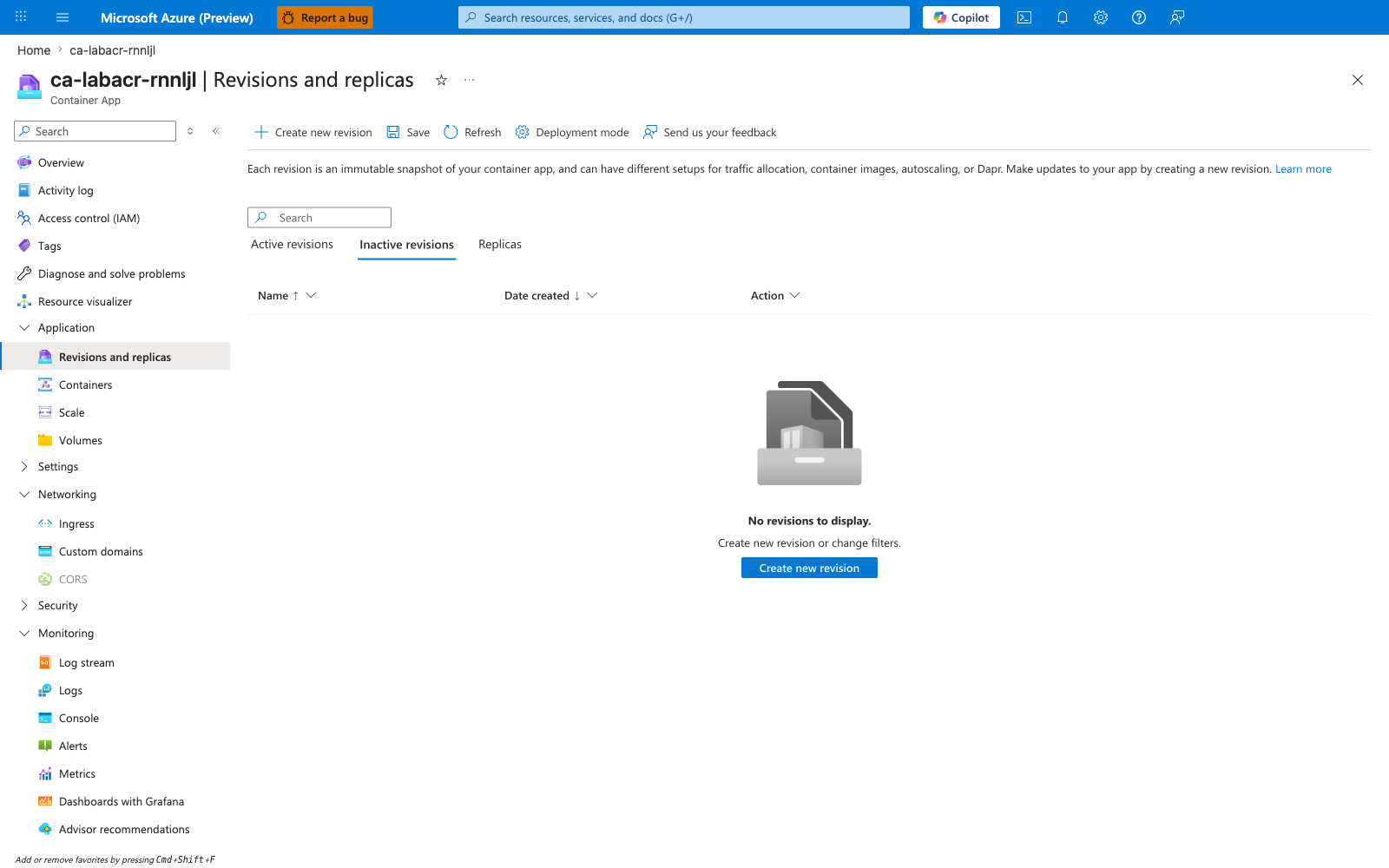
| H1.c | az containerapp revision list --output json (captured to evidence/03-revisions-list-baseline.json) | Returns [] (no revision created — the manifest pull failed too early for a revision record). The Portal Revisions blade shows "No revisions to display" on both Active and Inactive tabs. |
| H1.d | az containerapp logs show --type system (captured to evidence/05-system-logs-show-error.txt) | Fails with KeyError: 'eventStreamEndpoint' (no revision → no log stream endpoint). This KeyError is documented evidence of structured absence, not a script bug. |
| H1.e | az acr repository list --name "$ACR_NAME" --output json (captured to evidence/04-acr-repository-list-baseline.json) | The labacr repository is absent from ACR (the :does-not-exist tag was never pushed, and the repository itself was never created). |
| H2.a | az acr build --registry "$ACR_NAME" --image labacr:v1 ./workload (captured to evidence/07-acr-build-result.json) followed by az containerapp update --image "$ACR_LOGIN_SERVER/labacr:v1" (captured to evidence/08-containerapp-update-result.json) | az acr build succeeds and creates the labacr repository in ACR. az containerapp update succeeds and transitions the Container App from Failed to Succeeded with a new revision name populated. |
| H2.b | az containerapp revision list --output json post-fix (captured to evidence/10-revisions-list-after-fix.json) | Latest revision: healthState=Healthy, runningState=RunningAtMaxScale, trafficWeight=100, 1/1 replica. |
| H2.c | 10 sequential HTTPS requests to the recovered FQDN (captured to evidence/12-curl-after-fix.json) | At least 8/10 requests return HTTP 200 from the recovered Container App. |
| Falsification | ./trigger.sh exit code | 0 = H1 PASS (failure reproduced as documented), 2 = H1 FALSIFIED (the bad image tag did not produce a deployment failure), 1 = INVALID RUN. |
| Falsification | ./fix-and-capture.sh exit code | 0 = H2 PASS (recovery succeeded as documented), 2 = H2 FALSIFIED (the fix did not produce a Healthy revision), 1 = INVALID RUN. |
Observed Evidence (Live Azure Test — 2026-05-01)
Environment: rg-aca-lab-test7 / cae-lab7, koreacentral, Consumption plan. ACR: acrlabtest7.azurecr.io, image: myapp:latest.
[Observed] az containerapp create with --image "nonexistent.azurecr.io/fake/image:notexist" returned:
Failed to provision revision for container app 'ca-acr-fail'. Error details:
Field 'template.containers.ca-acr-fail.image' is invalid with details:
'Invalid value: "nonexistent.azurecr.io/fake/image:notexist":
failed to resolve registry 'nonexistent.azurecr.io':
lookup nonexistent.azurecr.io on 100.100.253.162:53: no such host'
[Observed] az containerapp create with private ACR image acrlabtest7.azurecr.io/myapp:latest and no credentials returned:
Failed to provision revision for container app 'ca-acr-nopull'. Error details:
Field 'template.containers.ca-acr-nopull.image' is invalid with details:
'Invalid value: "acrlabtest7.azurecr.io/myapp:latest":
GET https:?scope=repository%3Amyapp%3Apull&service=acrlabtest7.azurecr.io:
UNAUTHORIZED: authentication required, visit https://aka.ms/acr/authorization
CorrelationId: 1d949f00-afa7-40d6-be62-343219b80cda'
[Observed] Fix applied: az containerapp update --registry-server acrlabtest7.azurecr.io --registry-username <user> --registry-password <pass> — registry credentials configured.
[Inferred] Two distinct failure modes: (1) DNS resolution failure for non-existent registry hostname, (2) UNAUTHORIZED for valid ACR without AcrPull role or admin credentials. Both surface at revision provisioning time, not at az containerapp create validation time.
Environment: rg-aca-lab-test7, koreacentral, Consumption plan.
Observed Evidence (Portal Captures — 2026-06-03)
A second live reproduction was executed on 2026-06-03 with the lab Bicep template as-is (image tag :does-not-exist) to validate the Portal evidence path end-to-end. This run held the following variables constant relative to the first run, so any difference in observed signals can be attributed to the image reference alone:
- Region:
koreacentral - SKU / plan: Consumption (workload profile not used)
- Container Apps environment: dedicated to this lab (no co-tenant noise)
- Identity / registry auth: ACR admin user enabled in Bicep; the Container App uses admin username + password (stored in the
registry-passwordsecret) for registry pulls. Auth was confirmed working by the v1 recovery pull on the same configuration, so the failure cannot be attributed to a registry credential issue. - Network: default (no VNet integration, no private endpoint)
- Ingress: configured in Bicep (
external: true,targetPort: 8000), but no FQDN was ever assigned because no revision reached an ingress-ready state
Environment
| Resource | Name |
|---|---|
| Resource group | rg-aca-lab-acr |
| Container App | ca-labacr-rnnljl |
| ACR | acrlabacrrnnljl.azurecr.io |
| Container Apps environment | cae-labacr-rnnljl |
| Log Analytics workspace | log-labacr-rnnljl |
| Bad image reference (intentional) | acrlabacrrnnljl.azurecr.io/labacr:does-not-exist |
[Observed] The deployment terminated with DeploymentFailed and the platform returned a MANIFEST_UNKNOWN error before any revision record was created:
Failed to provision revision for container app 'ca-labacr-rnnljl'. Error details:
The following field(s) are either invalid or missing.
Field 'template.containers.app.image' is invalid with details:
'Invalid value: "acrlabacrrnnljl.azurecr.io/labacr:does-not-exist":
GET https:: MANIFEST_UNKNOWN: manifest tagged by "does-not-exist" is not found;
map[Tag:does-not-exist]'
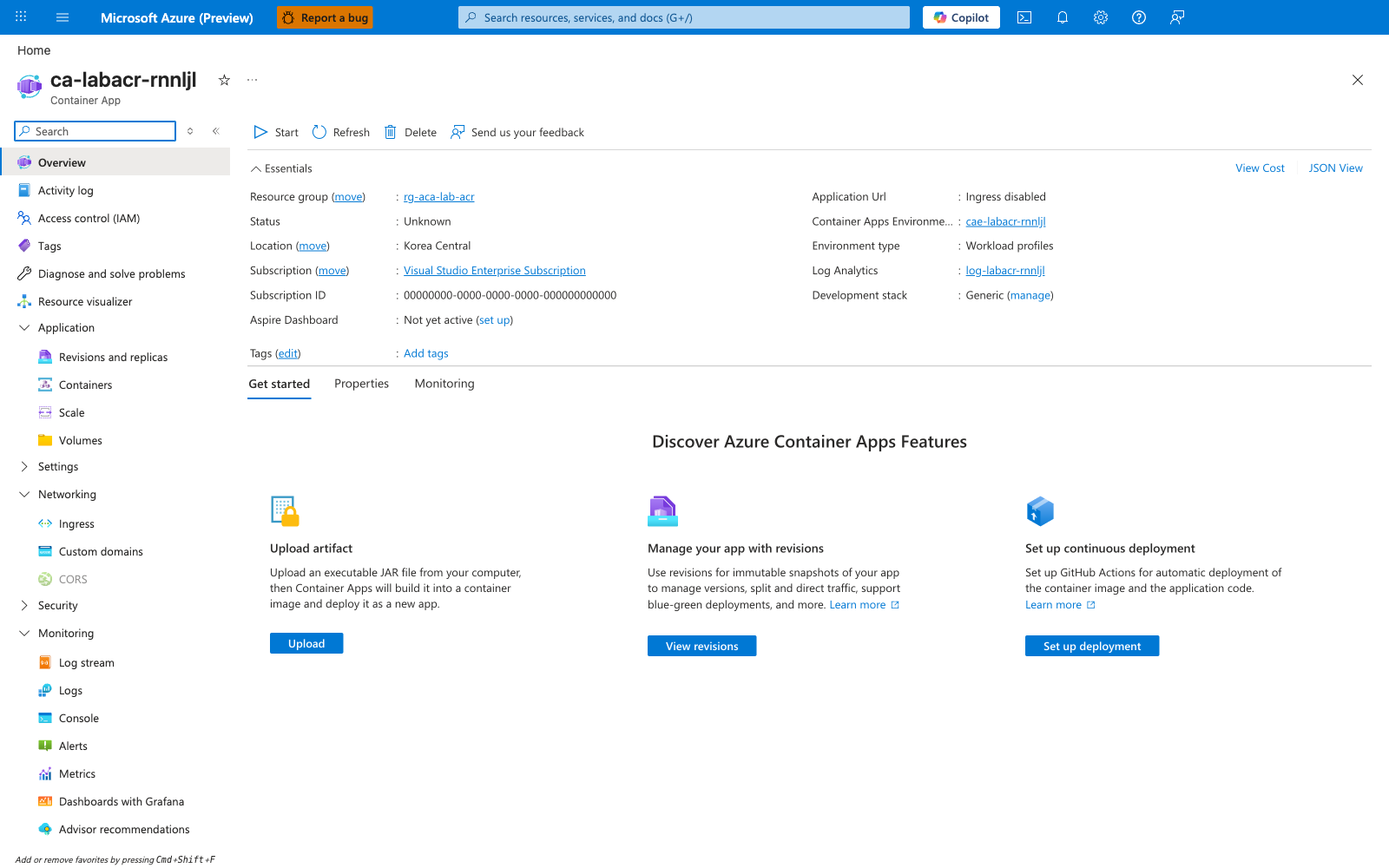
[Observed] Container App Overview blade: Status = Unknown, Application Url = Ingress disabled.
[Inferred] The platform never assigned an FQDN because no revision reached an ingress-ready state, even though ingress is enabled in the Bicep template.
[Observed] Revisions and replicas blade: both the Active and Inactive tabs render "No revisions to display". This is a stronger signal than the Failed health state that the original hypothesis predicted — the manifest pull failed so early that the platform never created a revision row at all.
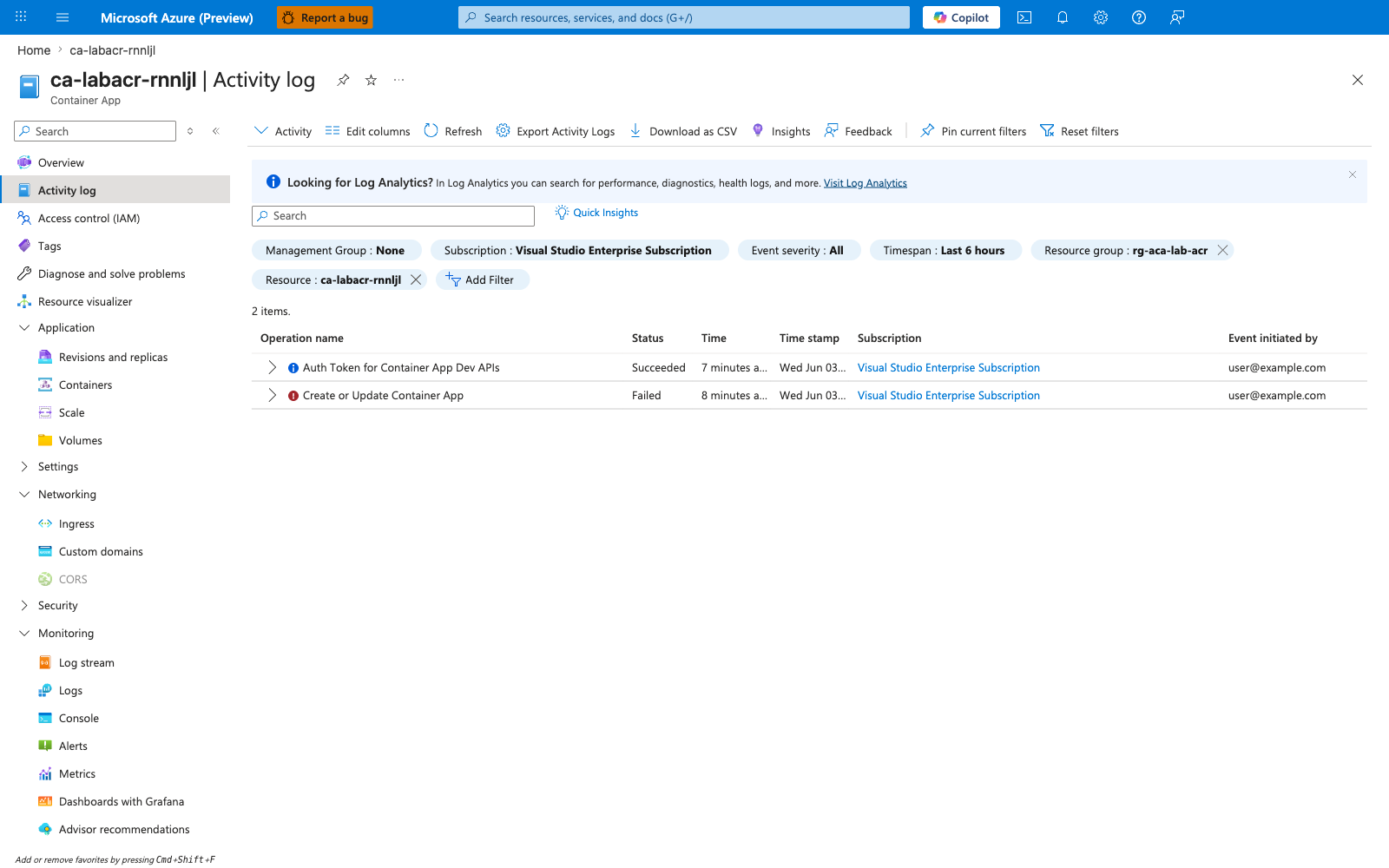
[Observed] Activity Log: a single Create or Update Container App operation with Status = Failed, originated by the deployment principal. This is the most reliable Portal evidence for this failure mode because it does not depend on revision state or system log propagation.
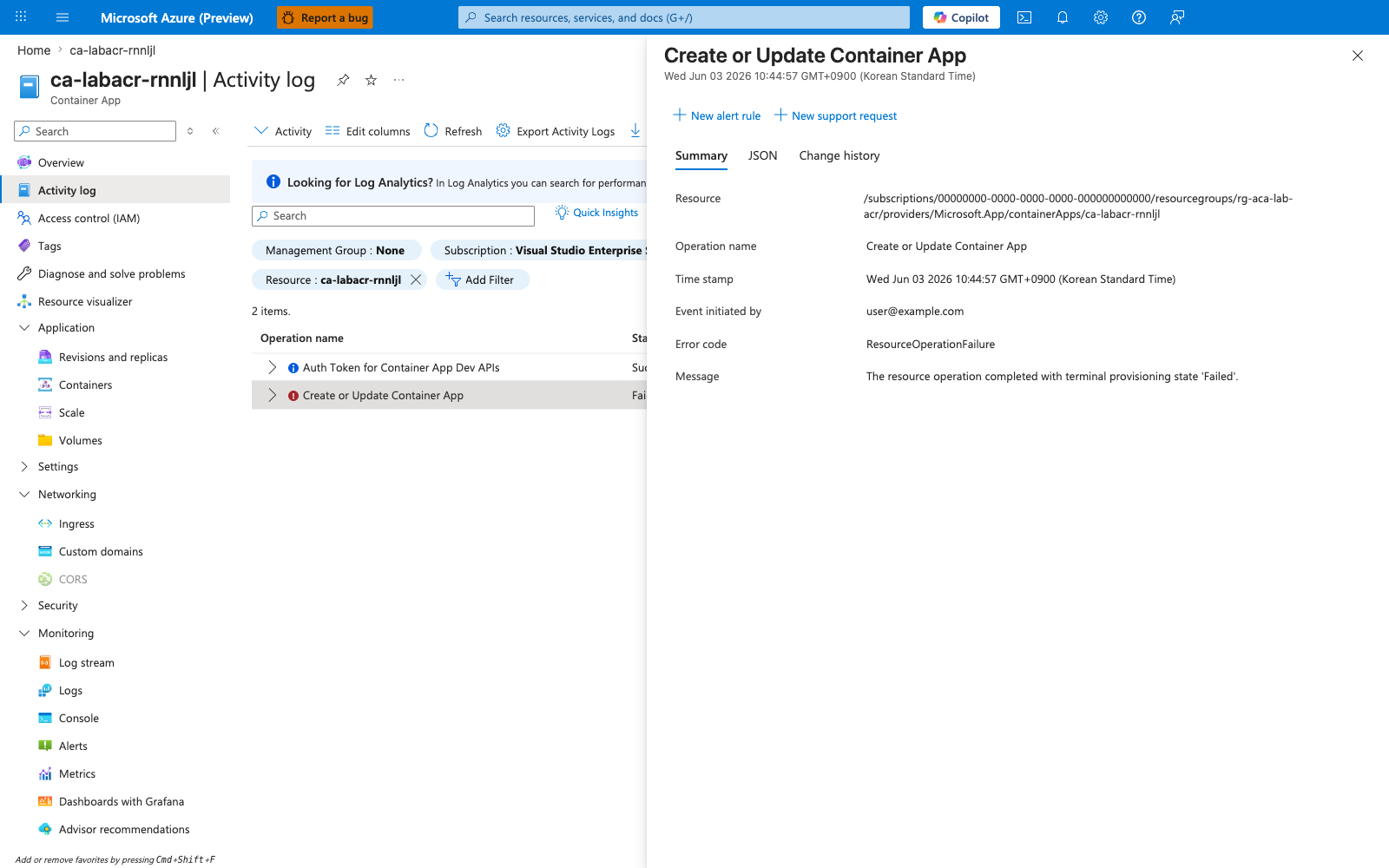
[Observed] Activity Log → Summary tab for that operation: terminal status Failed, event category ResourceOperationFailure. The Summary tab is the recommended evidence surface — the JSON tab is rendered by a Monaco editor that bypasses the standard PII replacement helper and therefore must not be captured for documentation.
[Observed] az containerapp logs show --type system fails with KeyError: 'eventStreamEndpoint' (Azure CLI 2.71.0). The ContainerAppSystemLogs_CL table is not present in the Log Analytics workspace during the failed-deployment window.
[Inferred] Because no revision was created:
- The log stream endpoint is a per-revision construct, so it does not exist when
latestRevisionNameisnull, which explains theKeyError. - No container ever started, so no rows are emitted to
ContainerAppSystemLogs_CLand the custom table is not materialized in this workspace for this failure window. Engineers searching Log Analytics for the failure will find an empty workspace and may incorrectly conclude that diagnostics are misconfigured.
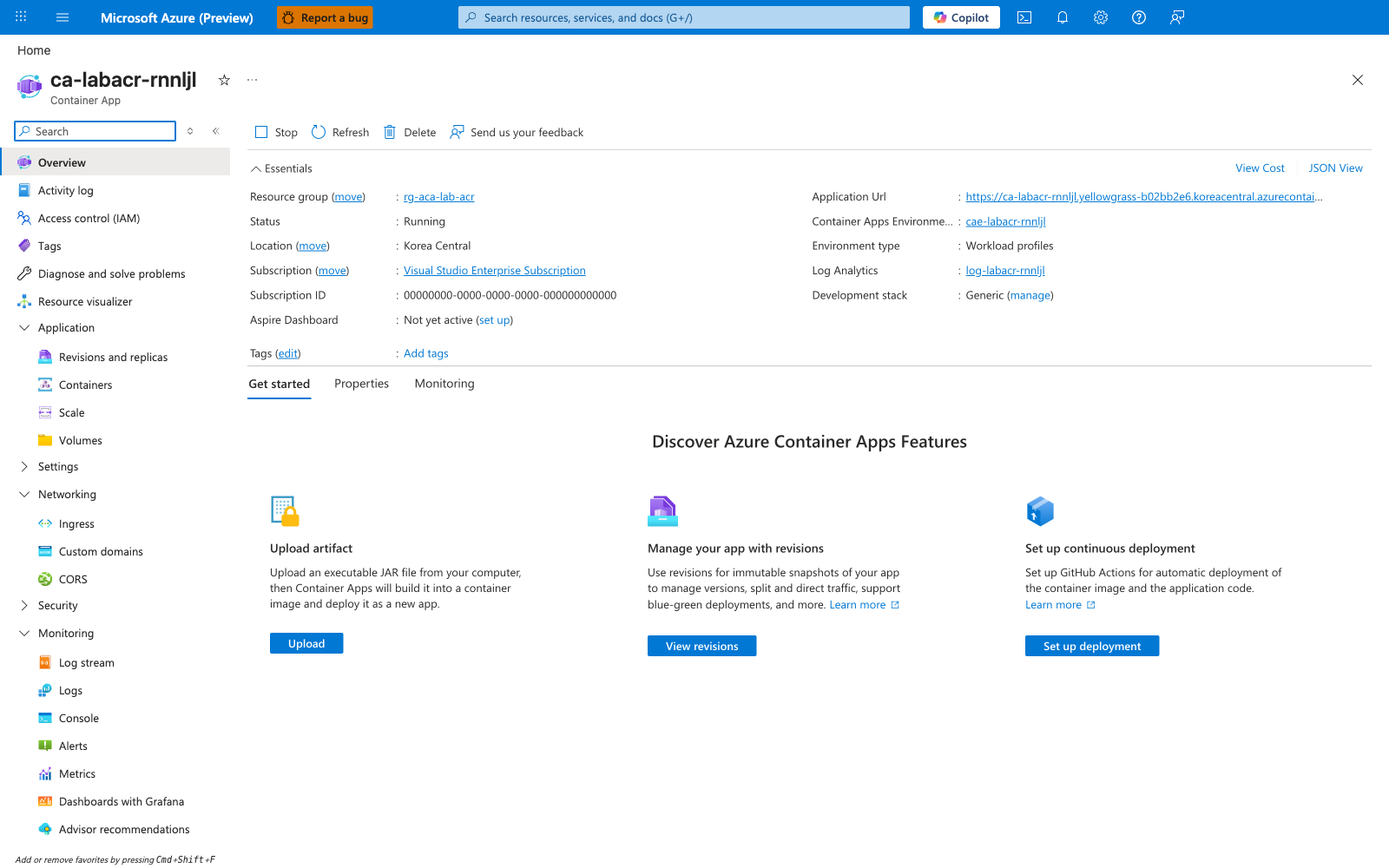
[Observed] Recovery executed with az acr build (no local Docker daemon required) and az containerapp update --image acrlabacrrnnljl.azurecr.io/labacr:v1. The update reached provisioningState = Succeeded and the platform created revision ca-labacr-rnnljl--at9gdr2. The Overview blade then reflected Status = Running and a populated Application Url:
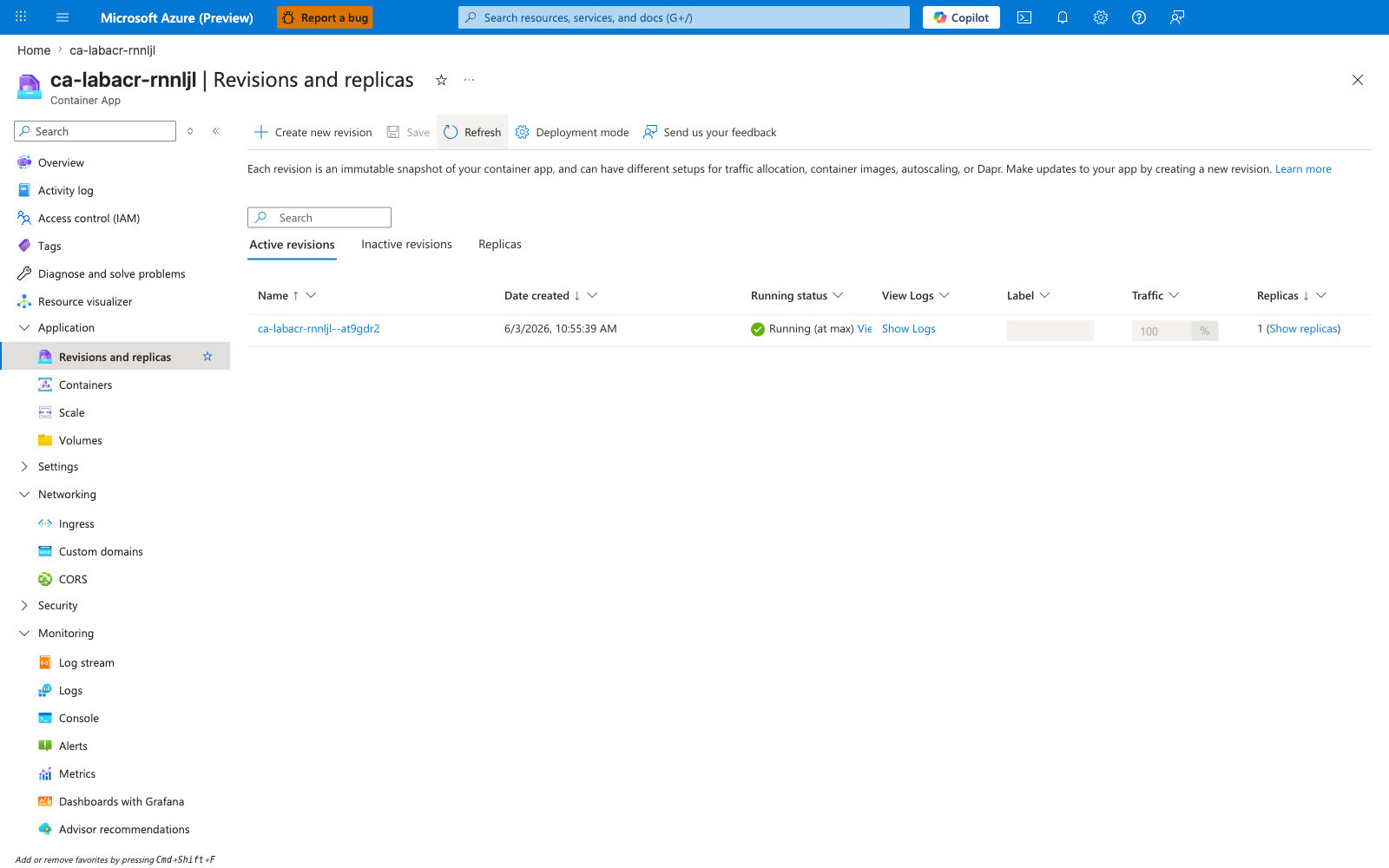
[Observed] Revision ca-labacr-rnnljl--at9gdr2: Health state = Healthy, Running state = RunningAtMaxScale, 100% traffic, 1 replica. End-to-end HTTP validation against the assigned FQDN returned HTTP 200 on 5/5 probes.
[Inferred] Falsification logic. Region, SKU, environment, registry credential configuration (ACR admin user via registry-password secret), and ingress configuration were held constant between the failing run and the recovered run. The only change was the image tag (:does-not-exist → :v1). The transition from "no revision, Status Unknown, no FQDN" to "Healthy revision, Status Running, FQDN returning HTTP 200" is therefore strongly consistent with the missing ACR tag being the cause, and refutes alternative explanations (registry credential failure, environment-level failure, ingress misconfiguration, networking).
Observed Evidence (Scripted Reproduction — 2026-06-22)
A third live reproduction was executed on 2026-06-22 in koreacentral using the scripted trigger.sh + fix-and-capture.sh flow added in labs/acr-pull-failure/ with structured H1 / H2 gate emission. The run produced two new platform observations that the 2026-05-01 and 2026-06-03 reproductions did not surface, both of which materially change how operators should derive resource names and locate the smoking-gun error string when responding to this failure mode in production.
Environment
| Resource | Name |
|---|---|
| Resource group | rg-aca-lab-acr |
| Container App | ca-labacr-rnnljl |
| ACR | acrlabacrrnnljl.azurecr.io |
| Container Apps environment | cae-labacr-rnnljl |
| Log Analytics workspace | log-labacr-rnnljl |
| Bad image reference (intentional) | acrlabacrrnnljl.azurecr.io/labacr:does-not-exist |
| Post-fix image | acrlabacrrnnljl.azurecr.io/labacr:v1 |
| Post-fix revision | ca-labacr-rnnljl--mvlbg1j |
| Post-fix FQDN | ca-labacr-rnnljl.blueflower-a74812c9.koreacentral.azurecontainerapps.io |
| Azure CLI version | 2.79.0 |
| Total wall clock | ~13 min |
Platform Discovery 1 — properties.outputs is null for Failed deployments
[Observed] After az deployment group create exits with provisioningState=Failed, az deployment group show --resource-group "$RG" --name main --query "properties.outputs" returns null (captured to evidence/23-deployment-outputs.json). The resource shells (Container App, ACR, Log Analytics workspace, Container Apps environment) WERE created and are queryable via direct list calls; the outputs block specifically is unpopulated.
[Inferred] This is intentional Azure Resource Manager behavior — outputs are not committed when the deployment did not reach Succeeded. The original lab guide's "Capture deployment outputs" step (lines 113-135 above) recommends az deployment group show --query "properties.outputs.containerAppName.value", which silently produces empty strings in this failure state and downstream az commands then fail with confusing "resource not found" errors that point operators at the wrong problem.
[Observed] The scripted Quick Start (in labs/acr-pull-failure/README.md) derives resource names from az containerapp list / az acr list / az monitor log-analytics workspace list --resource-group "$RG" --query "[0].name" (one-row queries against the dedicated lab RG). This approach succeeds regardless of deployment outcome because the resource shells exist independently of deployment success.
Platform Discovery 2 — MANIFEST_UNKNOWN lives in az deployment operation group list, NOT az deployment group show
[Observed] az deployment group show --resource-group "$RG" --name main returns a top-level properties.error.message that contains only the generic "At least one resource deployment operation failed" envelope text; properties.error.details[0].details is null at the leaf in the failed-deployment JSON. The smoking-gun MANIFEST_UNKNOWN: manifest tagged by "does-not-exist" is not found string is NOT in this output (captured to evidence/01-deployment-result.json).
[Observed] The authoritative per-operation detail lives in az deployment operation group list --resource-group "$RG" --name main --query "[].{statusMessage:properties.statusMessage}" — specifically in properties.statusMessage.error.message on the failed Container App write operation. This call returns the full MANIFEST_UNKNOWN string (captured to evidence/01-deployment-operations-failed.json).
[Observed] az monitor activity-log list --resource-group "$RG" --status Failed also surfaces the MANIFEST_UNKNOWN string in properties.statusMessage, but with higher ingestion lag than az deployment operation group list (the activity log typically lags 1-5 minutes behind the deployment).
[Inferred] Operators triaging an ACR pull failure who reach for az deployment group show first will see a generic deployment-failed envelope and may incorrectly conclude that the platform is not surfacing actionable detail. The az deployment operation group list call is the canonical first-touch evidence command for image-manifest failures.
H1 Gate — Deployment-level evidence (PASS)
[Observed] All five H1 sub-gates emitted by trigger.sh evaluated true (captured to evidence/06-h1-gate.json):
{
  "gate_classification": "deployment_failed_manifest_unknown",
  "deployment_state": "Failed",
  "manifest_unknown_in_error": true,
  "app_provisioning_state": "Failed",
  "app_latest_revision_name": "",
  "revision_count": 0,
  "labacr_repository_present_in_acr": false,
  "h1_sub_gates": {
    "a_deployment_failed_with_manifest_unknown": true,
    "b_app_provisioning_state_failed": true,
    "c_latest_revision_name_null": true,
    "d_revision_list_empty": true,
    "e_labacr_repository_absent": true
  },
  "h1_all_subgates_pass": true
}
[Observed] az containerapp logs show --type system failed with KeyError: 'eventStreamEndpoint' (captured to evidence/05-system-logs-show-error.txt) — same signature documented in the 2026-06-03 reproduction. The ContainerAppSystemLogs_CL table was not materialized in the workspace during the failed-deployment window.
H2 Gate — Recovery evidence (PASS)
[Observed] az acr build --registry acrlabacrrnnljl --image labacr:v1 ./workload succeeded on a Microsoft-hosted ACR Tasks worker (no local Docker daemon required); az containerapp update --image acrlabacrrnnljl.azurecr.io/labacr:v1 reached provisioningState=Succeeded and the platform created revision ca-labacr-rnnljl--mvlbg1j.
[Measured] 10/10 sequential HTTPS requests to the recovered FQDN returned HTTP 200 with end-to-end latency 423-535 ms (median ~478 ms), captured to evidence/12-curl-after-fix.json.
[Observed] All four H2 sub-gates emitted by fix-and-capture.sh evaluated true (captured to evidence/14-h2-gate.json):
{
  "gate_classification": "revision_healthy_traffic_100_curl_ok",
  "post_fix_revision": "ca-labacr-rnnljl--mvlbg1j",
  "post_fix_fqdn": "ca-labacr-rnnljl.blueflower-a74812c9.koreacentral.azurecontainerapps.io",
  "final_revision_health": "Healthy",
  "revision_healthy_traffic_100": true,
  "curl_after_fix_ok": 10,
  "labacr_present_in_acr": true,
  "post_fix_kql_gate": "silent_acceptable_post_fix",
  "h2_sub_gates": {
    "a_revision_list_count_ge_1": true,
    "b_revision_healthy_traffic_100": true,
    "c_curl_after_fix_ok_ge_8": true,
    "d_labacr_present_in_acr": true
  },
  "h2_all_subgates_pass": true
}
[Observed] Post-fix KQL probe against ContainerAppSystemLogs_CL returned 0 rows within the ~90-second post-fix window (captured to evidence/13-kql-after-fix-raw.txt and parsed to silent_acceptable_post_fix in evidence/13-kql-after-fix.json).
[Inferred] The post-fix silence is consistent with platform-side ingestion lag, not with a failure. The table was just materialized for the first time when the Healthy revision started, and Log Analytics commonly takes 2-5 minutes to surface fresh rows from a freshly-materialized custom table. The fix-and-capture.sh post-fix KQL classifier therefore treats 0 rows post-fix as silent_acceptable_post_fix (informational, not a gate failure) — distinguishing it from the H2 PASS verdict, which is anchored to the deterministic Healthy + traffic + curl signals.
Falsification logic (2026-06-22)
[Inferred] Region (koreacentral), SKU (Consumption), environment, registry credential mechanism (ACR admin user via registry-password secret), and ingress configuration were held constant between the failing baseline and the recovered state. The only experimental variable was the image tag (:does-not-exist → :v1). The transition from deployment_failed_manifest_unknown (revision count 0, labacr repository absent, no FQDN) to revision_healthy_traffic_100_curl_ok (Healthy revision, labacr repository present in ACR, 10/10 HTTP 200 at FQDN) is therefore consistent with the missing ACR tag being the single controlling variable for this failure mode. VERDICT: SUPPORTED.
Clean Up
| Command | Why it is used |
|---|---|
az group delete ... | Removes the lab resource group and its contained resources. |