ACR Network Path B — Private Endpoint Direct Lab
Reproduce Scenario B from ACR Network Path Selection: a Container App pulls images from an Azure Container Registry through a Private Endpoint over the Azure backbone, with no firewall on the image data path.
This is the recommended default for production Container Apps that pull from ACR. The lab proves the path is real, then falsifies the hypothesis by breaking the only thing that makes it private (the VNet link to privatelink.azurecr.io) and showing the pull fails — then restoring it and showing the pull recovers.
Lab Metadata
| Attribute | Value |
|---|---|
| Difficulty | Intermediate |
| Estimated Duration | 30-45 minutes |
| Tier | Workload Profiles (Consumption profile) |
| Failure Mode (Falsification) | ImagePullBackOff after the private DNS link is removed |
| Skills Practiced | ACR Private Endpoint, Private DNS Zone wiring, managed identity ACR pull, falsifiable lab design |
| Estimated Cost | ~$1-2 USD per run (Korea Central, 2-3 hours, ACR Premium dominates) |
Lab position
This lab is part of the 5-lab ACR network path series that reproduces the five distinct network paths a Container App can take to reach ACR. See ACR Network Path Selection for the conceptual taxonomy that names and orders all five paths.
| Item | Value |
|---|---|
| Series | ACR Network Path Labs |
| Scenario label | Scenario B — Private Endpoint Direct |
| Conceptual order | 2 of 5 in ACR Network Path Selection |
| Implementation order | 1 of 5 — this lab was the first authored in the series and established the baseline topology that Labs C/D/E build on (ACR Premium PE, privatelink.azurecr.io linked zone, managed-identity auth) |
| Main path tested | ACR Premium PE in workload VNet → privatelink.azurecr.io linked DNS zone → PE NIC RFC1918 IP → Azure backbone (no firewall in image-data path) |
| Failure mode class | Pull-fails on fresh pull (visibly broken revision with ImagePullUnauthorized after the VNet → DNS-zone link is removed) |
| Existing-revision impact during broken window | None — already-running replica keeps serving from cached image layers; the failure surfaces only on the next fresh pull (new revision, manual restart, or scale-out) |
| Fresh-pull behavior cleanly proven | Partially — managed identity is used, so the control-plane token-exchange path is on a different network path than the data-plane image pull; the data-plane failure is proven by a forced fresh pull (az containerapp revision restart) that surfaces ImagePullUnauthorized |
Observed in this lab
This behavior was reproduced in Korea Central on 2026-06-05 with the specific topology described above (ACR Premium with Private Endpoint, privatelink.azurecr.io linked DNS zone, Container Apps Consumption profile, managed-identity auth, no firewall on the image-data path). Treat it as validated for this lab's specific topology, auth mode, and timing — not as a universal statement for every Azure Container Apps + ACR deployment. Different ACR SKUs (Basic/Standard cannot host a Private Endpoint), different DNS topologies (custom DNS server without proper forwarding — see sibling Scenario E lab), missing zone records (see sibling Scenario D lab), and different Container Apps platform versions can change the observed behavior.
1) Background
Azure Container Apps can reach ACR through several network paths — public via firewall, Private Endpoint direct, Private Endpoint with forced inspection, or one of two DNS misconfiguration scenarios. The ACR Network Path Selection page documents all of them.
Path B (Private Endpoint direct) is the production default. ACR is set to publicNetworkAccess: Disabled, a Private Endpoint puts the registry's registry sub-resource on a NIC inside the workload VNet, and the privatelink.azurecr.io Private DNS Zone is linked to that VNet so the login and data FQDNs resolve to the PE NIC's private IPs. The Container App's managed identity pulls images over the Azure backbone — the firewall is not on the path.
Two non-obvious properties make this lab worth running:
- Absence of firewall logs is the expected state, not evidence of breakage. If the PE path is working, you will not see ACR egress in firewall logs. Engineers who expect to see them sometimes "fix" the wiring to make them appear, which silently breaks Path B and slides into Path A or D.
- The
/32PE route beats a0.0.0.0/0UDR. This is the property that keeps Path B from accidentally becoming Path C when an operator adds a default route to the firewall. It also means Path C (forced inspection) requires deliberate configuration; see ACR Network Path Selection.
Architecture
flowchart TD
    REPLICA[Container App replica<br/>workload profile subnet]
    DNS[Azure DNS<br/>168.63.129.16]
    ZONE[Private DNS Zone<br/>privatelink.azurecr.io]
    PE[ACR Private Endpoint NIC<br/>RFC1918 private IP]
    ACR[Azure Container Registry<br/>Premium<br/>publicNetworkAccess=Disabled]
    ENTRA[Microsoft Entra ID<br/>login.microsoftonline.com]

    REPLICA -->|1 resolve registry FQDN| DNS
    DNS -->|2 zone is linked to VNet| ZONE
    ZONE -->|3 returns private IP| REPLICA
    REPLICA -->|4 pull image over Azure backbone| PE
    PE --> ACR
    REPLICA -.->|MI token acquisition<br/>port 443| ENTRA

    classDef path fill:#e1f5ff,stroke:#0078d4
    classDef registry fill:#e5f5e5,stroke:#107c10
    classDef identity fill:#fff4e6,stroke:#ca5010

    class REPLICA,DNS,ZONE,PE path
    class ACR registry
    class ENTRA identity
The solid arrows are the image data path. The dashed arrow is the platform acquiring an Entra ID token for the Container App's managed identity. Even though the data path is fully private, Entra ID egress is still required — this is the most commonly forgotten outbound dependency when locking down a Container Apps environment for ACR pulls. See the AzureActiveDirectory requirement in Egress Control.
2) Hypothesis
IF ACR is set to publicNetworkAccess: Disabled, a Private Endpoint exists in a non-delegated subnet of the workload VNet, and privatelink.azurecr.io is linked to that VNet with a populated <registry> A record, THEN the Container App's managed identity pull will:
- resolve the ACR login FQDN to the PE NIC's private (RFC1918) IP,
- complete the pull over the Azure backbone (not via the public ACR endpoint),
- create a
Healthyrevision,
AND removing the only thing that makes the FQDN resolve privately (the VNet link to privatelink.azurecr.io) will cause the next pull to fail, falsifying any alternative hypothesis (auth, ACR availability, image content).
| Variable | Control State (Path B working) | Experimental State (Falsification) |
|---|---|---|
ACR publicNetworkAccess | Disabled | Disabled (held constant) |
privatelink.azurecr.io zone | Linked to VNet, populated | Linked, populated |
| VNet → zone link | Present | Removed, then restored |
| ACR FQDN resolution from VNet | PE NIC private IP | Public IP (after link removed) |
Pull from ACR (publicNetworkAccess=Disabled) | Succeeds via PE | Rejected (no public path) |
| Revision health | Healthy | Unhealthy / ImagePullBackOff |
| Managed identity / AcrPull role | Configured | Configured (held constant) |
| Image content | Built fresh in ACR (v1, v-broken, v-recover) | New tag per attempt (cache-defeating) |
3) Runbook
Deploy baseline infrastructure
export RG="rg-acr-pe-direct-lab"
export LOCATION="koreacentral"
export BASE_NAME="acrpedir"

az extension add --name containerapp --upgrade

az group create --name "$RG" --location "$LOCATION"

az deployment group create \
    --resource-group "$RG" \
    --name acr-pe-direct \
    --template-file labs/acr-network-path-pe-direct/infra/main.bicep \
    --parameters baseName="$BASE_NAME"
| Command | Why it is used |
|---|---|
az extension add --name containerapp --upgrade | Installs or updates the Container Apps CLI extension. |
az group create ... | Creates the lab resource group; everything else lives inside it. |
az deployment group create ... | Provisions VNet (snet-aca delegated + snet-pe), Log Analytics, ACR Premium with publicNetworkAccess=Disabled, Private Endpoint, privatelink.azurecr.io zone + VNet link, workload-profile Container Apps environment, and a Container App with system-assigned managed identity + AcrPull role on the registry. |
Expected output pattern:
The initial Container App boots from a public placeholder image (mcr.microsoft.com/k8se/quickstart:latest) so the deployment succeeds before there is anything in the private ACR.
Switch the app to the private ACR image
The trigger script runs:
az acr build --registry "$ACR_NAME" --image "pe-lab:v1" \
    --file labs/acr-network-path-pe-direct/workload/Dockerfile \
    labs/acr-network-path-pe-direct/workload

az containerapp registry set --name "$APP_NAME" --resource-group "$RG" \
    --identity system --server "$ACR_LOGIN_SERVER"

az containerapp update --name "$APP_NAME" --resource-group "$RG" \
    --image "${ACR_LOGIN_SERVER}/pe-lab:v1" \
    --set-env-vars "BUILD_TAG=v1"
| Command | Why it is used |
|---|---|
az acr build ... | Builds the lab image directly inside ACR (no local Docker required). The build happens via ACR Tasks; the resulting image is only retrievable through the PE because publicNetworkAccess=Disabled. |
az containerapp registry set ... --identity system | Wires the Container App's managed identity as the ACR pull credential, instead of admin user / static credentials. |
az containerapp update --image ... | Triggers a new revision that must pull the freshly built image. The first pull is the moment the PE path is actually exercised. |
Expected output: provisioningState: Succeeded. A new revision is created and begins pulling.
Verify Path B is live
The verify script checks two independent signals:
- The latest revision's
healthStateisHealthy. - The PE NIC's
customDnsConfigsfor the ACR FQDN holds an RFC1918 IP.
Both must hold for the pull to have traversed the PE path. The script exits non-zero on any mismatch.
Expected pattern:
[verify] latest revision: healthState=Healthy provisioningState=Provisioned
[verify] PASS: ACR <registry>.azurecr.io resolves to private IP 10.50.4.5 via PE NIC
[verify] PASS: revision is Healthy → ACR pull traversed the Private Endpoint
Falsify the hypothesis
The falsification script:
- Deletes the VNet link to
privatelink.azurecr.io— the only thing that makes the FQDN resolve privately from inside the VNet. - Builds a new image tag (
v-broken) in ACR. A new tag is mandatory — Container Apps caches image layers on the underlying nodes, so reusingv1would not exercise the network path. - Updates the app to
v-broken. The pull must fail because ACR haspublicNetworkAccess=Disabledand the VNet no longer has private DNS to resolve the PE. - Restores the VNet link.
- Builds and pushes
v-recover, updates the app, and confirms the new revision isHealthy.
If step 3 fails (pull is rejected) and step 5 succeeds (pull works again), then the Private DNS link was the cause and Path B is confirmed.
| Command | Why it is used |
|---|---|
az network private-dns link vnet delete ... | Removes the VNet link so the privatelink.azurecr.io zone is no longer consulted from inside the VNet. |
az acr build --image pe-lab:v-broken ... | Forces a brand-new image tag so the next pull cannot be served from the node's image cache. |
az containerapp update --image ... --set-env-vars BUILD_TAG=v-broken | Triggers a new revision that must pull the new tag. |
az network private-dns link vnet create ... | Restores the VNet link so the PE-via-private-DNS path is live again. |
Inspect system evidence
| Command | Purpose |
|---|---|
az containerapp logs show \ --name "$APP_NAME" \ --resource-group "$RG" \ --type system \ --tail 50 | Pulls Container Apps system logs, which is where provisioning, probe, scaler, and image-pull failures appear before application code starts. |
Expected pattern in the post-break window:
Reason_s          Log_s
----------------  -----------------------------------------------------------------
PullingImage      Pulling image '<acr>.azurecr.io/pe-lab:v-broken'
ImagePullFailed   Failed to pull image: ... lookup <acr>.azurecr.io: no such host
                  (or: connection refused / unauthorized, depending on resolution path)
BackOff           Back-off pulling image '<acr>.azurecr.io/pe-lab:v-broken'
In the post-recover window:
PullingImage      Pulling image '<acr>.azurecr.io/pe-lab:v-recover'
PulledImage       Successfully pulled image '<acr>.azurecr.io/pe-lab:v-recover'
RevisionReady     Revision is ready
4) Experiment Log
| Step | Action | Expected | Actual (2026-06-05, koreacentral, Azure CLI 2.79.0) | Pass/Fail |
|---|---|---|---|---|
| 1 | Deploy lab infrastructure (az deployment group create) | Deployment Succeeded | provisioningState: Succeeded after 5m 13s; all 8 outputs returned (registry, app, environment, LAW, VNet, zone, PE, NIC IPs). | Pass |
| 2 | Run trigger.sh (twice: default IMAGE_TAG=v1, then IMAGE_TAG=v2) | Revision becomes Healthy after pulling private ACR image | First run (IMAGE_TAG=v1): az acr build produced pe-lab:v1 (digest captured); az containerapp registry set --identity system configured the system-assigned MI as ACR pull credential; az containerapp update triggered revision --0000001; PullingImage→PulledImage for v1 succeeded in 2.55s at 10:26:47 UTC. Second run (IMAGE_TAG=v2): triggered revision --0000002; PullingImage→PulledImage for v2 succeeded in 2.37s at 10:37:30→10:37:31 UTC. Both revisions reached healthState=Healthy. trigger.sh briefly toggled --public-network-enabled true for the az acr build step (ACR Tasks build agents need the public surface to push the layer) and restored Disabled before the Container App pull, so every container pull attempt happened with publicNetworkAccess=Disabled. | Pass |
| 3 | Run verify.sh | PE NIC IP is RFC1918, revision Healthy | Output: PE NIC IPs: 10.50.4.4 (data), 10.50.4.5 (registry), both RFC1918 in snet-pe (10.50.4.0/24); healthState=Healthy, provisioningState=Provisioned. | Pass |
| 4 | falsify.sh step 1 (delete VNet link) | Link removed; subsequent DNS lookups fall back to public | az network private-dns link vnet delete completed; az network private-dns link vnet list returned [] (zero links). | Pass |
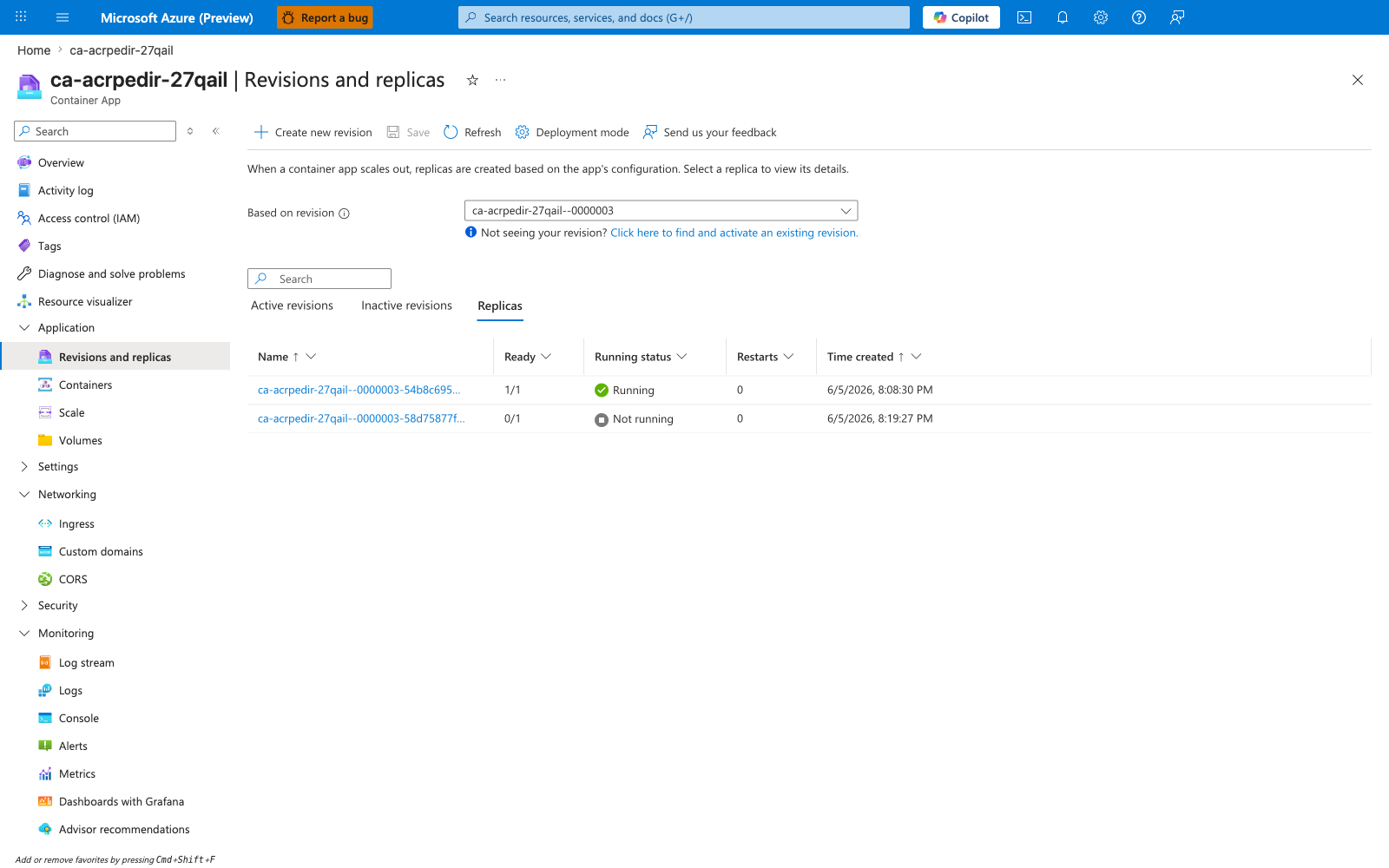
| 5 | falsify.sh step 3 (update to v-broken) | New revision fails to pull | After replica restart (forcing fresh pull past node-level layer cache), replica 0000003-58d75877fc-7gmzx entered tight retry loop: 6× PullingImage→ImagePullUnauthorized→ContainerTerminated reason=ImagePullFailure between 11:19:41–11:20:53 UTC. Replica Ready=0/1, Running status=Not running. Portal Revisions blade shows the split state (one cached replica Running, one new replica Not running). See screenshot 7. | Pass |
| 6 | falsify.sh step 5 (restore link, push v-recover) | New revision becomes Healthy again | After az network private-dns link vnet create vnet-link-recover, DNS resumed resolving the ACR FQDN to PE NIC IP 10.50.4.5. az containerapp update --image pe-lab:v-recover triggered revision --0000004; pull succeeded in 3.28s at 11:31:11 UTC; RevisionReady at 11:30:56; healthState=Healthy. | Pass |
Expected Evidence
| Evidence Source | Expected State |
|---|---|
az containerapp revision list --name "$APP_NAME" --resource-group "$RG" --output table | Latest revision is Healthy after trigger.sh; Unhealthy between steps 4 and 6; Healthy again after step 6. |
az network private-endpoint show --name "$PE_NAME" --resource-group "$RG" --query "networkInterfaces[0].id" --output tsv then az network nic show --ids "$NIC_ID" --query "ipConfigurations[].{fqdns:privateLinkConnectionProperties.fqdns, ip:privateIPAddress}" | One entry per FQDN (login + region data); each ip is an RFC1918 address from the PE subnet. (Note: with privateDnsZoneGroups enabled in Bicep, the legacy customDnsConfigs field on the PE is empty — the FQDN→IP mapping lives on the NIC ipConfigurations. This is what verify.sh queries.) |
az network private-dns record-set a list --zone-name privatelink.azurecr.io --resource-group "$RG" | Records for <registry> and <registry>.<region>.data pointing to PE NIC IPs. |
ContainerAppSystemLogs_CL \| where ContainerAppName_s == "$APP_NAME" \| where Reason_s in ("PullingImage","PulledImage","ImagePullFailed","ImagePullUnauthorized","BackOff") \| order by TimeGenerated asc | PullingImage/PulledImage for v1, v2, and v-recover; ImagePullUnauthorized/BackOff for v-broken after the VNet link is removed (the production-realistic surface — see Observed Evidence below for why this is ImagePullUnauthorized and not ImagePullFailed/no such host). |
az acr show --name "$ACR_NAME" --query "publicNetworkAccess" | Disabled during every container pull attempt. trigger.sh briefly opens public access to push the layer via ACR Tasks, then closes it before the Container App pull, so the snapshot during any pull will show Disabled. |
Observed Evidence (Live Azure Test — 2026-06-05)
Environment: rg-acr-pe-direct-lab / cae-acrpedir-27qail, koreacentral, Consumption + workload-profile environment, Azure CLI 2.79.0. ACR: acracrpedir27qail.azurecr.io (Premium, publicNetworkAccess=Disabled during every container pull attempt — trigger.sh briefly toggles it Enabled only for the duration of the az acr build step because ACR Tasks build agents need the public surface to push layers, then restores Disabled before the Container App pull). Image tags built and pushed with az acr build (no local Docker): pe-lab:v1, pe-lab:v2, pe-lab:v-broken, pe-lab:v-recover. PE NIC IPs (in snet-pe, 10.50.4.0/24): 10.50.4.4 (data group), 10.50.4.5 (registry group).
[Observed] After trigger.sh built and pushed pe-lab:v2 and the Container App was switched to it (system-assigned managed identity with AcrPull), revision ca-acrpedir-27qail--0000002 pulled through the PE in 2.37s while ACR publicNetworkAccess=Disabled:
2026-06-05T10:37:30Z | rev=...--0000002 | PullingImage     | Pulling image 'acracrpedir27qail.azurecr.io/pe-lab:v2'
2026-06-05T10:37:31Z | rev=...--0000002 | PulledImage      | Successfully pulled image "acracrpedir27qail.azurecr.io/pe-lab:v2" in 2.37s. Image size: 44040192 bytes.
2026-06-05T10:37:31Z | rev=...--0000002 | ContainerCreated | Created container 'app'
2026-06-05T10:37:31Z | rev=...--0000002 | ContainerStarted | Started container 'app'
[Observed] verify.sh confirmed the registry's data-plane FQDN resolves inside the VNet to the PE NIC, and that the registry's public surface is closed:
Revision: ca-acrpedir-27qail--0000002
  healthState=Healthy, provisioningState=Provisioned, trafficWeight=100
PE NIC IPs: 10.50.4.4 (data group), 10.50.4.5 (registry group) -- both RFC1918 in snet-pe (10.50.4.0/24)
ACR publicNetworkAccess: Disabled
[Observed] After falsify.sh step 1 deleted the privatelink.azurecr.io → vnet-acrpedir-27qail link (az network private-dns link vnet delete --name vnet-link-acr ...), az network private-dns link vnet list --zone-name privatelink.azurecr.io --resource-group rg-acr-pe-direct-lab --output json returned [] (zero links). The already-running replica on revision --0000003 (qail--0000003-54b8c69594-qj62h) kept serving HTTP 200 because the image layers were already on the node — no new pull was attempted by that replica.
[Observed] Forcing a fresh pull with az containerapp revision restart --revision ca-acrpedir-27qail--0000003 (the replica restart subcommand does not exist) spawned replica qail--0000003-58d75877fc-7gmzx, which then entered an ImagePullUnauthorized retry loop. The replica reported runningState=NotRunning, container state Waiting / ImagePullBackOff:
2026-06-05T11:19:41Z | replica=7gmzx | PullingImage          | Pulling image 'acracrpedir27qail.azurecr.io/pe-lab:v-broken'
2026-06-05T11:19:41Z | replica=7gmzx | ImagePullUnauthorized | Container pull image failed with unauthorized error.
2026-06-05T11:19:41Z | replica=7gmzx | ContainerTerminated   | Container 'app' was terminated with exit code '' and reason 'ImagePullFailure'
... (retry at 11:19:43, 11:19:53, 11:20:12, 11:20:53, 11:22:13, 11:24:53 with growing BackOff)
[Inferred] The failure surface is ImagePullUnauthorized, not no such host (the textbook DNS-failure error). With the VNet→DNS-zone link removed, the override that points acracrpedir27qail.azurecr.io to the PE NIC IP is gone, but the standard Azure public resolver still answers the same query with the registry's real public IP. The pull request therefore reaches the ACR public surface, which rejects it because publicNetworkAccess=Disabled, and the platform surfaces this as an authorization error. In any environment that has public DNS fallback (which is most of them), this is the production-realistic signal — engineers chasing this lab's failure mode should not expect a no such host error and should not waste time auditing registry credentials or RBAC first.
[Observed] After falsify.sh step 4 restored the link (az network private-dns link vnet create --name vnet-link-recover ...), DNS resumed resolving the registry FQDN to the PE NIC IP. The replica that had been in ImagePullBackOff (7gmzx) pulled pe-lab:v-broken successfully in 1.54s once its retry cycle came back around, and then falsify.sh step 5 pushed pe-lab:v-recover and deployed revision --0000004, which pulled in 3.28s and reached healthState=Healthy:
2026-06-05T11:29:52Z | rev=...--0000003 | PullingImage     | Pulling image 'acracrpedir27qail.azurecr.io/pe-lab:v-broken'
2026-06-05T11:29:54Z | rev=...--0000003 | PulledImage      | Successfully pulled image "acracrpedir27qail.azurecr.io/pe-lab:v-broken" in 1.54s
2026-06-05T11:31:11Z | rev=...--0000004 | PullingImage     | Pulling image 'acracrpedir27qail.azurecr.io/pe-lab:v-recover'
2026-06-05T11:31:11Z | rev=...--0000004 | PulledImage      | Successfully pulled image "acracrpedir27qail.azurecr.io/pe-lab:v-recover" in 3.28s
2026-06-05T11:31:13Z | rev=...--0000004 | ContainerStarted | Started container 'app'
[Inferred] Falsification logic. Region, registry, registry credentials (system-assigned MI with AcrPull role), Container Apps environment, VNet, PE, and image base layers (all four tags share ~99% of layers) were held constant across the full run. The only variable changed during the broken window was the VNet-to-private-DNS-zone link. The state transitions follow that variable exactly:
| VNet→DNS link | Fresh pull attempted? | Pull result | Replica state |
|---|---|---|---|
| Linked | Yes (initial deploy of v-broken) | PulledImage 1.17s | Running |
| Linked | No (cached on node) | n/a | Running |
| Unlinked | Yes (forced restart) | ImagePullUnauthorized retry loop | NotRunning / ImagePullBackOff |
| Re-linked | Yes (BackOff retry + v-recover) | PulledImage 1.54s / 3.28s | Running |
This isolates the cause to Path B's DNS contract (private DNS zone → PE NIC IP) and refutes the alternative explanations the symptom typically invites: registry auth (unchanged across the run), ACR public access (Disabled during every container pull attempt — including the Healthy windows — and never opened to the workload subnet), image existence (all four tags resolved at registry level), Container Apps environment / VNet / PE (unchanged), and node-level layer cache (which only delayed observability of the failure on the original replica — it did not cause it).
[Inferred] Operational lesson. Removing the VNet→DNS-zone link does not break already-running replicas immediately, because the node-level image layer cache continues to serve any revision whose layers were pulled before the link was removed. The failure surfaces only on the next fresh pull: a new replica from scale-out, a manual restart, or a new revision. When investigating an ImagePullUnauthorized in a PE + private-DNS topology, check az network private-dns link vnet list --zone-name privatelink.azurecr.io --resource-group <rg> before assuming the failure is a credential or RBAC issue.
Observed Evidence (Portal Captures — 2026-06-05)
A live reproduction on 2026-06-05 captured the full Path B topology and the falsification surface.
Environment
| Resource | Name |
|---|---|
| Resource group | rg-acr-pe-direct-lab |
| Container App | ca-acrpedir-27qail |
| ACR | acracrpedir27qail.azurecr.io |
| Container Apps environment | cae-acrpedir-27qail |
| Log Analytics workspace | log-acrpedir-27qail |
| VNet / PE subnet | vnet-acrpedir-27qail / snet-pe (10.50.4.0/24) |
| Private DNS zone | privatelink.azurecr.io |
| PE NIC IPs | 10.50.4.4 (data group), 10.50.4.5 (registry group) |
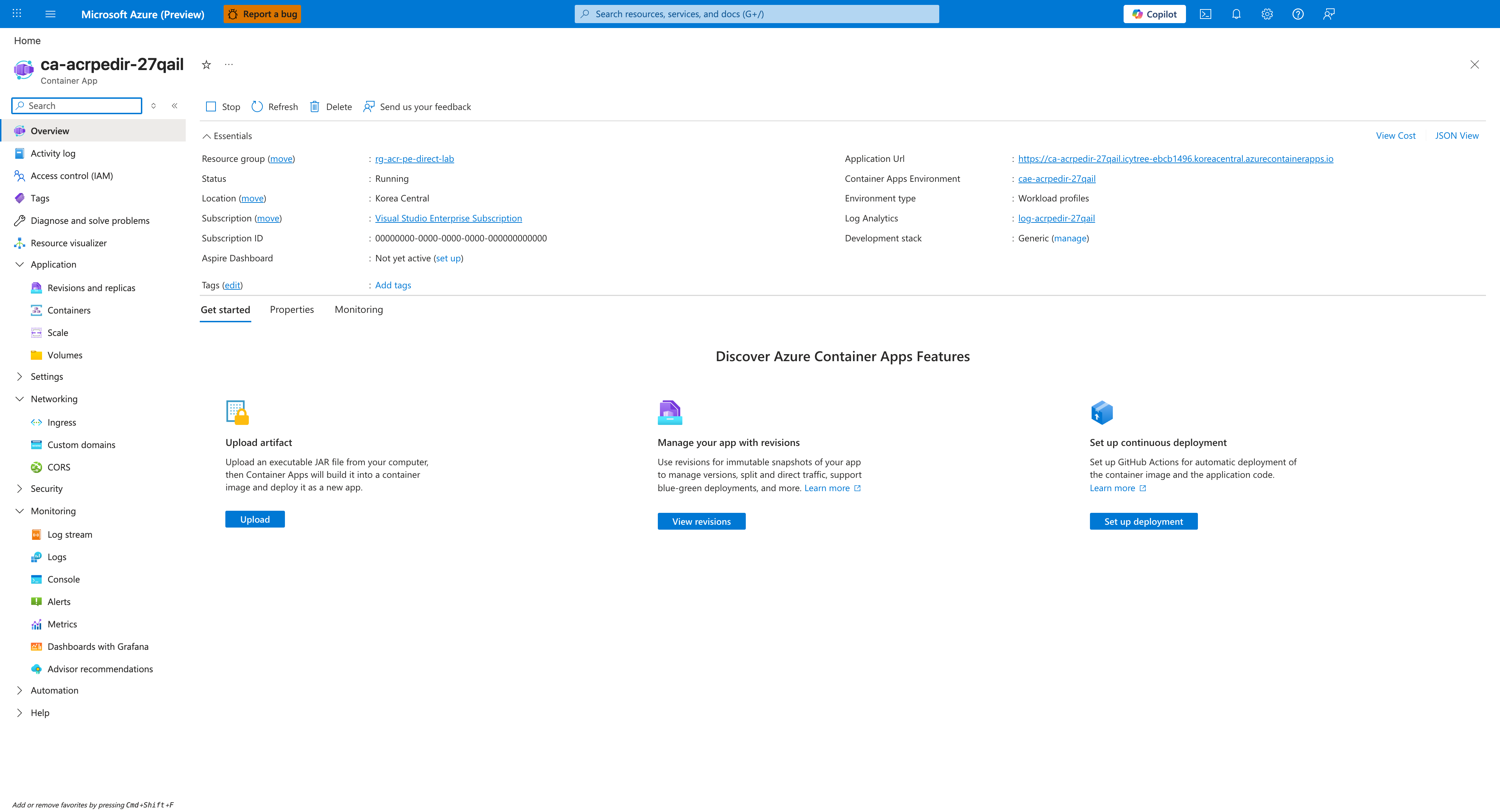
[Observed] Container App Overview after trigger.sh: Status = Running, Application URL populated, latest revision active. The baseline confirms the data path through the PE is working while ACR public access is disabled.
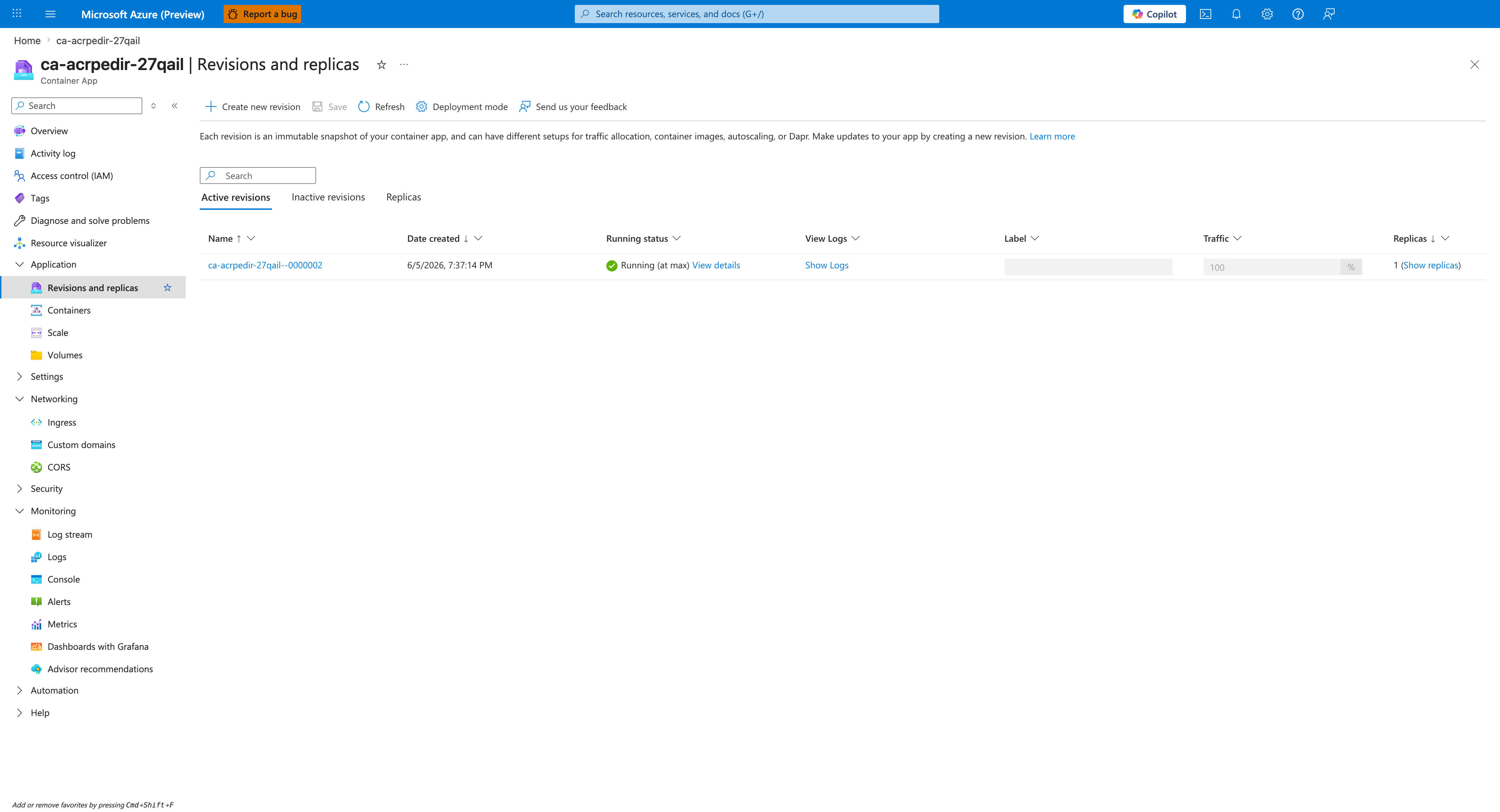
[Observed] Container App Revisions and replicas → Active revisions: revision ca-acrpedir-27qail--0000002 (created 6/5/2026 7:37 PM KST = 10:37 UTC, matching the trigger.sh deploy of pe-lab:v2) is Running (at max), 100% traffic, 1 replica. This is the Healthy baseline produced entirely through the private endpoint with the ACR public surface closed.
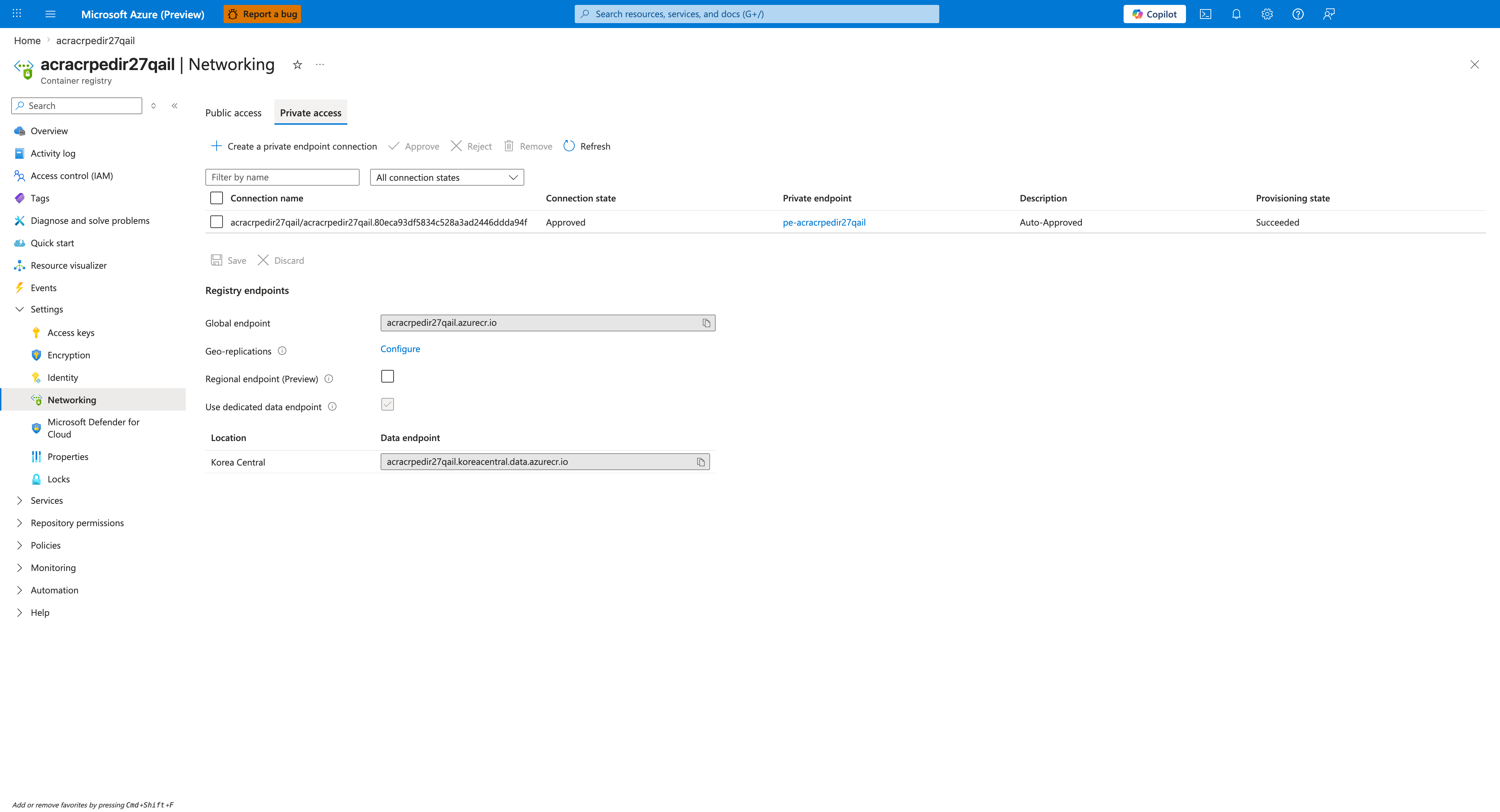
[Observed] ACR → Networking → Private access tab: Public network access = Disabled, private endpoint connection pe-acracrpedir27qail Approved with group ID registry. This is the configuration under test — without the private endpoint pathway, the container app would have no route to pull images.
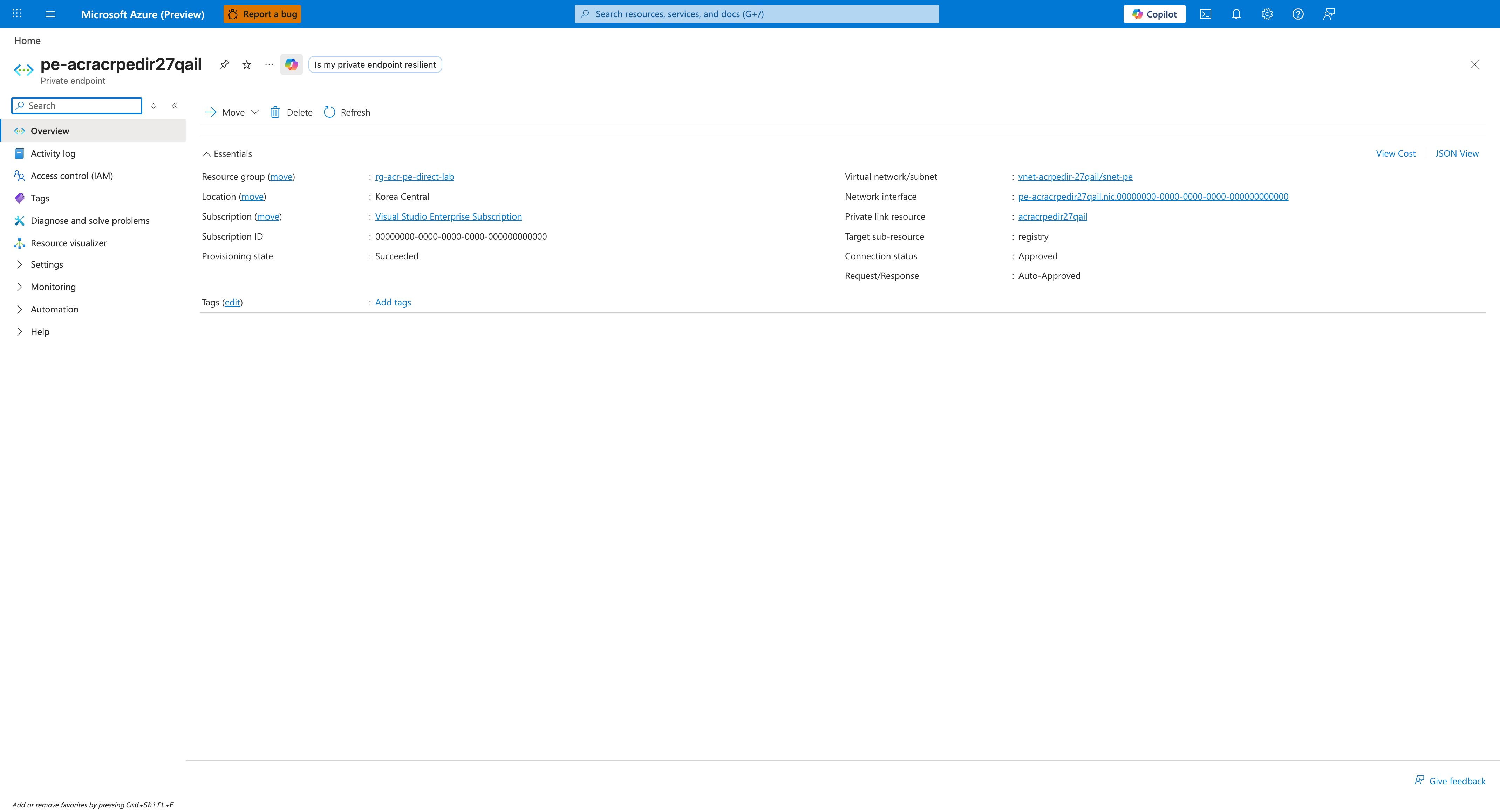
[Observed] Private Endpoint Overview blade for pe-acracrpedir27qail: provisioning state Succeeded, subnet snet-pe, NIC resolves to RFC1918 IPs 10.50.4.4 and 10.50.4.5 inside the PE subnet. This is the L3 leg of Path B — the registry's plumbing into the customer VNet.
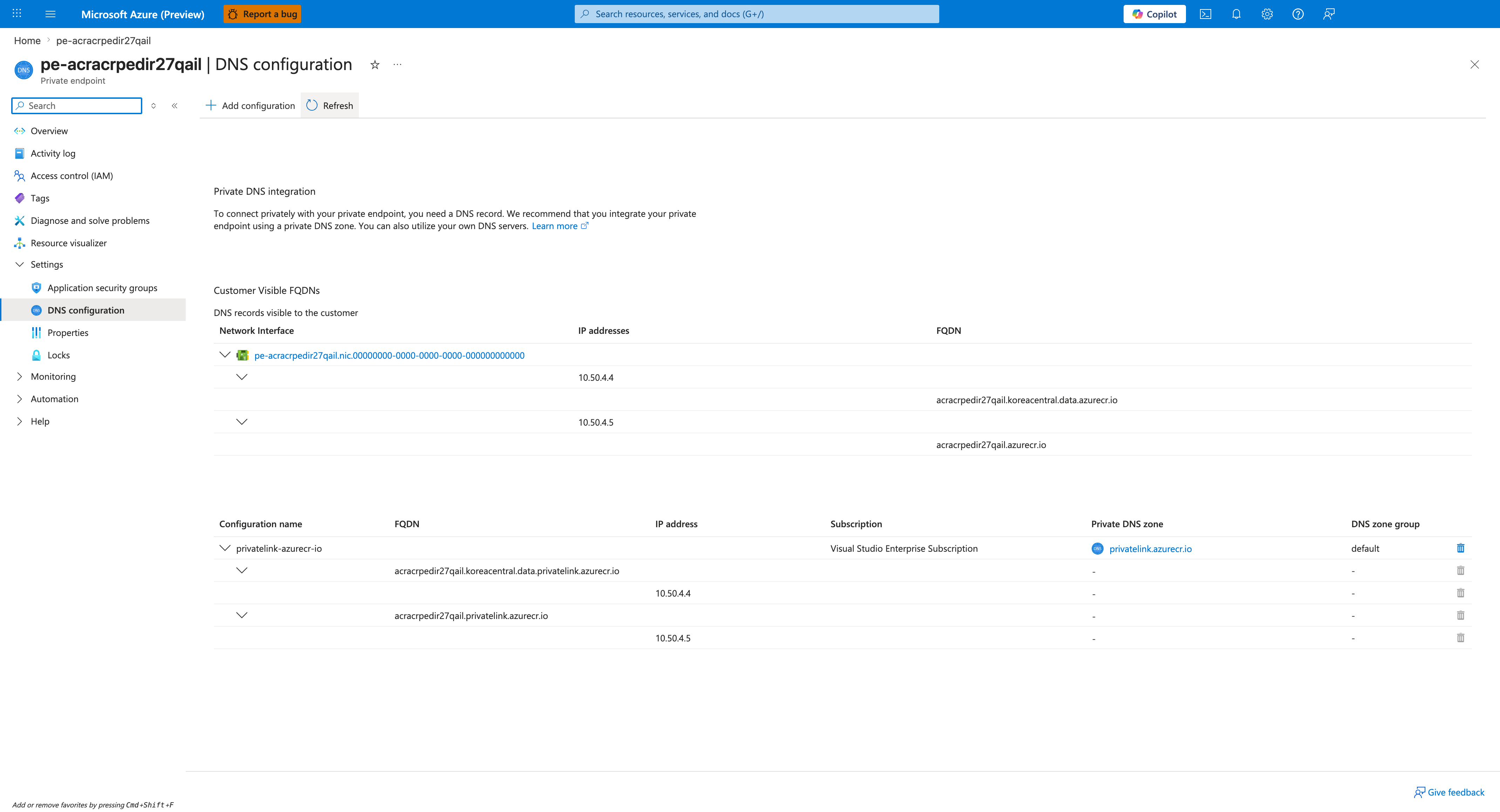
[Observed] Private Endpoint DNS configuration blade: two FQDNs registered — acracrpedir27qail.azurecr.io → 10.50.4.5 (registry group) and acracrpedir27qail.koreacentral.data.azurecr.io → 10.50.4.4 (data group). Both records target IPs inside snet-pe (10.50.4.0/24). The two-FQDN pattern is the Premium ACR data-vs-registry split — both must resolve privately or the pull fails.
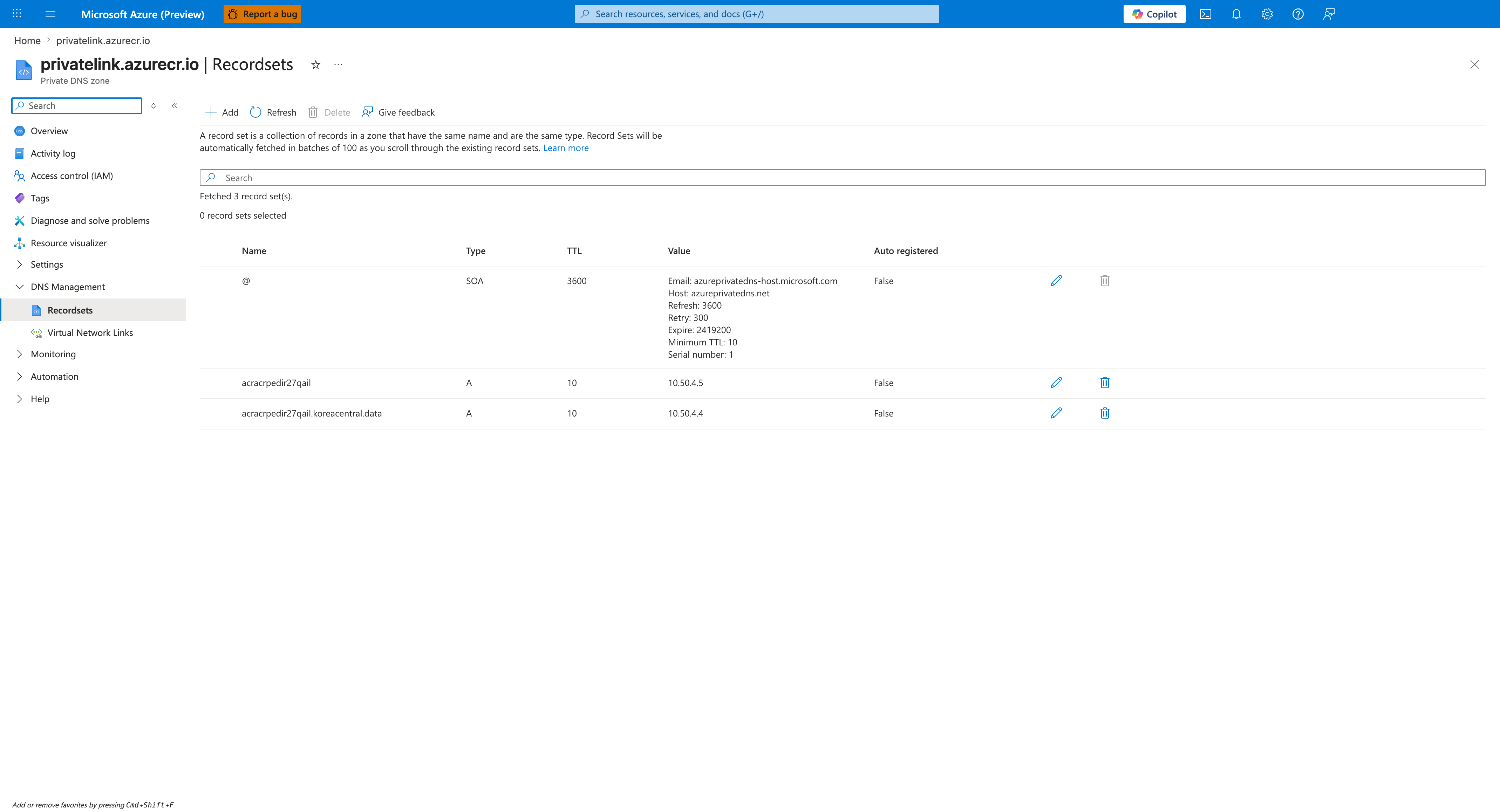
[Observed] Private DNS Zone privatelink.azurecr.io Record sets blade: two A records — acracrpedir27qail → 10.50.4.5 and acracrpedir27qail.koreacentral.data → 10.50.4.4. The zone is linked to vnet-acrpedir-27qail, so DNS queries from the Container Apps subnet hit the override and resolve to the PE NIC IPs instead of the registry's public IP. This is the DNS contract that the falsification step removes.
[Observed] Container App Revisions and replicas → Replicas tab (during the falsification window, after az containerapp revision restart forced a fresh pull on revision --0000003 with the VNet link removed): the blade shows the split-replica state — replica --0000003-54b8c695… still Running (Ready 1/1, created at 8:08:30 PM, serving from the on-node image cache), and replica --0000003-58d75877f… Not running (Ready 0/1, created at 8:19:27 PM, fresh pull failed with ImagePullUnauthorized because DNS fell back to the public registry FQDN). This is the production-realistic failure surface — ImagePullUnauthorized, not no such host.
[Inferred] The seven captures, taken in time order, document Path B's three required legs (registry-side PE + PE NIC IP + DNS zone with VNet link), prove the path is in use end-to-end (Healthy revision with ACR public access closed), and prove the path's failure mode in the Portal (removing the DNS leg surfaces as ImagePullUnauthorized on the next fresh pull, not on the already-running replica). Capture rules follow the shared lab Portal capture briefs — full-screen 1600x1000, PII helper applied, no black-box masks except the Account-menu avatar.
Clean Up
Which runs:
| Command | Why it is used |
|---|---|
az group delete --no-wait | Deletes the lab resource group and everything in it (Premium ACR, PE, DNS zone, VNet, Container App, environment, Log Analytics). The PE and zone link have no deletion ordering issues at the resource group level. |
ACR Premium is the dominant cost (~$1.67/day), so do not leave the lab running between sessions.
Related Playbook
See Also
- ACR Network Path Selection — the platform decision page this lab implements
- ACR Pull Failure Lab — covers tag/auth/manifest errors (different failure family; this lab is purely about network path topology)
- Egress Control — explains why Entra ID egress is still required with PE
- Private Endpoints
Sources
- Configure a private link for an Azure Container Registry (Microsoft Learn)
- Networking in Azure Container Apps (Microsoft Learn)
- Use a private endpoint with Azure Container Apps (Microsoft Learn)
- What is a private endpoint? (Microsoft Learn)
- Use Azure Firewall to inspect Private Endpoint traffic (Microsoft Learn) — explains why default routing keeps PE traffic off the firewall
- Securing a custom VNET in Azure Container Apps (Microsoft Learn) — egress requirements for Container Apps environments, including why AzureContainerRegistry service tag egress is not required when ACR is reached via PE
- Authenticate with an Azure container registry (Microsoft Learn)