Resource Relationships
This overview maps how Azure Container Apps runtime components, identities, and dependent Azure services interact in a typical production deployment.
Architecture
flowchart TD
    C[Client] --> I[Container Apps Ingress]

    subgraph ENV[Container Apps Environment]
        APP[Container App]
        REV[Active Revision]
        APP --> REV
        DAPR["Dapr sidecar (optional)"]
        APP -.-> DAPR
    end

    I --> REV

    APP --> COSMOS[Azure Cosmos DB]
    APP --> SQL[Azure SQL Database]
    APP --> REDIS[Azure Cache for Redis]
    APP --> KV[Azure Key Vault]
    APP --> STG[Azure Storage]
    APP -.->|image pull at startup| ACR[Azure Container Registry]

    APP -.-> MI[Managed Identity]
    MI -.-> ENTRA[Microsoft Entra ID]

    DAPR -.-> APP2["Container App (peer service)"]

    MI -.-> COSMOS
    MI -.-> SQL
    MI -.-> REDIS
    MI -.-> KV
    MI -.-> STG
    MI -.-> ACR
Solid arrows show runtime data flow. Dashed arrows show identity, authentication, and deployment-time dependencies.
Shared dependencies become shared failure domains
Multiple apps using the same database, cache, or Key Vault can fail together during dependency incidents. Design for graceful degradation and fallback behavior per service.
Separate control and data concerns
Keep deployment-time concerns (image pull, identity assignment, RBAC) in infrastructure automation, and runtime concerns (timeouts, retries, circuit breaking) in application configuration.
Portal view: resource group as the visible dependency boundary
This screenshot is used here as a visual companion to the Architecture diagram and the Dependency Classification Matrix, focusing on the resource types visibly listed in the resource group.
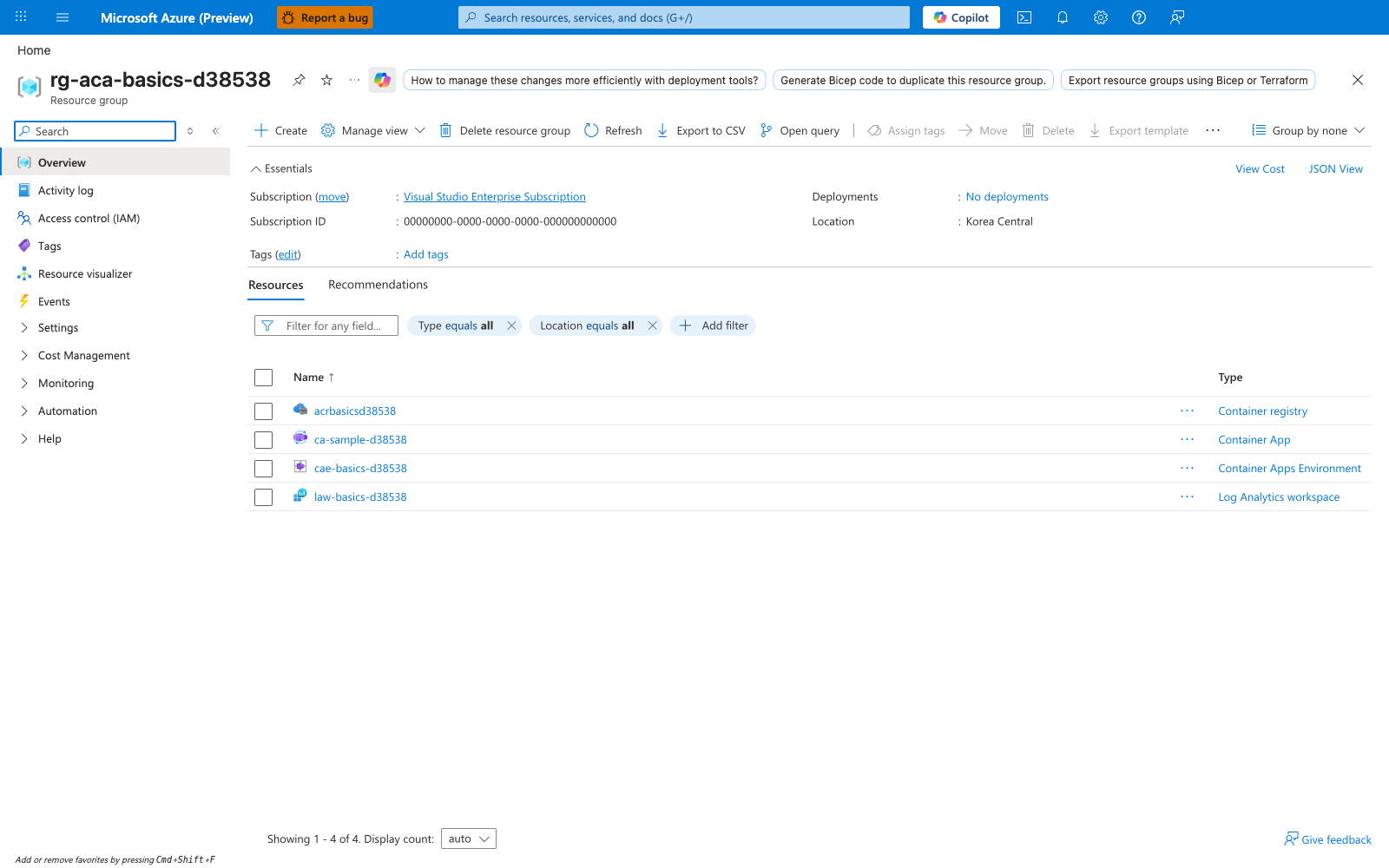
[Observed] The Resources list shows four rows: "acrbasicsd38538" with Type "Container registry", "ca-sample-d38538" with Type "Container App", "cae-basics-d38538" with Type "Container Apps Environment", and "law-basics-d38538" with Type "Log Analytics workspace". The Essentials panel shows "Location : Korea Central" and "Deployments : No deployments".
[Inferred] The separate Container registry, Container App, and Container Apps Environment rows are consistent with this page's Architecture diagram treating image source, application runtime, and environment boundary as different parts of the deployment. The Container registry row appears to map directly to the Azure Container Registry row in the Dependency Classification Matrix.
[Not Proven] This blade does not show which Container App uses which Container Registry. It does not show the managed identity dashed-arrow relationships shown in Architecture. It does not show the Microsoft Entra ID node from the same diagram. It does not show whether Key Vault, Azure SQL/Cosmos DB, or Redis/Storage dependencies from the Dependency Classification Matrix exist in this deployment. It does not show the Dapr sidecar relationship from Architecture.
Dependency Classification Matrix
| Dependency | Access Pattern | Primary Risk | Mitigation Baseline |
|---|---|---|---|
| Azure Container Registry | Startup/image pull | Revision stuck in provisioning | Private access path, pull permissions, image tag discipline |
| Key Vault | Runtime secret retrieval | Auth/RBAC or network failures | Managed identity + retry/backoff + cached defaults where safe |
| Azure SQL/Cosmos DB | Runtime data plane | Latency spikes or throttling | Connection pooling, bounded retries, schema compatibility |
| Redis/Storage | Runtime cache/object plane | Transient unavailability | Timeout tuning, fallback reads/writes, idempotent operations |
Advanced Topics
- Add private networking controls with VNet integration and private endpoints for data services.
- Use workload profiles and KEDA scale rules to match resource behavior to traffic patterns.
- Standardize service-to-service communication and trace context propagation with Dapr.
Model blast radius explicitly
During architecture review, document which services share environment, identity, network path, and backing stores so incident responders can quickly estimate impact scope.