mTLS Best Practices
Use mTLS in Azure Container Apps as a layered control: edge client authentication at ingress, peer encryption for direct environment traffic, and Dapr sidecar mTLS for service invocation.
Why This Matters
mTLS helps you answer three different trust questions:
- Is this external caller allowed to reach my app?
- Is east-west traffic inside the environment encrypted?
- Should this internal service call use a platform-managed service identity path instead of custom TLS code?
flowchart TD
    Ext[External clients] --> Edge[Ingress mTLS]
    Edge --> Api[Public API app]
    Api --> Dapr[Dapr invocation with built-in mTLS]
    Api --> Direct[Direct internal traffic with peer encryption]
    Dapr --> Svc[Internal service]
    Direct --> Worker[Internal worker or API]
Recommended Practices
Enable peer encryption for production environments
Use environment peer encryption when services communicate directly inside the same managed environment and you want the platform to handle east-west encryption.
Terminate external mTLS at ingress
Prefer clientCertificateMode=require or clientCertificateMode=accept at ingress instead of rebuilding TLS termination inside each application container.
Why:
- The platform already terminates TLS at Envoy.
- Your app receives a normalized
X-Forwarded-Client-Certheader. - App code can focus on authorization policy instead of low-level certificate exchange.
Prefer Dapr for same-environment service-to-service calls
When both apps live in the same environment and Dapr already fits your architecture, use Dapr service invocation for:
- Built-in mTLS
- Service discovery through Dapr App IDs
- Retry and observability features alongside transport security
Rotate and store certificates deliberately
- Keep external client certificates in Azure Key Vault or your enterprise PKI workflow.
- Track expiration dates for partner or device certificates.
- Treat thumbprint allowlists as configuration, not hardcoded source values.
- Let Dapr and the platform manage their own mTLS certificates rather than exporting internal private keys into app code.
Validate the forwarded certificate in the app
Even when ingress accepts the certificate, your app should still validate the forwarded leaf certificate against:
- Expected issuer
- Expected subject or SAN
- Expected thumbprint
- Optional chain or revocation policy if your compliance model requires it
Verify mTLS ingress surfaces in Azure Portal
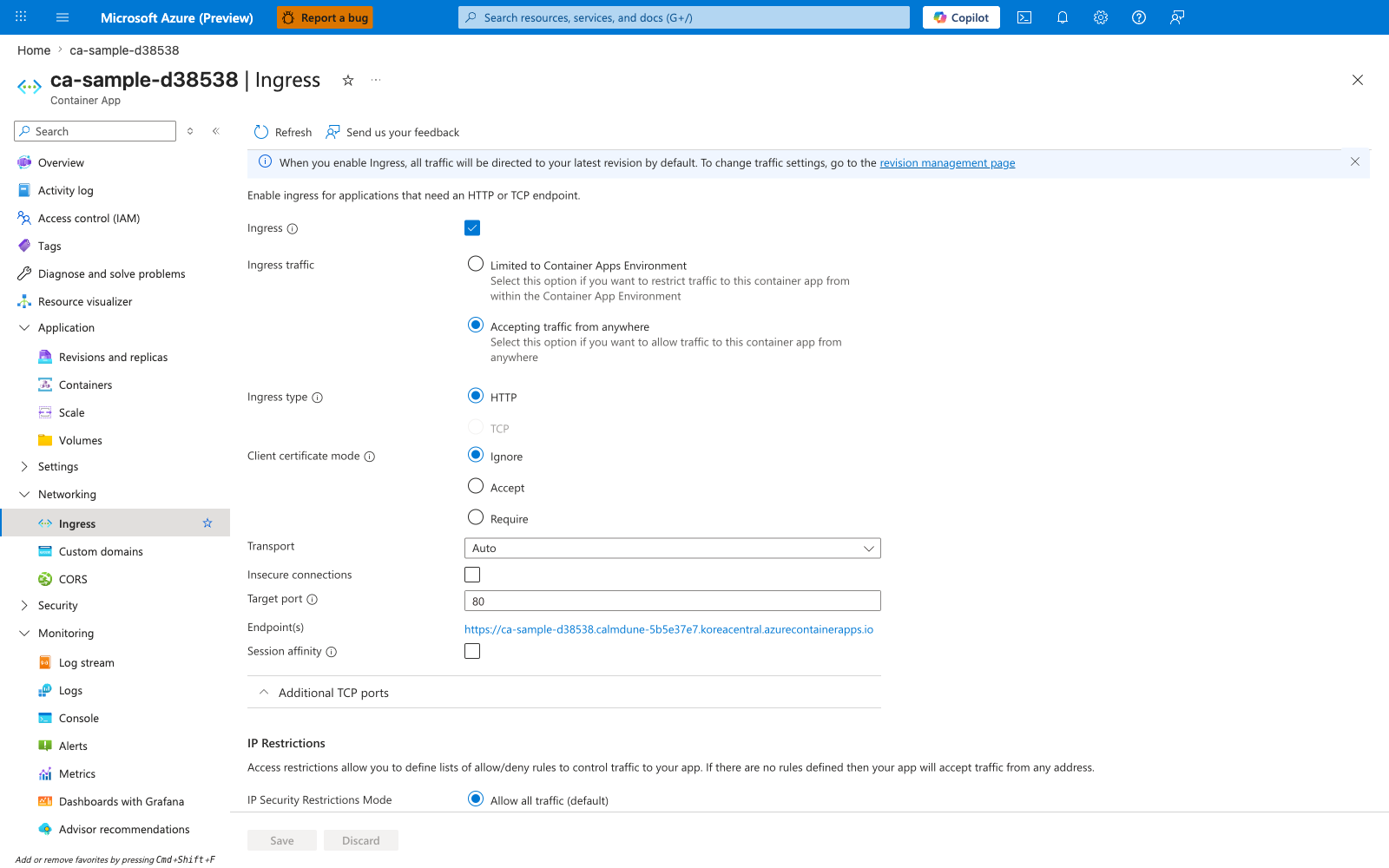
[Observed] ca-sample-d38538 | Ingress Container App Refresh Send us your feedback Ingress Ingress traffic Limited to Container Apps Environment Accepting traffic from anywhere Ingress type HTTP TCP Client certificate mode Ignore Accept Require Transport Auto Insecure connections Target port 80 Endpoint(s) https://<app-name>.<unique-id>.<region>.azurecontainerapps.io Session affinity Additional TCP ports IP Restrictions IP Security Restrictions Mode Allow all traffic (default) Save Discard.
[Inferred] The Client certificate mode selector with Ignore, Accept, and Require options appears to map to the ingress-side client-certificate handling discussed in Terminate external mTLS at ingress, where the platform negotiates the client certificate before the app sees the request. The Accepting traffic from anywhere radio paired with the external Endpoint(s) value is consistent with Terminate external mTLS at ingress treating the external ingress edge as the mTLS termination point. The Limited to Container Apps Environment radio option appears to map to the same-environment service-to-service scope described in Prefer Dapr for same-environment service-to-service calls, which keeps service-to-service traffic inside the environment. The Client certificate mode field is consistent with Validate the forwarded certificate in the app, which assumes the application validates the forwarded client certificate after ingress handling.
[Not Proven] Additional ingress certificate detail, validation detail, downstream handling detail, and environment encryption detail are not visible on this view.
Common Mistakes / Anti-Patterns
Re-implementing east-west mTLS in every service
If direct environment peer encryption or Dapr already covers the traffic path, adding custom app-level mTLS for every internal hop often adds complexity without improving trust boundaries.
Using accept mode and assuming authentication happened
accept means the request is still allowed without a certificate. Use it only when your app explicitly enforces certificate presence on selected routes or callers.
Trusting X-Forwarded-Client-Cert as an opaque string
Always parse and validate the leaf certificate. Do not treat the raw header value as proof of authorization.
Mixing CORS and mTLS decisions
CORS controls browser behavior. It does not authenticate callers and does not replace certificate validation.
Ignoring performance impact of peer encryption
Microsoft Learn explicitly notes that enabling environment peer encryption can increase response latency and reduce throughput under high load. Measure before broad rollout.
Validation Checklist
peerTrafficConfiguration.encryption.enabledis documented for production environments that use direct internal traffic.- External APIs use
clientCertificateMode=requireunless there is a documented reason to accept non-certificate callers. - Application code parses
X-Forwarded-Client-Certand validates issuer, subject, or thumbprint. - Dapr-enabled services use Dapr App IDs consistently and avoid bypassing the sidecar by accident.
- External certificate material is stored outside source code, ideally in Key Vault or enterprise PKI tooling.
- Load testing covers the latency impact of peer encryption or edge certificate validation.
Review Matrix
| Review area | Page-specific check |
|---|---|
| Scope | Confirm the guidance applies to mTLS Best Practices. |
| Source basis | Validate the recommendation against the Microsoft Learn sources in this page. |
| Evidence | Capture command output, portal state, metrics, logs, or screenshots before treating the result as proven. |
See Also
- mTLS Architecture in Azure Container Apps
- Ingress Client Certificates
- Azure Container Apps Security Best Practices
- Service-to-Service Communication